Dating App for Serious Relationships: What Actually Works
A dating app is good for serious relationships when its core interaction rewards consideration instead of speed. That means filtering for intent up front, putting substance ahead of photos, and stretching out the moment of choosing so a match feels like a decision, not a reflex. It matters because the search works: about four-in-ten U.S. adults (42%) say online dating has made finding a long-term partner easier, and one-in-ten partnered adults met their current significant other through a dating site or app, per the Pew Research Center (2023).
So the apps work — for some people, on some apps. But here's the part the marketing skips. Almost every app on the store calls itself "serious." The label is free. What isn't free is the design underneath it, and most "serious" apps are built on the one mechanic that rewards the opposite of commitment without ever saying so.
Write the version of yourself a serious match would recognizeSwipe apps work against serious intent because the swipe makes every choice feel reversible. When the next face is one flick away, no single match feels final — and what doesn't feel final doesn't feel worth finishing. The format optimizes for volume of matches, the metric that keeps you opening the app, not the metric that ends your search.
The cost shows up in the numbers. A 2025 study from Match and the Kinsey Institute found the average single now spends $213 a month on dating, and nearly seven in ten report a growing emotional divide between men and women. A lot of spending, a lot of friction, not a lot of landing.
Bumble's 2025 trends report, drawn from more than 40,000 members, found that nearly two in three women are now "getting clear about what they want and need, and refusing to settle." People are already serious. The apps are the part that isn't. Which raises the obvious question: if the swipe is the problem, what does an app feel like once you take the swipe out?
A serious dating app differs from a swipe app in what it makes you do before you can express interest. A swipe app asks for a half-second visual verdict; a serious app asks you to read something and respond to it. The first rewards the fastest judgment. The second rewards the most attentive one — and attention is the thing serious daters were short of, not options.
| Swipe-first app | Serious-intent app | |
|---|---|---|
| First impression | A photo grid, judged in ~1.5 seconds | Written words, read at reading speed |
| The core gesture | Swipe left / right — reversible, low-cost | Highlight, then choose — deliberate, unhurried |
| What it optimizes | Match volume (keeps you in the app) | Match depth (gets you out of the app) |
| When you decide | Instantly, on appearance | After you've actually read someone |
| Reversibility | Infinite — the next face is one flick away | A 48-hour window, then the match is real |
The table maps the format. But format is only the surface of it. The deeper difference is what each app is really measuring about you — and one of them isn't measuring compatibility at all.
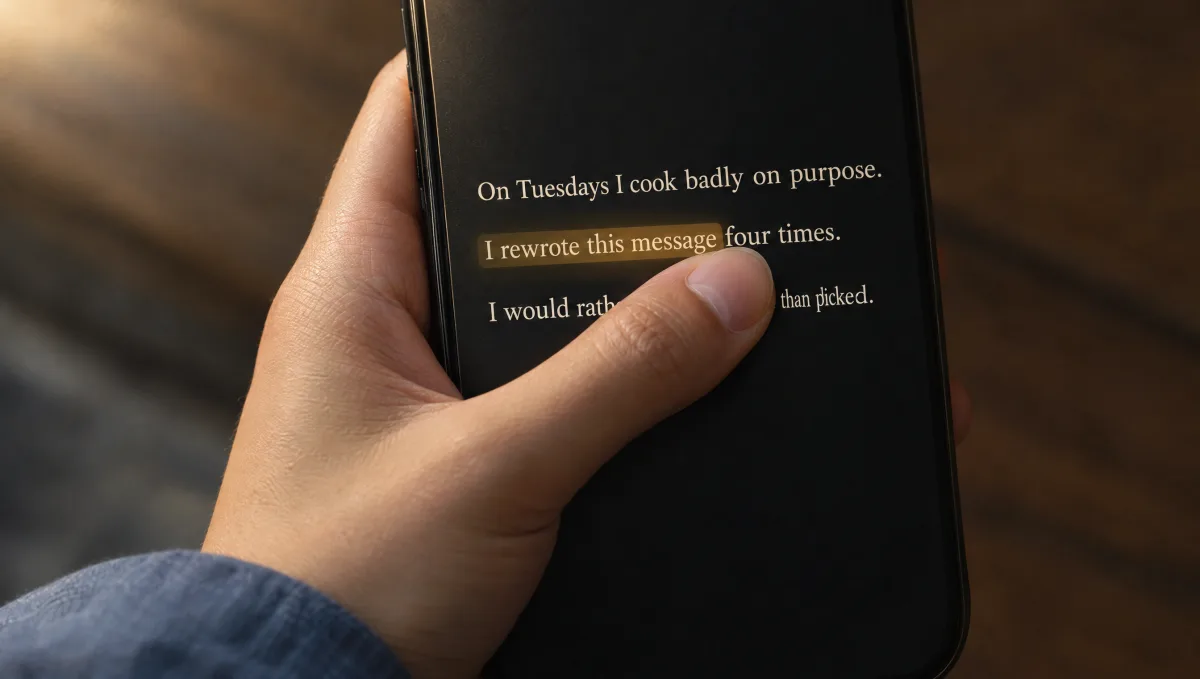
It learns it from what you pay attention to. Instead of a personality quiz you can game, the strongest serious-intent apps read your behavior on real writing. On Anketta, no photo enters the decision and there's no swipe gesture at all — every profile is a free-form manuscript, and to signal interest you highlight a phrase that landed with you, then press the heart. Those highlights aren't decoration. Each one teaches the system what you actually want more of, so the next manuscripts you see skew toward it, and away from what you crossed out.
That's a different contract than "tell us your preferences and we'll filter." The app doesn't ask you to describe your type; it watches which sentences you linger over. The more you read, the more the queue narrows toward the things you genuinely respond to — and the further it drifts from generic optimized profiles, because a manuscript can't be optimized the way a photo can. But reading someone closely, and being read that closely back, takes a kind of nerve a swipe never asks for. Which is exactly why the next part is the hard part.
You find one by treating the app as a place to be known, not a place to be picked. The mechanics reward depth, so the move is to give them something with depth in it. Five steps that move the needle:
- Lead with intent, not a highlight reel. Set your intent to relationships and write the manuscript a serious match would recognize — your actual evenings, not your aspirational ones.
- Write more than feels comfortable. A longer manuscript surfaces more specific phrases for someone to catch on — substance is the surface area that matching runs on.
- Name something true and small. The detail that proves a person — "rewrote one message four times," a standing Tuesday habit — is what a careful reader stops on. Generic confidence reads as nobody.
- Read before you react. Highlight the line that actually moved you, not the profile that looks safe. Your highlights are training the only filter that matters.
- Let the 48-hour window do its work. When you match, you both have 48 hours to start talking. If neither of you walks away, the match becomes permanent and the app collapses to that one conversation — a window that turns a match into a decision instead of a tab you'll forget.
Every step lands on the same act: writing. And that's the part no app, no guide, and no algorithm can do for you — the version of you a serious match recognizes has to be written by you.
Write the manuscript a serious match would stop to readWhich dating apps are actually for serious relationships?
The honest test isn't the marketing — it's the core gesture. Apps that ask for a fast visual verdict optimize for match volume; apps that ask you to read and respond optimize for depth. Anketta removes photos and swiping entirely, matching you on written manuscripts and intent filters instead.
Are dating apps good for finding a long-term partner?
For many people, yes. About 42% of U.S. adults say online dating made the search for a long-term partner easier, and one-in-ten partnered adults met their current significant other through an app (Pew Research, 2023). The variable is which app — and whether its design rewards consideration over speed.
Why don't I find serious relationships on swipe apps?
Because the swipe makes every choice feel reversible, and reversible choices don't feel worth finishing. The format is tuned to keep you matching, not to end your search. An app without a swipe gesture removes that incentive and draws out the moment of choosing.
Do serious dating apps work without photos?
They can, and removing photos can help. Without a photo to judge in a second, the first impression becomes someone's writing — which carries far more about how a person thinks and what they want than a posed image does. On Anketta, no photo enters the decision — faces are revealed only after a mutual match.
How do dating apps for serious relationships match people?
The strongest ones learn from behavior rather than a quiz. On Anketta, highlighting phrases in someone's manuscript as "like" or crossing them out as "dislike" trains a preference model that surfaces more of what you respond to and less of what you don't — no personality test required.
What is the 48-hour match window?
After a mutual like, both people have 48 hours to start the conversation. If neither walks away, the match becomes permanent and the app collapses to that single chat — the browsing surface locks until the relationship ends. It's designed to turn a match into a decision.
No swipes. No selfies. Just the words you chose, read by someone who stayed with them long enough to answer — and the only way to know if that fits you is to write the first one.
Unsure about writing? Try reading first.