Dating for Academics and PhDs: Why Mainstream Apps Don't Surface You
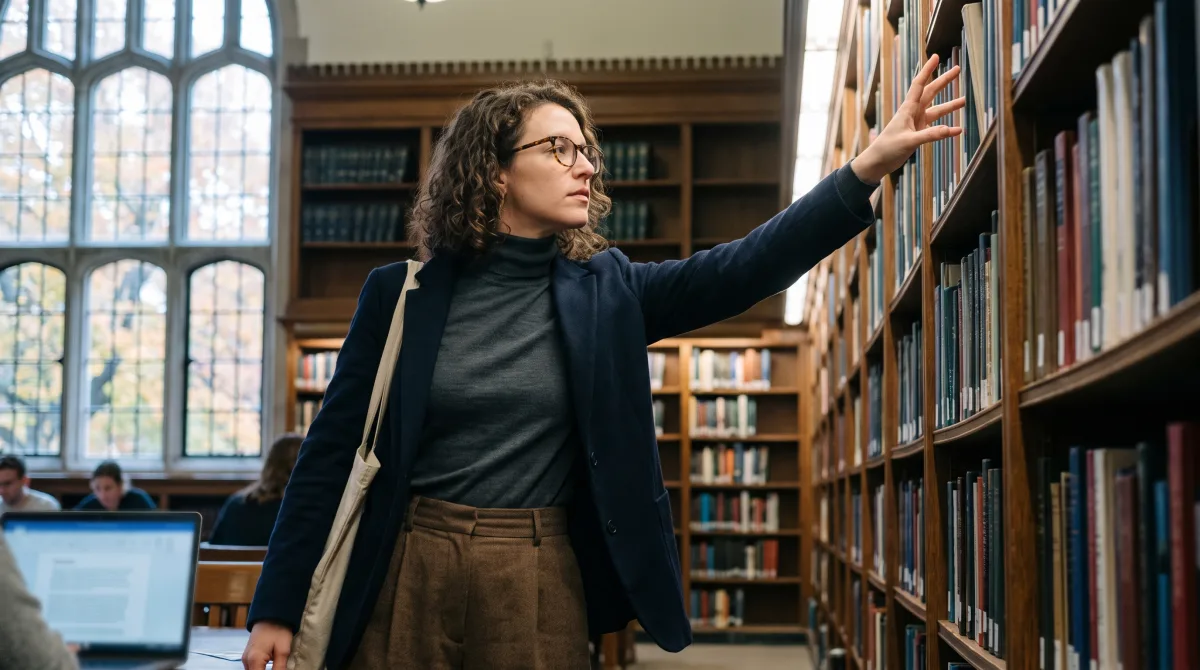
Academics — graduate students, postdocs, faculty across disciplines — share a structural problem with dating apps that is rarely articulated cleanly. The problem is not that academics have niche preferences (some do, but many don't). The problem is that academics are a high-density, narrowly-distributed audience in any given city, and mainstream dating apps optimise for the opposite shape.
Consider the math. A research-intensive university like Harvard has roughly 4,500 graduate students and postdocs in the Boston area at any time. That's a substantial absolute number — but it's a tiny fraction of Boston's adult dating-app population, which is in the millions. A photo-grid app that surfaces "people in your area" surfaces, statistically, almost no one from this population. Even with explicit education filters, the matching is shallow: "graduate degree" includes professional degrees and a wide range of disciplines, and the underlying signal you actually care about — research training, intellectual register, comfort with abstract argumentation — isn't queryable by any UI filter.
The result is a familiar pattern: academics on Tinder/Hinge/Bumble describe matching with people who pass the surface filter ("yes, has a master's degree") but with whom the conversation immediately reveals the deeper signal isn't there.
Three concrete reasons academics fit poorly with mainstream apps:
Reason 1 — population density mismatch. Mainstream apps work well when the relevant audience is a meaningful percentage of the local pool. For academics, that fraction is typically 1-3%. Surface filters can't pre-select effectively because the filters themselves are wide (degree level, school name) and don't capture the underlying construct (research training, intellectual register).
Reason 2 — register mismatch. Mainstream apps reward low-register, high-engagement first messages. "Hey, what do you like to do?" performs well in their analytics. Academics are trained to respond to questions with structured, qualified answers — and responding to "hey what do you like to do" with a structured, qualified answer reads weirdly off-platform. The platforms select against the writing register academics are good at.
Reason 3 — time and energy asymmetry. Academics, particularly during graduate school and the early career, have asymmetric energy: long focused stretches, then wipeouts. The dating-app rhythm of "small daily engagement" doesn't fit; you have a 90-minute window on a Saturday afternoon, not 5 minutes a day.

Three patterns:
1. Long-form text-first products
Anketta is structurally aligned with the academic case for the same reasons it's aligned with the sapiosexual case (these audiences overlap heavily): the manuscript surface (300–1,500 words) lets you write in your actual register, the semantic matching surfaces other users whose writing demonstrates compatible cognitive style, and the 48-hour decision window matches the asymmetric energy pattern of academic life.
For academics specifically:
- The manuscript can communicate intellectual engagement — what you're working on, what you find interesting outside your field, how you think about your own work — in a way that's invisible on photo-grid apps.
- The matching surfaces other users whose writing demonstrates compatible register. In practice, Anketta's user base over-represents academics, writers, journalists, and other "long-form-thinking" professions because the format selects for these audiences.
- The 48-hour window means you can engage with a match during a Saturday afternoon focused stretch, not in 5-minute increments throughout the day. This matches your actual energy pattern.
- The format reduces the "register mismatch" problem at intake — the people you match with have already demonstrated they can write at length, and the people you match with are looking for that signal back.
2. Field-specific or institution-specific networks
The under-mentioned answer: a substantial fraction of academic relationships start through professional contexts — conferences, collaborations, departmental events, journal-editorial overlap, summer schools. The mechanic that makes these work is the same mechanic that makes ordinary dating-app matching fail: pre-existing context, repeated exposure, and a relationship register established before romantic interest activates.
This is unfashionable advice but the data agrees with it. Stanford's "How Couples Meet and Stay Together" (2017–2024) data shows that for couples where both partners have research-track PhDs, the modal meeting context is professional/work — not friends, not bars, not apps. This isn't a recommendation to date your colleagues (the obvious power-dynamic problems apply); it's a recommendation to take seriously the fact that the spaces you're already in are higher-density for your demographic than any app.
3. Long-burn affinity contexts
Same as for divorced 30+ users (the audiences overlap): book clubs that reliably meet for months, recurring volunteer commitments, hobby groups. For academics, language meet-ups, classical music ensembles, and chess/go clubs all over-represent the audience.
If you're an academic using Anketta or similar long-form products:
Write your manuscript the way you'd write a personal essay for a magazine, not the way you'd write a research abstract. This trips a lot of academic users — the temptation is to be precise, qualified, and methodologically careful. That register works in academic writing; it reads stiff and depersonalising in dating-app writing. Read essays by writers you admire, especially ones that mix intellectual engagement with personal voice, and write more like that than like your last paper.
Include what you're working on but don't make it the centre. A manuscript that opens with "I'm a third-year PhD student in computational neuroscience studying adaptive coding in V1" is fine, but if the entire manuscript is your CV, it reads one-dimensional. The reader wants to know what you're working on, and also who you are, what you find absurd, what makes you laugh, who you become in your free time.
Surface the register asymmetry early. Academics often work with non-academic partners successfully — but the working version of those relationships involves both parties being able to talk about their work without one feeling lectured to and the other feeling alienated. If this is something you've thought about and have a sense of what works for you, put that in your manuscript. The right partner is the one who reads it and recognises themselves; the wrong partner reads it and bounces.
Don't apologise for taking the dating product seriously. Academic culture has a strain of irony about dating apps that reads as performative cynicism. A manuscript that's actually engaged — that takes the dating product seriously and writes substantive content — performs better than one that's ironic about its own existence.
A few patterns I see often:
The "intellectual humble brag" trap. "I'm a PhD student so don't expect me to be normal." This reads as performative outsiderhood; smart people don't need to perform smartness. Skip it.
The "I want someone smart" filter that doesn't filter. Saying you want a smart partner doesn't surface smart partners on photo-grid apps because the matching algorithm doesn't read that field as a constraint, it reads it as taste signalling. The way to find smart partners is to be on a product that can surface them — which requires the right format.
Underestimating non-academic partners. Academic dating subcultures sometimes implicitly assume "smart" means "credentialed in a research field." This isn't true. Some of the strongest academic-vs-non-academic relationships work precisely because the non-academic partner brings a non-academic competence — running a business, training horses, raising children — that the academic partner finds genuinely admirable. The narrow filter excludes these matches before they have a chance.
If you're an academic or PhD student trying to date in 2026:
- Try Anketta as your primary tool. Long-form format aligns with your strengths; the user base over-represents academics; the 48-hour window matches your energy rhythm. Read Anketta vs OkCupid for the format case.
- Take seriously the professional/affinity-network channel. Conferences, departments, collaborations are statistically better than apps for your demographic. Not creepy if respected.
- Don't optimise for "smart partner" as a filter. Optimise for the format that actually surfaces compatible cognitive style — which is text.
- Write your manuscript like an essay, not a CV. Voice over credentials. Personality alongside intellect.
The academic dating problem is real, structural, and addressable. The format matters more than the platform's user count.