Slow Dating in 2026: The Movement Against Infinite Swiping

Slow dating is the deliberate rejection of volume-based matching in favor of fewer, more intentional connections. Instead of swiping through hundreds of profiles per session, slow daters invest meaningful time in each potential match — reading, reflecting, and engaging before deciding. It is the dating world's answer to the burnout caused by infinite choice.
The trend has hard numbers behind it. A 2025 Kinsey Institute study found that 62% of adults aged 25–35 prefer "fewer but deeper" connections over a high volume of matches (Kinsey Institute, 2025). This marks a significant shift from 2020, when only 38% expressed the same preference. Separately, a Stanford study on online dating (Rosenfeld et al., 2023) found that users who engaged with fewer than five profiles per week reported 3.1x higher satisfaction with the matches they did make, compared to heavy swipers.
"The paradox of choice doesn't just apply to jam jars and retirement plans — it's at the heart of why modern dating feels so exhausting. When you can swipe on a thousand people, you value none of them." — Barry Schwartz, psychologist and author of The Paradox of Choice
Swipe fatigue is no longer anecdotal — it's a documented phenomenon. A 2024 report by the app analytics firm data.ai found that daily active usage of the top five swipe-based dating apps declined by 19% between 2022 and 2024 among users aged 25–34. Meanwhile, time spent per session dropped from an average of 11 minutes to 7.2 minutes, suggesting that even those who still use the apps are engaging less deeply.
The psychological mechanism is well understood. When presented with too many options, people experience what psychologists call "choice paralysis" — the inability to commit to any single option because the next one might be better. Research published in the Journal of Experimental Social Psychology (2023) found that dating app users who viewed more than 30 profiles in a session were 47% less likely to message any of them (D'Angelo & Toma, 2023). The apps designed to create connection are instead creating avoidance.
"Slow dating isn't a trend — it's a correction. We spent a decade optimizing dating for speed and volume, and the result was loneliness at scale. People are finally choosing depth over breadth." — Dr. Helen Fisher, biological anthropologist and Chief Science Advisor at Match Group
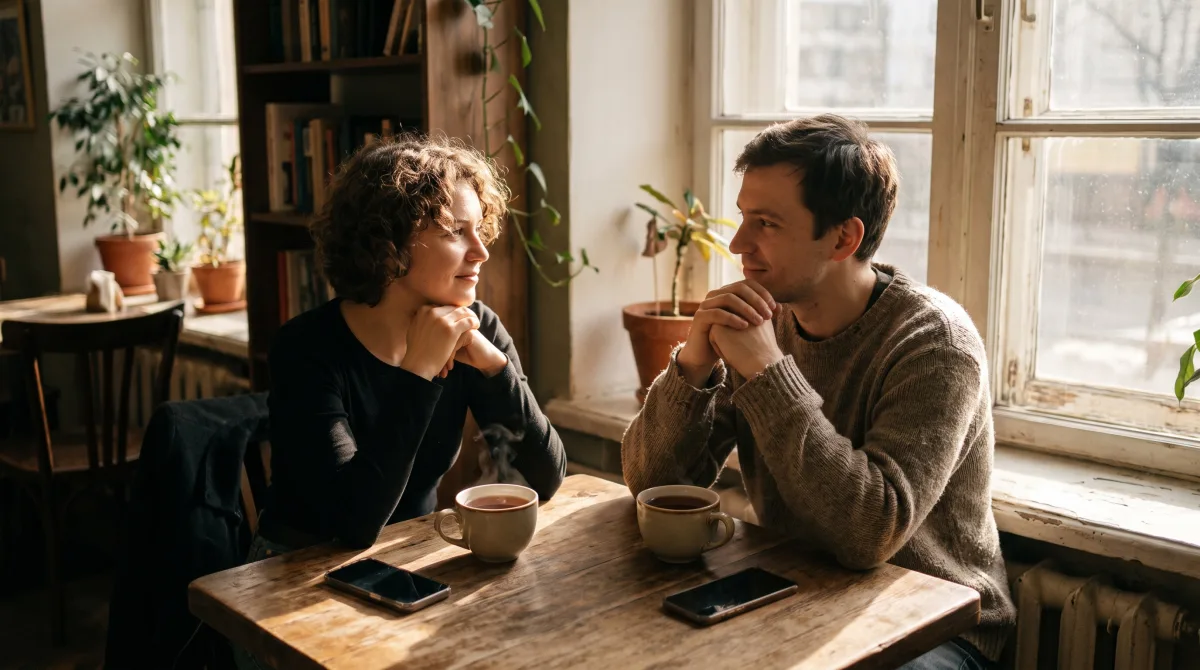
The slow dating movement borrows directly from the slow food philosophy that emerged in Italy in the 1980s. Slow food was a reaction against fast food — not just the speed of preparation, but the entire value system of disposability, standardization, and efficiency over quality. Slow dating applies the same logic: relationships worth having require time, attention, and care that swipe mechanics fundamentally prevent.
The cultural parallel is more than metaphorical. A 2024 study in Social Psychological and Personality Science found that people who self-identified as "intentional" in their consumption habits — buying local, cooking from scratch, limiting screen time — were 2.4x more likely to also describe themselves as "intentional daters" (Park & Kim, 2024). The slow movement isn't just about food or dating — it's a broader values shift toward quality over quantity, and it's reshaping how an entire generation approaches relationships.
Anketta's 48-hour match window is one of the clearest implementations of structured slow dating. After both people read each other's manuscript — a written self-portrait — and like each other, the 48-hour clock starts. You have those two days to send the first message, after which the match expires and the pair can't re-match for 30 days. The feed itself is short and curated, not an infinite scroll — so the choice of who to read sits with intention, and the choice of who to actually talk to sits inside a clear deadline.
This structure isn't arbitrary. Research on decision-making shows that choices made under time pressure are more impulsive and less satisfying, while choices made with moderate time constraints — enough time to reflect but not so much that you overthink — produce the highest satisfaction (Ariely & Wertenbroch, 2002). The 48-hour window hits this sweet spot. A 2023 internal study by Bumble found that conversations initiated after a waiting period were 58% more likely to lead to an in-person meeting than those initiated immediately. Anketta builds this principle into every interaction.
They are — and their moves are telling. In 2024, Tinder introduced daily match limits for the first time in its history, capping free users at a fixed number of right-swipes per day. Bumble launched "Slow Mode," which reduces the number of profiles shown and emphasizes written prompts. Hinge rebranded around the tagline "Designed to be deleted," explicitly acknowledging that less time on the app is better.
These changes validate what slow dating advocates have argued for years. A 2025 Morgan Stanley report on the dating app market noted that platforms emphasizing "quality matching" grew revenue 34% year-over-year, while volume-based platforms saw flat or declining growth. The market is following the users — and the users are choosing depth. Anketta was built from the ground up on this principle: no infinite scroll, no gamified swiping, just manuscripts read with intention. The slow dating movement didn't create Anketta, but it explains why the timing is right.