Bi Dating Apps: Why a Photo Can't Say What You Are
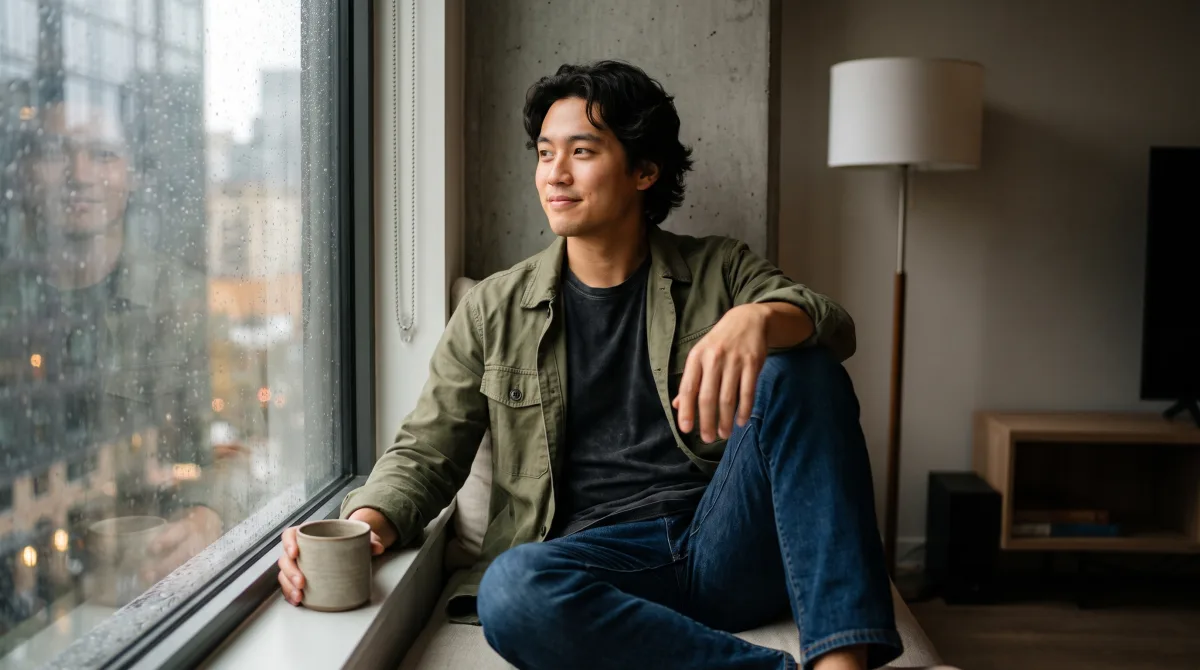
A photo answers a dozen questions before anyone reads a word — hair, age, whether you smile with your teeth, who's standing next to you in the frame. It answers none of the ones that matter here. Bisexuality has no photograph: no angle, no lighting, no crop that captures it, which means every photo-first app answers the wrong question first and leaves the real one for later, if it gets asked at all.
Somewhere in a swipe deck right now, a bisexual person is being read as whichever half of their attraction the last picture happened to show — gay if a man is in it, straight if he isn't. Nobody wrote that rule down. It's just what happens when an identity with no visual signature gets forced through a format built entirely around one.
Write the sentence a photo was never going to say for youA bi dating app, loosely, would be any platform where a bisexual user gets read correctly without extra effort — and most photo-first apps make that harder, not easier. The mechanism working against them has a name: bi erasure, the default assumption that attraction runs one direction, so evidence of one relationship gets read as the whole story. Interviewing 19 bisexual men alongside 40 gay men in 2025, researchers found assumed heterosexuality and erasure complicating the bisexual group's everyday interactions in ways the gay men in the same study didn't describe (Ford, Shah & Dodge — LGBT Health, 2025).
Anketta's own mechanic runs on the opposite premise. There's no photo anywhere before a match — you're read on what you actually wrote, and a manuscript has room for a full sentence where a dating profile's single-word label never gets to hold one.
A photo can show a face, a setting, sometimes a partner standing beside you. It can't show an orientation, because orientation isn't a visual trait at all — it's a pattern of attraction across time, exactly the kind of thing one frozen frame is structurally unable to hold. A sentence can hold it, in however many words it takes. A JPEG cannot add a clause.
That's the general case for writing over photographs, and our guide to dating without photos makes it in full. The bisexual case is sharper than most, though, because the thing missing from the photo isn't merely unshown — it's unshowable. A tall person's photo omits their height by accident. A bisexual person's photo omits their orientation by the nature of what a photo is.
Research on sexual-minority women found that those with a different-gender partner are "routinely perceived as heterosexual" by default (Manley, Goldberg & Ross — Psychology of Sexual Orientation and Gender Diversity, 2018) — and the same shortcut plainly runs the other way with a same-gender one, since the mechanism doing the assuming doesn't care which direction it's wrong in. A photo with a partner in it answers "with whom." Daters read that as "capable of what," and the two questions were never the same question.
This is the part that makes bi erasure structurally different from most dating-app friction: it isn't that the app shows too little of you. It's that the one thing it does show — who you were last seen with — gets treated as a complete answer to a question it was never asked.
There's no single dedicated "bi dating app" the way there's a dedicated lesbian one — bisexual daters mostly use the same photo-first apps everyone else does, plus the extra work of correcting whatever the photo implied. Sorting the field by how orientation actually gets represented, rather than by marketing copy, tells you more than sorting it by name.
| Format | How bisexuality gets represented | What tends to go wrong |
|---|---|---|
| Mainstream swipe app | A tag in a settings menu, underneath a photo grid | The photo gets read first; the tag gets read never |
| Niche "inclusive" app | A longer orientation list at signup | More boxes to choose from, same photo-first order |
| Anketta | Written into a manuscript, in the writer's own words, before any photo exists | Takes longer to write than to swipe |
Our guide to text-based dating covers what a written profile does in general; here's what changes specifically when the identity in question is bisexual. A checkbox forces one word. A manuscript doesn't have that limit, so open a blank one and use the room it gives you.
- Name it in a sentence, not a tag. "I've dated men and women" carries information a single word never does — which, roughly how much, how recently.
- Put a past relationship in context instead of letting it explain your whole orientation on its own. The fact used to travel silently inside a photo; now it travels with whatever explanation you actually give it.
- Say what you're looking for without hedging toward whichever gender a reader might default to. Write the real range, not the version that sounds safer to type.
- Let the writing do the introducing. Anketta's matching runs on what a reader underlines in what you wrote, not on a photo they judged before reading a word of it.
None of this is free. Four sentences that actually hold together take longer to write than a swipe takes to execute, and that's a real cost daters have always paid for being specific, on any app. A bisexual dater just has slightly more to be specific about before the reader has the full picture.
Say the whole sentence — the manuscript has room for itSometimes, and sometimes it just adds a round of questions a straight or gay profile never gets asked. In an open-ended survey of 442 bisexual and non-monosexual adults, the most common types of discrimination described were identity invalidation and identity invisibility, ahead of verbal abuse and stereotyping (Doan Van, Mereish, Woulfe & Katz-Wise — Archives of Sexual Behavior, 2019). Writing it down doesn't end the erasure. It puts the correction in the reader's hands instead of leaving it to a guess.
What's the difference between a bi dating app and a regular app with a bisexual filter?
Mostly marketing. Adding "bisexual" to an orientation list doesn't change what loads first — the photo still arrives before the label does, every time. What actually changes anything is whether text or image comes first, not whether the word "bisexual" shows up somewhere in a settings menu.
Do bisexual people get fewer matches on photo-first apps?
There's no reliable public data on match rates broken out by orientation, and a specific number here would be easy to invent and hard to verify. What Ford, Manley, and the other researchers cited above document instead is a pattern of being misread — assumed straight with one partner, assumed gay with another — rather than a measurable rejection rate.
Is bi erasure the same thing as biphobia?
No. Biphobia is active hostility toward bisexuality; erasure is the quieter assumption that it doesn't need naming because it will show up on its own. Nobody has to dislike bisexuality to erase it — they just have to default to whichever binary the evidence in front of them seems to suggest.
Does Anketta ask users to declare a sexual orientation?
Anketta's hard filters run on age range, gender, the "show me" preference, intent, and city. Whatever else someone wants to say about their orientation is theirs to write into the manuscript, at whatever length they choose — and there's no photo before a match either way, so nobody reads an assumption off a picture first.
Can writing really replace a photo where bisexuality is concerned?
Not everything a photo does — it can't show a face, and sometimes a face is exactly what someone wants to see. But the specific job of representing an orientation was never a job a photo could do to begin with, so nothing is being replaced. The room for it just has to exist somewhere else — try writing a few sentences and see how much fits that a photo never could.
Why do some bisexual daters avoid naming their orientation at all?
Naming it can turn any dating profile into an FAQ — the reply that comes back is "so which do you actually prefer" instead of an opening line. Some daters decide the correction costs more than staying quiet, which is its own kind of erasure: silence chosen because precision gets treated as an invitation to interrogate.
A camera has never once caught someone being bisexual — the only instrument that's ever managed it is a sentence, and only when somebody actually sits down and writes one.
Unsure about writing? Try reading first.