Deepfakes and Dating Verification 2026: The Trust Crisis
Synthetic profiles stopped being a fringe worry and became something most daters now assume they've already encountered. By early 2026, 84% of UK dating-app users said AI content has made it harder to trust matches or date successfully — up from 64% a year earlier (Global Dating Insights, 2026).
The original survey behind that shift found three in four UK daters believed they'd already come across a deepfake profile, and roughly one in five had been personally deceived by one (Sumsub, 2025). That moves the deepfake from a thing that happens to other people into the working assumption behind every new match.
What changed wasn't the existence of fake profiles — catfishing is older than the apps. What changed is the cost. Generating a face that doesn't exist, cloning a voice from a few seconds of audio, or running a convincing chat across dozens of profiles at once all dropped to near-free between 2024 and 2026. That moved deepfakes from a hand-built con into an industrialized one, with its own supply chain from profile to script to payout. This piece is the trend snapshot in our online dating safety cluster, and the verification angle the rest of the cluster doesn't cover. Refresh due Q3 2026 — detection tooling and platform policy in this space move fast enough that any number here should be re-checked each quarter.
Write the version of yourself that no model can fakeIt's large enough that the financial damage now registers in national crime statistics. The U.S. Internet Crime Complaint Center logged $16.6 billion in total cybercrime losses for 2024, a 33% jump on the prior year, with confidence and romance fraud a recurring line in that total (SecureWorld / FBI IC3, 2025).
In the UK, an estimated £410 million was lost to romance scams over five years, and the dating sector now sits near the top of the fraud-rate table alongside online media (Sumsub, 2025).
Two numbers matter more than the totals, though. First, 61% of daters have either been fooled by a fake profile or know someone who has — the problem is now mainstream, not edge-case. Second, confidence is dangerously high: among people who'd been deceived by a deepfake, 79% said they were confident they could spot one. The gap between feeling able to detect a fake and actually detecting one is exactly where the money is lost.
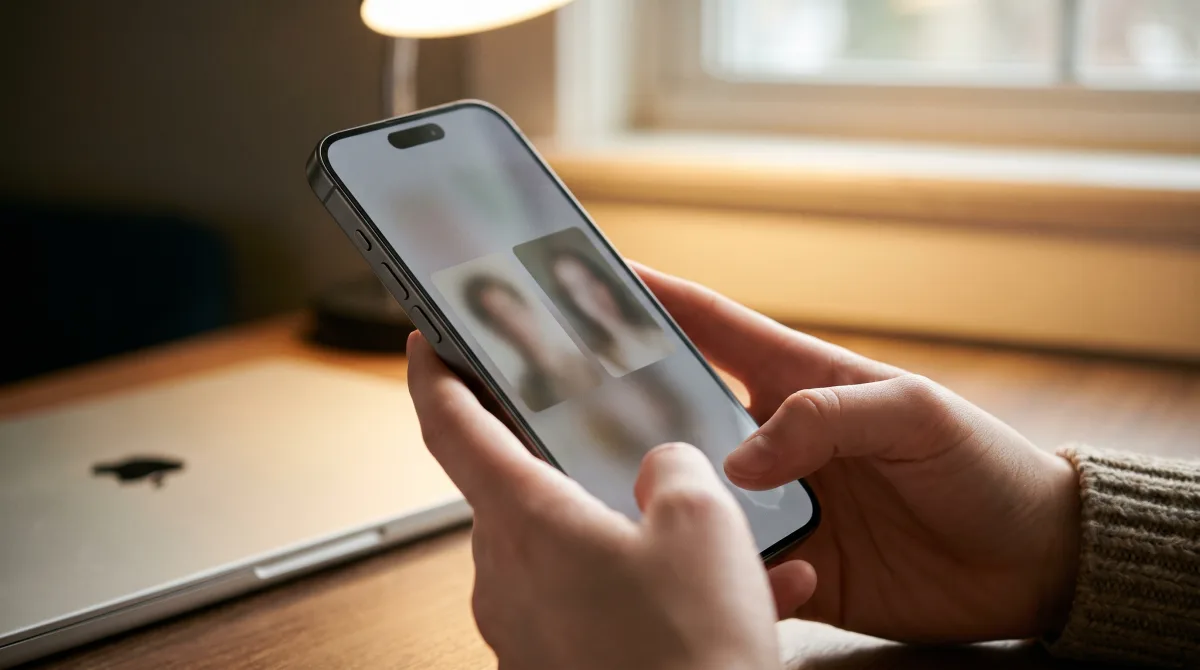
Look for the seams a generator still struggles to hide: too-perfect facial symmetry, eyes and teeth that don't quite render, backgrounds that change between photos with no shared place, an absence of group shots, a generic bio with no specifics, templated opening messages, and a hard refusal to go to voice or video. No single sign is proof. A cluster of them is a strong signal.
Here's a 2026 read-the-room checklist, split by what you can see and what you can feel.
Visual tells in the photos:
- Symmetry that's too clean. Real faces are asymmetric. A face that's flawlessly balanced left-to-right is a flag.
- Eyes and teeth. Generators still fumble close-up detail — odd reflections, mismatched pupils, teeth that smear on a zoom.
- Ears. Texture and asymmetry around the ears are a common giveaway.
- Backgrounds that don't agree. Across several photos there's no recurring café, park, or skyline — no consistent life behind the face.
- No group photos. A generator handling several coherent faces in one frame is much harder than one, so deepfake sets skew to solo shots.
Behavioral tells in the chat:
- A bio with no specifics. Vagueness is itself a signal — the same pattern we cover under generic dating scam red flags.
- Templated first messages, often reading like they were translated.
- "My phone's broken" when you ask for a voice note. "I'm shy on camera" when you ask for video.
- Any request for money, at any stage.
- Affection that escalates far too fast — love-bombing and synthetic fraud travel together more often than not.
The trouble with the visual list is that it's a depreciating asset. Each model generation closes another tell. A test cited in the 2026 reporting found people correctly identified AI-generated photos less than half the time, which means the eyeball method is already unreliable and getting worse. That's why the rest of this guide leans on process over pixel-spotting.
Verification stacks into three layers, and each closes a different class of attack. Photo verification matches a live selfie to the profile shots. Liveness checks ask for a real-time action a static image can't fake. AI detection scans uploads for the fingerprints of synthetic generation. The weakness is that the first two assume photos are the trust anchor — and a deepfake attacks exactly that anchor.
| Layer | What it does | What it catches | What it misses |
|---|---|---|---|
| Photo verification | Matches a live selfie to profile photos | Stolen and stale photos | Fully synthetic sets — both selfie and profile can be generated |
| Liveness check | Asks for a real-time gesture (wave, head turn, blink) | Static-image fakes and recycled photos | Real-time deepfake puppeteering, which is improving |
| AI detection | Scans uploads for synthetic-generation artifacts | Known-model outputs, after the fact | Novel models the detector hasn't been trained against |
| Architectural — no face in the decision | Keeps every photo out of the match decision itself | The payoff for faking a face to win a match | A deepfake shown after a match forms, and text-based bots |
Photo verification shipped across the big apps in 2023–2024 and stops an old con: someone using a stranger's pictures. It does nothing against a profile where every image, including the verification selfie, is generated. Liveness raises the bar — a real-time wave or blink is harder to fake than a still — but real-time deepfake puppeteering is the frontier scammers are actively working. AI detection is the most direct counter, yet it's structurally a step behind: it can only flag the models it's been trained to recognize, so a new generator buys the attacker a window. The honest summary is that detection is necessary, improving, and permanently mid-race.
The most durable defense isn't a better detector — it's changing when a face enters the decision. A platform that matches people before any photo appears gives a visual deepfake nothing to win with, because there's no face in the moment that decides who you talk to. Photo-first platforms with liveness plus AI detection are a strong second tier. Platforms with no verification at all are where the risk pools.
That architectural point is the one most coverage skips, because it isn't a feature you can bolt on — it's a decision about what gets to matter first. Anketta matches people on their manuscript, and the manuscript is the entire decision: no photo appears in the feed, the readers tab, or a match card, so a deepfaked face has nothing to win with at the moment that decides who you talk to. (Anketta does let people add up to three photos — they stay off every pre-match surface, and even after a match they're shown only to someone who's shared one back, blurred until other members approve it.) When you open the editor and write your manuscript, the thing other people respond to first is your sentences — and while AI-written text exists too, sustaining specific, consistent writing across a real back-and-forth is a slower, higher-effort forgery than generating one convincing face.
That's not a claim that Anketta is scam-proof. Text bots exist, and someone could still upload a deepfaked photo after a match forms — but a deepfake photo can't win them the match in the first place, and if it goes up, only the one person they've already matched with ever sees it, with member review sitting between upload and "clear." The specific 2026 crisis — the synthetic face that 75% of daters now assume they've seen — needs a photo to win a match, and a surface that decides the match before any face appears denies it the one thing it needs to work at scale.
A profile no generator can forge is one you wrote yourselfSix practical moves cover most of the risk: reverse-image-search new matches early, push for voice in the first week, insist on a liveness-checked video call before meeting, never send money, treat fast-escalating affection as a flag, and prefer platforms whose architecture removes the attack surface. None of these depend on you being good at spotting AI artifacts, which is the point.
- Reverse-image search on day one. Run the profile photos through an image search early. If the same face turns up under a different name elsewhere, that's a serious flag.
- Voice within the first week. A partner who keeps dodging voice notes for a week is telling you something.
- Video with a liveness check before you meet. Ask for a specific live action on the call — "wave twice," "turn your head left." A real-time gesture is much harder to puppeteer than a still.
- No money, ever, at any stage. Effectively every romance-fraud campaign asks for money at least once. The request itself is the verdict.
- Let it move slowly. If someone is racing to declarations of love and future plans in the first weeks, it's either love-bombing or a script. Both warrant a pause.
- Choose the architecture. Favor platforms that keep faces out of the matching decision — text-first ones where no photo enters the picture until you've already matched — or photo-first ones with real liveness checks. This is the data-hygiene mindset we cover in dating data privacy 2026, applied to faces instead of files.
The behavioral shift is already underway among younger daters: a majority of Gen Z singles now say they prioritize meeting in person, and a growing share treat AI-scam concern as a reason to change how they date online (Biometric Update, 2026). The instinct is right. The faster you move a connection off generated images and into something verifiable — a live call, a shared place, eventually a real meeting — the less room a synthetic profile has to operate.
For the wider context on how AI reshaped the whole category, see our read on the state of AI dating in 2026.
How common are deepfake profiles on dating apps in 2026?
Common enough to be the default assumption: about three in four UK daters believe they've encountered a deepfake profile, one in five have been personally deceived, and 84% say AI content has made dating harder — up from 64% a year earlier (Sumsub, 2025; Global Dating Insights, 2026).
Can I reliably spot a deepfake by eye?
Less and less. Testing in 2026 found people identify AI-generated photos correctly under half the time, and the visual tells shrink with every model release. Eyeball-spotting is a weak first filter, not a defense — process beats pixel-hunting.
What verification actually stops deepfakes?
Three layers help — photo matching, liveness checks, and AI detection — but each has a gap, and detection is permanently a step behind new generators. The most durable defense is architectural: a platform that decides your match before any face appears gives a deepfaked photo nothing to win with.
Does a video call prove someone is real?
A liveness-checked video call — where you ask for a specific real-time gesture — is much stronger than a static photo, but real-time deepfake puppeteering is improving. Treat a clean video call as a good sign, not a guarantee, and keep moving toward an in-person meeting.
How do text-only dating apps change the risk?
They move the photo out of the decision, which is the thing a visual deepfake attacks. On Anketta you're matched on your writing, not a face — photos exist but stay off every pre-match surface, so a deepfake can't win you a match. Text bots, and a fake photo shown after a match, are separate, more tractable problems than a generated face deciding who you meet.
What's the single most important habit?
Never send money, and move connections toward verifiable contact quickly — voice, then a liveness-checked video call, then meeting in person. Most fraud collapses the moment you insist on something a generated profile can't sustain.
The arms race over better detectors will go on for years, but the readers who come out ahead won't be the ones with the sharpest eye for a rendering glitch — they'll be the ones who refused to make a face the basis of trust in the first place.
Unsure about writing? Try reading first.