Dating Without Photos Goes Mainstream in 2026
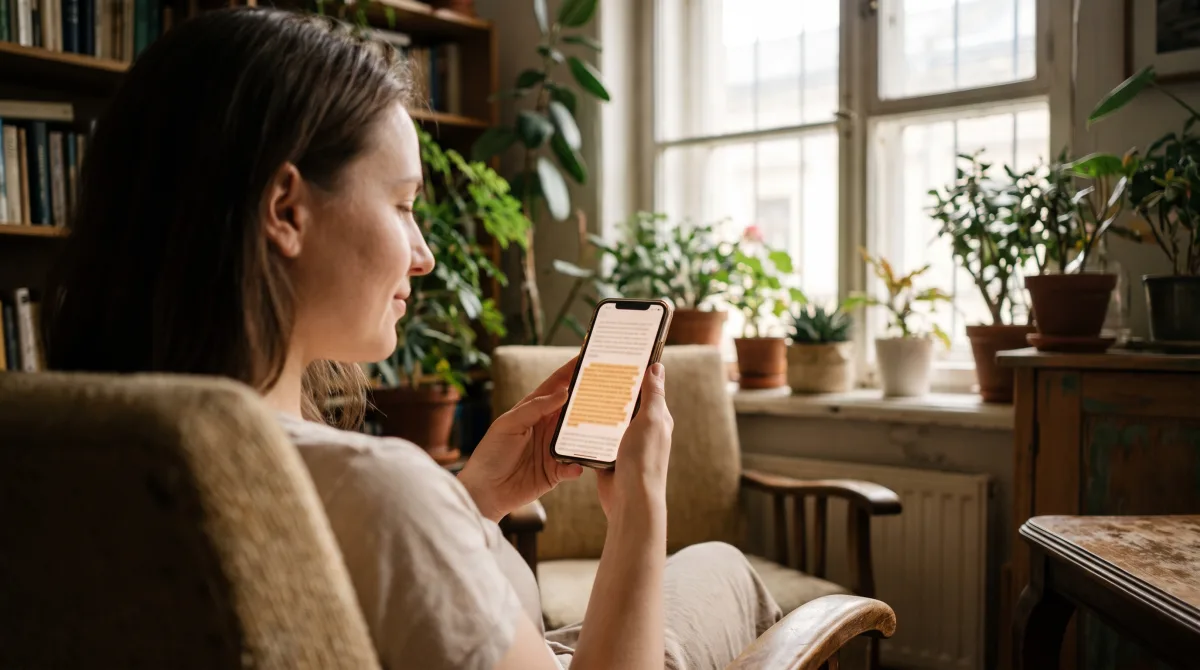
Dating without photos moved from niche curiosity to a real category in 2026 because three pressures landed at once: app fatigue, a trust collapse around profile images, and text-matching that finally works well enough to carry a first impression. The photo is no longer the obvious anchor of a dating profile — for a growing share of daters, it's the part they most want to remove. If you're choosing between them, we sort the dating apps without photos by how far each one actually moves the picture out of the way.
This is not a return to the text-only personals of the 1990s. Back then, photos were absent because the technology couldn't carry them. Now their absence is a deliberate design choice. Apps built around writing — Anketta among them — are betting that a paragraph reveals more than a portrait, and the 2026 numbers on burnout and fakery are starting to make that bet look conservative.
Write the version of yourself a photo can't show.Three forces converged: exhaustion with the swipe loop, eroding trust in profile images, and the rise of text-matching that produces useful first impressions. Each on its own is a nudge. Together they're a shove, and 2026 is the year the shove showed up in product categories.
Burnout is now the default emotional state of the swipe. A Forbes Health survey found that 78% of respondents reported dating-app burnout sometimes, often, or always — climbing to 79% among Millennials and Gen Z (Forbes Health, 2023). Pew's own data points the same way: among recent online daters, 46% describe the experience as negative, and roughly nine in ten say they've felt disappointed by the people they've seen (Pew Research, 2023). When nearly half of users walk away feeling worse, the format itself is the problem.
The photo stopped being a trust signal. As AI image tools got cheap and convincing, the profile picture quietly lost its job. In the UK, 61% of people who have used dating apps say they matched with a profile they later discovered — or strongly suspected — was a bot, scammer, or catfish (Biometric Update, 2026). A face you can't trust is worse than no face at all. Text is harder to fake convincingly across a few hundred words — a generated paragraph reads flat, and a stolen one rarely fits the conversation that follows.
Text-matching finally works. Modern language models read tone, vocabulary, and the way a person tells a story well enough to surface people who think alike. That's the difference between a 2026 text-first app and a 1996 chat room: the matching is doing real work behind the writing. We unpack the mechanics in why text-based dating works, and the broader move toward AI-read profiles in the state of AI dating in 2026.

The research has long suggested that photographs predict physical attraction but not compatibility, while extended writing predicts personality and values more accurately. Photo-first apps optimize for the wrong signal — and people are starting to notice the gap between a good match rate and a good relationship.
The clearest evidence comes from communication science. Ramirez and Zhang (2007), studying how relationships fare when partners move from text to face-to-face, found that impressions formed through sustained writing held up better than impressions front-loaded by appearance — the people who built a relationship through words before meeting reported smoother transitions offline. Writing is a high-resolution signal. A photo tells you what someone looks like; a paragraph tells you how they think, what they notice, and whether they're funny on purpose.
"The medium shapes the message. When you design a platform around photographs, you get shallow engagement. When you design around writing, you get the kind of self-disclosure that actually predicts relationship success." — Dr. Arthur Aron, Stony Brook University, architect of the "36 Questions to Fall in Love" study
Here's the underlying split between the two signals:
| Dimension | Photo as the signal | Writing as the signal |
|---|---|---|
| What it reveals | Appearance, grooming, vibe | Tone, values, sense of humor, how they think |
| How easy to fake | Increasingly trivial (AI images) | Hard to fake across hundreds of words |
| Bias it triggers | Halo effect — looks stand in for character | Judged on the actual content of thought |
| First-impression speed | Instant | Slower, but more durable |
| Predicts compatibility? | Weakly | More reliably (Ramirez & Zhang, 2007) |
For a deeper, head-to-head breakdown of the two formats, see text vs photo dating. And if you're still on photo apps and trying to optimize your shots, our guide to choosing dating photos is honest about the ceiling that approach hits.
A handful of platforms now run partly or entirely without profile images. Some drop photos completely; others make them optional or temporary. The fully photo-free end of the spectrum is where the most interesting product design is happening, because removing the image forces a different matching mechanic.
Anketta keeps the photo out of the decision entirely. There is no profile picture, avatar, gallery, or upload visible anywhere in the product before a match — you're matched on a written manuscript, a free-form text document you shape yourself with headings and paragraphs. There are no set prompts to fill in, no fixed question count, no minimum word target; the editor is a blank page, and a more substantive manuscript simply gives other people more to react to. Interest isn't a swipe. You highlight a phrase in someone's writing that you actually liked — "grew up between two languages," say — and then press the heart. The highlight teaches the matching model what you want more of, and the next batch of manuscripts skews toward it.
Personality-based apps like Boo keep the image optional and lead with a personality framework instead of a face, surfacing photos only after a few messages.
Privacy-first and ephemeral apps like Pure don't ban photos outright but de-emphasize them, with profiles and messages designed to disappear quickly.
The fully photo-free-until-you-match design earns something the optional-photo apps can't: there's no moment before that where the image reasserts itself and the halo effect snaps back. On Anketta, the photo doesn't enter the matching equation at all, so there's nothing to optimize, filter, or feel insecure about while you're being read. See how that plays out against the incumbents in Anketta vs Tinder.
No selfie to optimize. No filter to apply. Just what you wrote.Without photos, matching has to read the writing — and the better systems do this with a mix of hard filters and a preference model that learns from what you highlight, not from a personality quiz. The result is a queue that narrows toward your taste the more you read, which is the opposite of the random-swipe firehose.
On Anketta, hard filters come first: age range, gender, who you want to see, intent (relationships or friends), and city. Then the soft model takes over. When you highlight a phrase as a like, that phrase is stored and the algorithm surfaces more manuscripts mentioning it; when you cross out a phrase you dislike, it down-weights manuscripts that contain it. The system never asks what you want — it watches what you mark. Over a handful of sessions, the people you see start to read like people you'd actually want to talk to. We dig into the model behind this in AI text compatibility.
There's a deliberate slowness to the contact mechanic, too. To signal interest you must first highlight something specific in a person's writing, then press the heart — you can't fling a like at a face you glanced at for half a second. When two people both press the heart, a match opens with a 48-hour window. During those two days either person can still walk away; if neither does, the match becomes permanent and the app collapses to the chat between them. It's a structure built for fewer, deeper connections rather than an endless inbox.
It's the opposite. Removing photos removes the biometric data that fuels catfishing, reverse-image searches, and unwanted recognition — and the privacy gains compound when contact details are protected too. A text-first profile can't be reverse-searched back to your Instagram or your workplace, because there's no image to search.
On Anketta, the manuscript is the entire profile, and personal details inside it are protected by design. Phone numbers, emails, and addresses are server-blurred for anyone who hasn't matched with you — the server physically doesn't send the raw text to non-matched viewers, so there's no inspector trick to reveal it. After a mutual match, the same data unblurs automatically for both sides. You can even share your manuscript offline via a private link or QR code; the share page isn't indexed by search engines, and the PII stays blurred for strangers who land on it.
For the wider picture on how photo-free design changes the safety math, see data privacy in dating.
Text-first dating fits anyone for whom either privacy or conversation quality matters more than a fast visual verdict — introverts, writers and readers, academics, people in public-facing roles, divorced daters in their thirties, and expats building a circle across borders. These aren't fringe groups; they're a large slice of the people most worn down by the swipe.
- Introverts get time to compose a thought instead of performing one in real time.
- Writers and readers are matched on the thing they already do every day.
- Academics who find small talk a chore express themselves easily on the page.
- Divorced daters in their thirties tend to want substance over visual chemistry the second time around.
- People in public-facing roles need a profile that can't leak their identity early.
- Expats can be matched on language and cultural code, not just proximity.
If one of these is you, the persona guides go deeper: dating for introverts, dating for academics and PhDs, dating for writers, and dating for divorced thirty-somethings.
Is dating without photos really mainstream now?
It's a real category, not a stunt. Burnout sits near 78% across daters (Forbes Health, 2023), and trust in profile images has cracked — 61% of UK app users say they've matched a bot, scammer, or catfish (Biometric Update, 2026). The conditions that pushed text-first apps into the mainstream are structural, not seasonal.
Is text-first dating objectively better than photo-first?
On the dimensions that predict lasting relationships — impression accuracy, conversation depth, privacy — the research favors writing. Photo-first still wins on speed and raw match volume. If you want maximum matches fast, swipe apps deliver; if you want to connect with how someone thinks first, text-first is the structurally better path.
Which photo-free apps should I try?
Anketta shows no photo before you match — you're matched on a written manuscript, with no image visible anywhere in the product until then. Boo leads with a personality framework and keeps photos optional. Pure de-emphasizes images and makes profiles ephemeral. The end of the spectrum where the photo waits until after the match is where the matching design is most distinct.
How can an app match me with no photo to go on?
It reads your writing. Hard filters (age, gender, intent, city) run first; then a preference model learns from the phrases you highlight as likes or cross out as dislikes, surfacing more of what you mark. The more you read and highlight, the more the queue narrows toward your taste.
Is it safe to date without a profile photo?
Safer, in several ways. There's no image to reverse-search back to your real identity, and on Anketta, contact details inside your manuscript are server-blurred for anyone you haven't matched with. The raw text never reaches non-matched viewers, so there's no workaround to extract it.
Is this just like text personals from the 1990s?
No. In the 1990s photos were absent for technical reasons and there was no matching at all — only raw text. In 2026 the photo is absent by choice, and a language model does the matching behind the writing. The first meeting confirms a connection that was already built, instead of opening one from scratch.
The photo treadmill was always a strange place to start a relationship — optimizing a face for strangers who'll judge it in half a second. When the first thing someone reads about you is something you actually wrote, the whole encounter begins on different ground.
Unsure about writing? Try reading first.