Dating Profile Statuses: How to Write One That's Yours
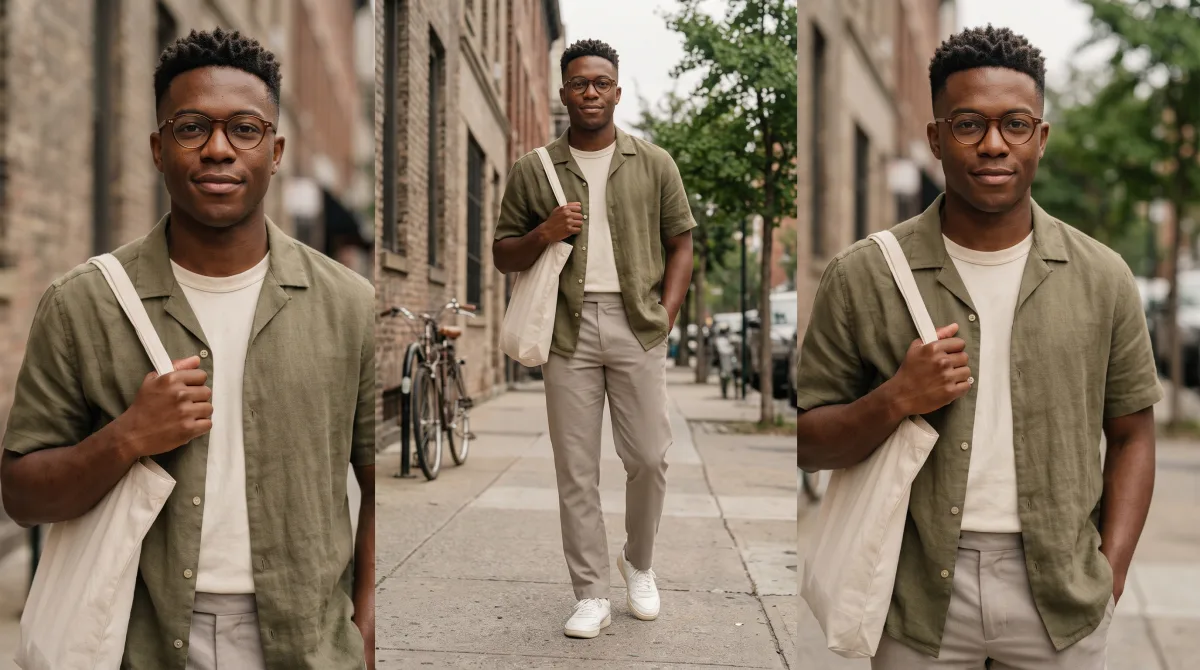
A dating profile status is the one line that sits under your name — and on most profiles, somebody else wrote it. In a 2024 eye-tracking study, 40 university students looked at mock dating profiles for a fixed ten seconds each: 83% of looking time went to the face, and the remaining 17% covered everything written (Gale, Torbay & Lykins, Archives of Sexual Behavior, 2024). If you have ever stared at that empty field and reached for a lyric, this piece is for you.
Search the phrase and the first page is not advice. It is inventory — lists of quotations, song lines, aphorisms, ready to paste. Anketta has no status field at all: a profile here is a whole manuscript, read before any photo is visible. Which is exactly what makes the one-line format easy to see clearly from outside it.
A line that could sit on ten thousand profiles has already done its only job — it filled the field. If you want that field to introduce you instead, the honest first step is finding somewhere to put the part that only fits you.
Start with the version that needs more than one lineRoughly a second, on the best evidence available. In the 2024 eye-tracking study above, each mock profile stayed on screen for a controlled ten seconds and the text region held about a fifth of the looking time. The sample was small — 20 men and 20 women, all university students, viewing profiles built for a lab — so treat it as an order of magnitude, not a stopwatch reading.
A second is enough for one idea. It is also, less helpfully, enough to recognise a line you have already read on somebody else's profile — and recognition is not the same as interest. The reader does not consciously think this is borrowed. They just move on, and could not tell you afterwards what the line said.
Which sets the real constraint. Not brevity: a status has to survive being read once, at speed, with no context, beside a name. One idea. No set-up. No punchline that needs a first act.
Because familiarity is genuinely pleasant, and this is the part the advice pages get wrong. When Bohrn and colleagues compared well-known proverbs against modified and unfamiliar variants, the familiar versions won on aesthetics: familiar proverbs were judged significantly more beautiful than every other condition, and were also the easiest to process (Bohrn et al., Frontiers in Psychology, 2012).
So the borrowed status is not bad writing. It is pleasant writing — smooth, fast, faintly satisfying — that identifies nobody. That is a stranger problem to fix than clumsiness, because nothing in the line feels wrong when you read it back. It feels fine. Fine is what it costs you.
Concrete detail and figurative language, more than wit. Van der Zanden and colleagues asked 1,234 people — all of them account holders on one of two dating sites — to rate 308 real profile texts, and the texts read as most original were the ones carrying metaphors and concrete self-disclosure (van der Zanden et al., PLOS ONE, 2022). Originality is a matter of what you name, not how clever you sound.
That is a working definition you can actually test a line against. Five questions, in order:
- Could this sentence sit, word for word, on someone else's profile? If yes, it is not a status. It is filler with good manners.
- Does it need a set-up? A status has no room for a first act, so anything requiring one arrives as a shrug.
- Does it name something a reader can picture — an object, a street, an hour of the day?
- Would you say it out loud, to a stranger, without wincing?
- Does it still work read next to your name and nothing else? That is the only condition it will ever be read in.
Most borrowed lines fail the first question and never get to the rest.
Every borrowed line is a claim with the specifics removed. The rewrite is not a matter of finding a better quotation — it is putting back the object, the hour or the small grievance that was there before the sentence got smoothed. The pairs below are the same person in both columns.
| Borrowed line | What it tells a reader | A line only you could write |
|---|---|---|
| "Not here for games" | That you have read other profiles | "I'll ask what you're reading by the fourth message. Consider that fair warning." |
| "Living life to the fullest" | Nothing that can be checked | "Three countries with one bag, and I still overpack socks." |
| "Probably overthinking this" | That you are apologising before anyone asked | "I argue with podcasts on the walk to work. Out loud. In public." |
| "Here for a good time and a long time" | That the field has been filled in | "I want someone to come to the bad Tuesday film with me." |
| A lyric from a song you love | That you like the song | "I sing the second verse wrong on purpose. It's better my way." |
None of the right-hand lines are witty. All of them are answerable, which is the property that matters — a reader with something to reply to replies.
No, and the belief that it does is what sends people to the quotation lists in the first place. Length is not the constraint; borrowing is. A status fails when it could belong to anyone and works when it names something checkable, whether that runs six words or twenty. Humour is optional, and a joke needing context is worse than a plain sentence.
Here is one that works and is not funny at all: I know which of the four bakeries on my street opens earliest, and I have opinions about the other three. Nothing about it is clever. It is doing four things at once — it puts you on a street, at an hour, with a habit, and with a mild grievance you would happily defend for ten minutes.
Compare it against "coffee lover." Same person, same subject, no street, no hour, no grievance, nothing to answer. The second version is shorter and has less to say, and that is what borrowing actually costs. Not space. Everything specific that was in the sentence before someone smoothed it into a phrase that fits anywhere.
You will have noticed that the bakery line is already too long for most status fields — and that this is not really a problem with the line.
Say the thing about the four bakeries somewhere it fitsThen write the ordinary thing, precisely. The originality research points at concrete self-disclosure rather than at interesting biography: what makes a line land is that it names something real, not that the something is remarkable. A commute, a stubborn houseplant, the one dish you can cook without looking — each is more identifying than an adventure described in general terms.

The people in that photograph are laughing at something that took ten minutes to arrive at. A status cannot do that, and pretending otherwise is where most of them break. What it can do is hand someone the first ten seconds of that walk — a detail specific enough that a stranger has an obvious thing to say back.
This is the same instinct behind intentional dating: fewer, more deliberate signals rather than a wider net. If you want the long version of the argument, our guide to essay-length dating profiles covers what happens when the format stops rationing you.
When the thing you want to say has a middle. A status can carry one claim; anything with a condition, a contradiction or a reason needs room to put it. That is the fork where people either flatten themselves into a slogan or move to a format that has space — a paragraph, a page, a whole written profile.
Anketta took the second road, which is why there is no status field to fill. People are read before they are seen: no photo appears anywhere before a mutual match, so the writing is the whole first impression rather than a caption underneath one. The line about the bakeries stops being a compression problem and becomes a sentence in something longer, sitting next to the reason you have opinions about the other three. You can write yours in an afternoon and edit it for a year.
The written version travels, too. An approved manuscript gets a public link and QR code you can hand over offline, with phone numbers, emails and addresses server-blurred for anyone you have not matched with — so somebody can read you properly from a printed card, which no status field has ever managed. More on why the product is shaped this way is on our about page.
What should I write in a dating profile status?
One specific, checkable thing about your actual week. An object, a place, an hour, a small habit you would defend. Skip anything that states a preference in the abstract — "loves travel", "not here for games" — because a preference without a detail is a claim every profile makes and none can prove.
Are quotes and song lyrics a bad idea?
They are pleasant and uninformative, which is a worse combination than it sounds. Familiar phrasing genuinely reads well, so nothing feels wrong when you check it back — but the reader learns only that you have heard the song. If a lyric matters to you, write the reason it matters instead.
How long should a dating profile status be?
Long enough to name one concrete thing, short enough to survive one reading at speed. Six words can do it; twenty can too. Length is not what fails — a twenty-word line about your commute outperforms a four-word line that could belong to anybody. Count specifics, not characters.
Should my status say what I am looking for?
Rarely, because almost everyone wants roughly the same things and says so in the same words. A line describing what your Tuesday evening looks like tells a compatible stranger far more than a line describing your ideal partner, and it gives them something to answer rather than something to agree with.
Can I use the same status on every app?
You can, and the risk is not duplication across apps — it is duplication across people. The line copied from a list appears on thousands of profiles at once; the line about your own bakeries appears on one. Reuse your own writing freely. Just make sure it started as yours.
What if I change my mind about my status?
Change it. A status is a sentence, not a commitment, and the version you write after three months of using an app is usually sharper than the one you wrote on the signup screen. If you find yourself rewriting it constantly, that is a sign the format is too small for what you want to say — and the answer is somewhere with more room, not a better line.
Do statuses matter at all if people look at photos first?
They matter differently. In the 2024 eye-tracking study, the face took most of the looking time — but the written part is the only half of the profile you fully control, and it is what a reader has left when the face has already been decided about. On a text-first platform the ordering flips entirely.
The face in the photograph is already looking straight at you; it does not need a caption to explain itself. The line underneath is the only part of the introduction you get to choose — so spend it on something the photograph could never have told anyone.
Unsure about writing? Try reading first.