Dating Apps for Writers: Where Words Are the First Impression
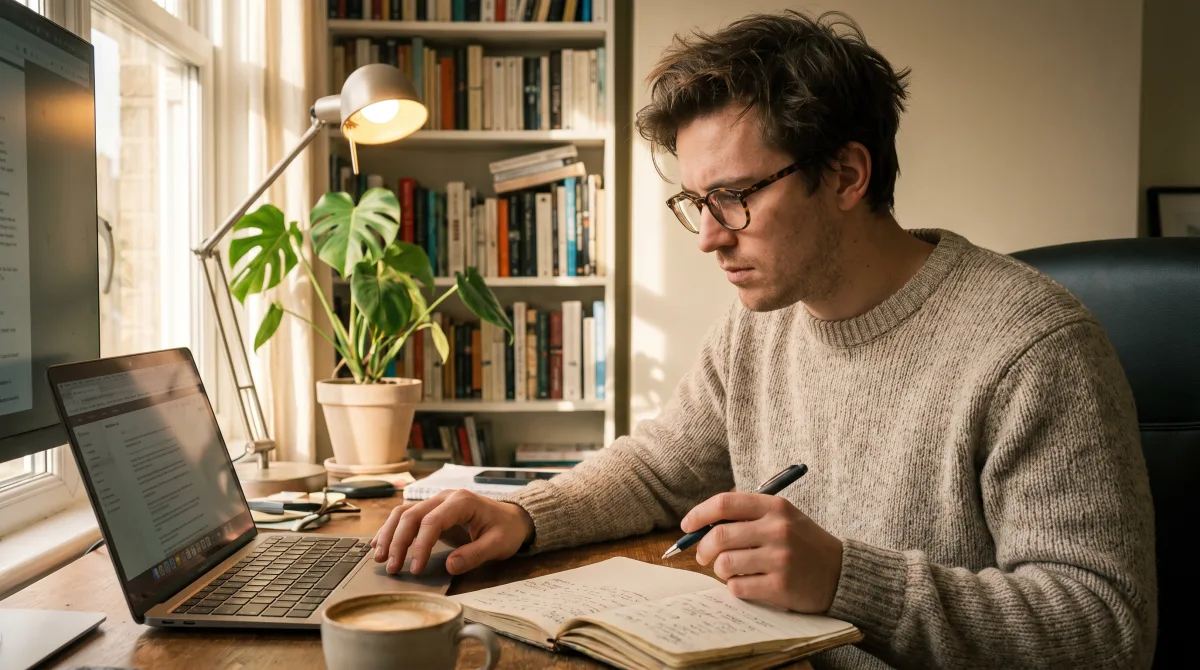
Writers define themselves through language — their craft is self-expression through words. Yet every major dating app forces them to compete in a visual arena where a curated photo grid matters more than anything they could write. For verbal thinkers, this creates a fundamental mismatch between who they are and how they're asked to present themselves.
The frustration is measurable. A 2023 survey by the Authors Guild found that 78% of professional writers described photo-first dating apps as "inadequate for representing who I am." The same survey revealed that writers spent 3.2x longer crafting profile text than the average user — effort that goes largely unread in a swipe-first environment. Research from OkCupid's data team (2022) showed that only 14% of users read the full written profile before making a swipe decision, meaning the medium where writers excel is effectively invisible.
"Language is the most intimate technology we have. When someone writes honestly about themselves, they're handing you a map to their inner world. No photograph can do that." — George Saunders, Booker Prize-winning author and writing professor at Syracuse University
Yes — and the evidence is compelling. A landmark study by Ireland et al. (2011) published in Psychological Science found that linguistic style matching — the degree to which two people mirror each other's function words, pronouns, and syntax — predicts relationship initiation and stability with remarkable accuracy. Couples whose writing styles converged were 33% more likely to still be together after three months.
This research suggests that how someone writes reveals more about compatibility than what they look like. James Pennebaker, the co-author of the study and a leading researcher in computational linguistics, found that function words — the small words we use unconsciously like "the," "I," "but," and "very" — are reliable markers of personality, social status, and emotional state (Pennebaker, 2011). On a platform like Anketta, where your essay is your introduction, these linguistic signals are front and center rather than buried beneath photos.
"We think we choose partners based on big, obvious traits. But the research shows it's the subtle patterns — how someone structures a sentence, their ratio of 'I' to 'we' — that predict whether two people will actually connect." — Dr. James Pennebaker, Professor of Psychology, University of Texas at Austin
The essay has a centuries-long tradition as a vehicle for personal revelation. From Montaigne to Joan Didion, the essay form exists to explore the self through language — to think on the page and discover meaning through the act of writing itself. When applied to dating, this form transforms a profile into something closer to literature: a genuine attempt to articulate who you are and what you're looking for.
Research published in Communication Research (2023) found that people who engaged in extended written exchanges before meeting reported 41% higher relationship satisfaction at the six-month mark compared to those who moved quickly to in-person meetings. The act of writing — and being read — creates a form of intimacy that's qualitatively different from visual attraction. A 2024 Hinge study confirmed this, finding that matches originating from text-heavy profiles resulted in 2.8x more dates that led to second dates (compared to photo-focused profiles).
Anketta was designed for people who think in words. Your manuscript — a written self-portrait of roughly 500 words — is what introduces you to potential matches. There are no photos in the initial evaluation. The feed is short and curated rather than infinite, so each profile is read instead of skimmed. Just your words, read by someone who chose to spend time with them.
For writers, this isn't just a dating app — it's a platform that finally speaks their language. The manuscript format rewards exactly the skills that writers possess: the ability to be vivid, honest, surprising, and vulnerable on the page. According to a 2023 study in Personality and Individual Differences, individuals who scored high on verbal intelligence reported 52% greater satisfaction with text-based dating platforms compared to photo-first apps (Grieve et al., 2023). And once both readers like each other, the 48-hour window to start the conversation ensures your words aren't just glanced at — they're absorbed, considered, and responded to with intention.
Not replace — redefine. The assumption that physical attraction must come first is a cultural norm, not a biological imperative. Research from the University of Texas (Eastwick & Finkel, 2008) demonstrated that attraction developed through conversation is more durable than attraction based on initial physical impression. For writers, who have always known that language creates connection, this finding is intuitive.
Anketta doesn't eliminate physical attraction — it resequences it. You connect with someone's mind first, and when you eventually see their face, you see it through the lens of everything they've already shared. A 2022 meta-analysis in Psychological Bulletin found that this "familiarity-to-attraction" pathway produces relationships with 26% lower rates of early dissolution (Montoya et al., 2022). For writers, the question was never whether words could create chemistry. The question was when a dating platform would finally let them try.