How to Choose Dating Profile Photos (An Honest Guide)

Choose three to five different shots: one close-up portrait with an open face and a real smile, one full-body frame, and one of you doing something you actually love. Shoot in soft daylight, keep every photo recent — under a year old — and make sure each one looks like the person who shows up to the date. First impressions move fast: Janine Willis and Alexander Todorov found that we judge a face in roughly one-tenth of a second, so your lead photo does almost all the work.
This guide comes from an odd source: a dating app with no photos at all. So first, honest advice for the apps that use them. Then, near the end, a different path for anyone tired of picking the right frame and being judged in half a second. That path is an app with no photos at all.
Four or five is the sweet spot. Fewer than three reads as hiding something; more than six scatters attention until the photo that mattered drowns. Lead with your warmest portrait — it lands before any words do, and it decides whether someone keeps reading.
After that, keep a simple sequence: close-up portrait → full-body shot → an "in action" frame (doing the thing you love, mid-travel, with a book or an instrument) → one easy group photo where you're instantly recognizable. Every photo should add something new — a fresh angle, a different side of your life — not repeat the previous one from a slightly different tilt.
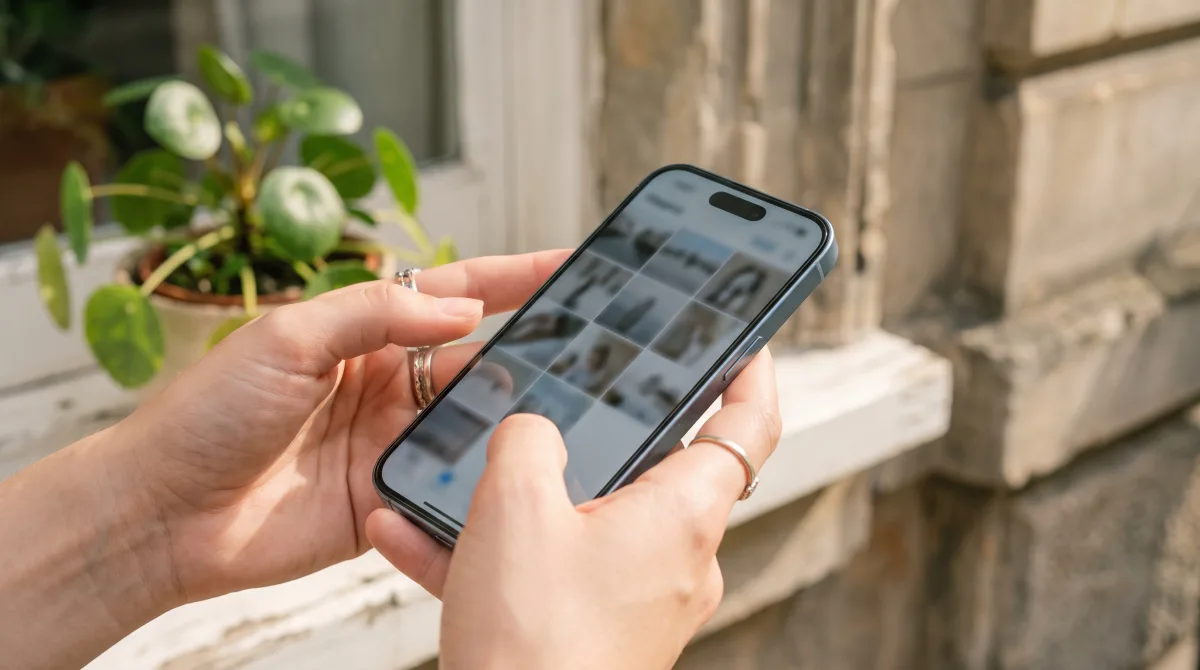
The best light is soft daylight — by a window, in open shade, an hour before sunset. It falls gently across the face without harsh shadows or blown-out highlights. Direct noon sun and overhead ceiling light age you and flatten you; skip both.
The smile has to be real — the kind that reaches the eyes, not just the mouth. A forced "for the camera" smile reads as fake instantly. Willis and Todorov's 2006 study showed that impressions of a face — trust, attractiveness, competence — form in about 100 milliseconds. You don't get a second take. You get the first frame and that tenth of a second.
The ones that hide you or mislead. The damage is always the same: you cover your eyes, smooth your face under a filter, lead with a group shot the viewer has to decode, or post a photo from a version of you that no longer exists. Each one promises something the real meeting won't deliver. Here are the most common mistakes, in order of damage:
- A group photo first. The viewer has to guess which of four people is you — and loses interest before they figure it out.
- Sunglasses and a low cap. Eyes are the main channel of trust; cover them and you cover yourself.
- Heavy filters and retouching. Smoothed skin and a porcelain face read as deception, and the real meeting disappoints.
- The gym-mirror selfie. A cliché that says exactly what a thousand other profiles already said.
- An old photo. A five-year-old shot is a promise you can't keep across a café table.
Each of these spends down trust. And trust is the only currency dating runs on.
The line is simple: a good photo shows you honestly; a bad one hides or flatters. One hands the viewer a real person; the other hands them a puzzle to solve. On photo apps that gap decides almost everything, because the choice happens in a tenth of a second. Here's the contrast side by side.
| Photo that works | Photo that hurts |
|---|---|
| Soft daylight by a window | Flash in a dim club |
| Open face, eyes visible | Sunglasses, hood, half-shadowed face |
| Real smile that reaches the eyes | Forced "for the camera" smile |
| Recent shot, taken this year | Photo from five years ago |
| You doing something you love | Gym-mirror selfie |
| One recognizable group shot | Five group photos in a row |
If you're unsure about a shot, it's probably in the right column. A good photo doesn't make you wonder.
Because the treadmill has no finish line. OkCupid once analyzed more than 7,000 photographs and found rules for every detail — where to look, whether to smile, what to shoot with (OkTrends, "The 4 Big Myths of Profile Pictures"). And still the rules shift every season, and you're back in your camera roll re-picking.
There's a darker side too — other people's photos. The U.S. Federal Trade Commission reports that scammers steal other people's pictures to build fake identities, and romance scams cost people $1.14 billion in a single year. More on spotting fake profiles is in our guide to avoiding dating scams. The photo that was supposed to prove you're real proves it less and less.
Then there's a different path — and it's more honest than any gallery. On Anketta no photo enters the decision: nothing shown before you match, nothing you're required to upload, no "pick your best shot" pressure. People know you by what you write first, not by how you came out on the eighth take in a row.
Here's how it works. Instead of a profile, you write a manuscript — free-form text in headings and paragraphs, about you and what matters to you. Others read it, highlight the phrases that land ("loves cats," "grew up by the sea"), and press a heart. When both hearts land, you match. No swipe, no half-second verdict — first someone reads you, then they choose.
Try a profile where your words do the introducingBecause text can't be "optimized" the way a photo can. The algorithm here doesn't ask what you want — it watches what you highlight. Mark a phrase as "this is me," and the next batch of manuscripts skews toward what's close to you. The more you read and highlight, the more the queue narrows toward what you actually like.
And one more thing: nobody judges you in a tenth of a second. The reader moves through your text without rushing, and gets to know you before the first message. The full contrast between photo and text dating is in our text vs photo breakdown; how dating without pictures actually works is in the guide to dating without photos.
The advice above about light and a real smile still holds — for photo apps. It just has nowhere to go on Anketta: there's nothing to choose.
Write the version of you that gets read, not scannedIf you can't leave a photo app yet, keep the minimum that won't let you down: one honest daylight portrait with an open face, one full-body shot, one of you doing the thing you love. No more than four. Recent, no filters. That's enough.
And if you want to try dating where there are no photos at all and people choose you for your words, the options are in our roundup of the best dating apps. The most radical one takes the camera out of the equation entirely.
How many photos do you need for a dating profile?
Four or five is enough. Fewer than three reads as hiding something; more than six scatters attention. Lead with your warmest open-faced portrait — it lands before any words and decides whether someone keeps reading your profile at all.
What should your main dating photo be?
A close-up portrait with a real smile and visible eyes, shot in daylight. Not a group photo, not a sunglasses shot. Your main photo has to show a real person in a tenth of a second, not a puzzle the viewer has to solve.
Should you smile in dating photos?
Yes — if the smile is real, the kind that reaches the eyes. A forced "for the camera" smile reads as fake instantly. A warm, relaxed expression beats an insincere grin produced on the photographer's count.
Which photos definitely scare people off?
Group photos as your first shot, sunglasses, heavy filters, gym-mirror selfies, and anything older than a year. Each one either hides you or promises something the real meeting won't deliver — and spends down trust.
Can you date without any photos?
Yes. Photos on Anketta are optional and never required — people choose you by the manuscript you write yourself, and no photo enters the decision before you match. That removes the whole treadmill: nothing to pick, nothing to filter, nothing to re-optimize every season.
Why do photos matter so much in dating?
Because impressions of a face form in about a tenth of a second — before anyone reads a word (Willis & Todorov, 2006). On photo apps that means one frame decides almost everything. Text-based dating removes that instant verdict: you get read first.
The camera promises fast and lies gracefully. The page is slower and more honest — it waits to be read, and only then makes the introduction.
Unsure about writing? Try reading first.