Dating for Freelancers: When There's No Office to Meet Anyone In
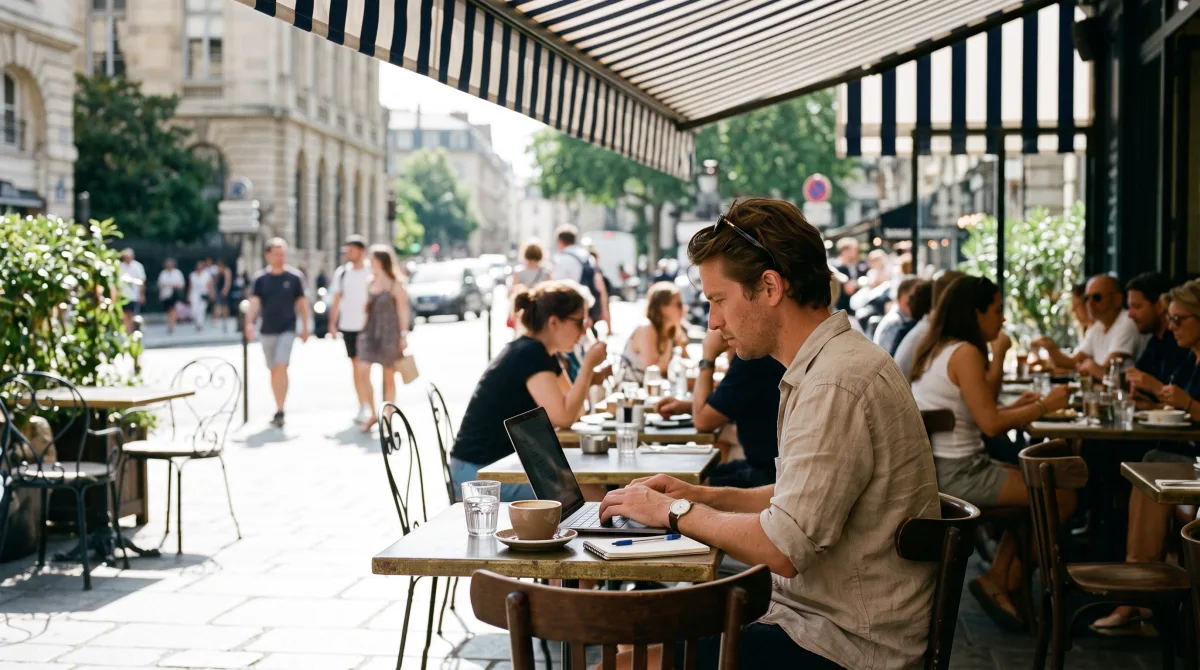
Freelancing didn't make dating harder by taking time away — it made it harder by removing the room where meeting someone used to happen automatically. An office hands out low-stakes introductions for free: the coworker two desks over, the same faces on a shared commute, a lunch break that occasionally turns into a coffee that turns into a date nobody had to arrange on an app. A freelancer keeps the desk and loses the room. Wang, Li & Coutts (2022), in a national British survey published in BMJ Open, found that loneliness explained 39% of the mental-health gap between gig workers and full-time employees — not the work itself, the isolation built into how the work happens.
Anketta's manuscript does the job the office used to do without being asked. There's no swipe gesture and no live queue — you highlight a line in someone's writing as a like, then press the heart, and a match opens a 48-hour window either side can use whenever their actual week has room. The filtering an office used to run on autopilot — who are you, does your life fit anywhere near mine — happens inside the writing itself, before either person spends an evening finding out.
Write the manuscript your commute used to write for youThree specific gaps open at once, not one. The ambient-introduction channel disappears — no coworker, no regular commute, no office happy hour nudging two people together. The rhythm that used to organize a social life around a workday stops organizing anything. And the money that funds dating stops arriving on the schedule it used to, which changes what "just go on more dates" actually costs.
- No ambient introduction channel. An office was never a dating app, but it ran one anyway — coworkers, recurring faces on the same train, a happy hour nobody had to plan. None of that survives the move to a kitchen table.
- No externally imposed rhythm. A 9-to-5 forces a social life to happen around it, whether or not anyone consciously plans one. A freelance week has no shape unless the freelancer builds one — and dating is usually the first thing that quietly doesn't get built.
- No steady paycheck to plan a dating life around. A subscription that renews on the 1st costs the same in a slow month as a busy one, and a dinner that felt easy in a strong month starts to feel like a decision in a lean one.
This isn't the same mismatch remote workers run into, where the problem is two clocks that don't line up, or the one entrepreneurs hit, where the problem is too little calendar for too many matches. A freelancer can have an open calendar and a perfectly normal clock and still lose the channel that used to do the introducing for free.
The "just join a co-working space" fix undersells how deep the gap runs — most freelancers don't reach for it. Reporting on IPSE research, Raconteur (2019) found that 76% of freelancers have never used a co-working space, which means the office's ambient-introduction channel doesn't quietly relocate somewhere else — for most people it just stops.
"What I miss most about being in an office is being sociable... going for afterwork drinks and having someone to bounce ideas around with." — Abby Young-Powell, freelance journalist, in a 2019 Raconteur interview
That's the version of the problem dating apps never had to solve for anyone else — not too little time, but too little ambient contact to begin with. Writing a manuscript doesn't recreate an office. It replaces the one job the office actually did: putting an honest version of you in front of someone who might actually read it.
It isn't that freelancers can't afford to date — freelance income is often competitive with a salary. It's that the income doesn't arrive on the same clock a subscription renewal or a dinner reservation does. A 2025 Upwork Research Institute study, reported by Forbes, found that 28% of skilled U.S. knowledge workers now freelance, earning a combined $1.5 trillion — real money, just not arriving on anyone else's schedule.
The same study put full-time freelance earnings anywhere from $31,000 to $275,000 a year, a spread no salaried role has to plan around. A dating budget that felt easy in a strong quarter can read as a stretch in a slow one — same person, same habits, different month. The fix isn't spending less on dating. It's not tying it to someone else's payday. Try Anketta on the slow Tuesday afternoon, not the day rent is due — the manuscript does its filtering before any subscription or dinner reservation is on the table.
A freelance week doesn't repeat. Some weeks are wide open; others are booked solid by a deadline that doesn't care what day it is. Text-first dating doesn't ask both people to be free at the same hour — you write once, matching runs on what gets highlighted, and a match opens a 48-hour window either side uses whenever their week actually clears, not on the 7pm every mainstream app quietly assumes.
That matters more for a freelancer specifically because every published manuscript ships with a public share link and QR code — a first conversation can start from something you actually wrote, on a Tuesday afternoon that happened to be free, instead of both people scrambling to protect the same evening. The reading happens whenever the reader's week has room for it — between two client calls, on the way to a co-working day, the quiet hour after a deadline finally goes out.
Write once — let the reading happen on whichever day is actually freeThe difference isn't the people on either platform — it's what has to line up before anything happens. A swipe app needs both schedules and both bank balances to cooperate on the same evening. A manuscript does its filtering before either is asked to.
| Stage | Mainstream swipe apps | Anketta |
|---|---|---|
| First impression | Photo grid, judged in seconds | Free-form manuscript, read whenever the reader's week allows |
| Filtering surface | Live chat — both people online at once | Reading and highlighting — asynchronous by default |
| Timing assumption | Same evening, roughly the same free hours | No fixed hours assumed; the 48-hour window travels with an irregular week |
| Spending rhythm | Same subscription and date cadence expected every month | Reading and writing cost nothing extra; spending decisions come after the filtering, not before it |
| What a slow reply means | Often read as losing interest | Just means the week got busy |
| Where the introduction comes from | The app has to manufacture every one | The writing carries its own introduction, the way an office used to |
None of this makes mainstream apps a bad choice — they fit daters whose weeks already repeat on a schedule. It's a worse fit specifically for a week that has no fixed shape and a paycheck that doesn't either; the fuller side-by-side is in Anketta vs Tinder if you want it in detail.
The instinct is to lead with the logistics — "I freelance, so my schedule is flexible." That's true, and it's not what makes someone want to write back. The manuscript that gets read says what an unscheduled week actually feels like day to day, not just that flexibility exists in theory.
Do:
- Say what a real week actually looks like — which days tend to be open, which get eaten by a deadline, how far ahead you can honestly plan a date.
- Name what the trade-off cost you — a steady paycheck, a team, an office you never had to build a social life around yourself.
- Be specific about how you'd actually want the early stage to go: text-first while a date lines up, or straight to meeting once a week looks clear.
Don't:
- Lead with "digital nomad" or "my own boss" branding. That's a job description, not an introduction.
- Promise flexibility you don't reliably have. If deadline weeks regularly eat your evenings, say so — the person reading will find out either way.
- Treat the income swings as a punchline ("feast or famine, lol"). It's a real fact about your life; write about how you actually handle it, not around it.
The shape repeats often enough to describe. The first stretch is writing — most freelancers draft it on whatever afternoon actually clears, sit with it a day, cut the line that sounds like a job listing, and publish. Anketta's editor doesn't ask for a fixed word count or a deadline — for once, that isn't a metaphor.
The next stretch is quiet, then a small wave of messages that reference something specific in the manuscript instead of opening with "so what do you do." Because nobody's waiting in real time, the early exchanges tend to run longer and more considered than a typical opening chat. The first meeting, when it happens, lands on whichever day both calendars actually agree — which, for two people whose weeks rarely repeat, tends to be the easiest part of the whole thing.
Are dating apps even worth it when my schedule doesn't repeat week to week?
Volume-optimized swipe apps assume both people are free at roughly the same evening hours, which a freelance week rarely guarantees. Text-first platforms remove that assumption — the manuscript does the filtering asynchronously, and the 48-hour match window doesn't care which day of the week either person's calendar finally clears.
How much should a freelancer write in their manuscript?
Anketta's editor is free-form, with no fixed intake schema and no minimum or maximum length. The useful length is whatever actually shows what an unscheduled week and an unpredictable income look like day to day — for most people that lands somewhere between a long email and a short essay.
Won't writing this much expose too much about my income or clients?
Manuscripts aren't indexed by search engines and aren't visible to strangers browsing — only mutual matches and people you've shared the link with can read them. Phone, email, and address are also server-blurred for anyone you haven't matched with, so client names or specifics you mention stay between you and whoever you actually match with.
Will I lose matches by being pickier about timing?
Probably, and that's the right trade. A smaller pool of people who are genuinely fine with a week that doesn't repeat converts into more real dates than a wider pool where half the matches quietly go cold from timing mismatch alone.
Is this only for freelancers who work completely alone, or does it apply to people who go to a co-working space too?
It applies either way. A co-working space brings back some ambient faces, but rarely the same ones twice, and it doesn't touch the income side of the problem at all. The common factor isn't solitude — it's a week and a paycheck that don't arrive on anyone else's schedule.
Can I use Tinder or Hinge alongside Anketta?
Plenty of people do, especially early on. What tends to happen is that once a couple of asynchronous conversations on Anketta are actually going somewhere, the volume-app notifications start feeling like one more thing competing for a week that's already unpredictable — the Q&A page covers more of the practical questions that come up after the first week.
A freelance week was never the obstacle by itself. The obstacle was a format built for a paycheck and a schedule that repeat — write the version of your week that doesn't need either one to.
Unsure about writing? Try reading first.