Muslim Dating Apps and the Order Halal Courtship Actually Runs In
You say it first. Not on the third date, not once it feels safe to bring up — in the opening exchange, because everything after that is arranged around an answer other dating products treat as a later topic. This is not a small constituency: Muslims made up 25.6% of the world's population in 2020, according to a June 2025 Pew Research Center analysis, and no single courtship script covers two billion people.
Anketta has no faith field to tick and no date to schedule. What it has is a manuscript — a free-form document you write yourself, in your own headings, read in full by someone who has never seen your face. Whether that format works inside your family's expectations is a question for your family and your imam, not for a landing page. What the product does is narrower and easier to check: people are read before they are seen, and there is nothing to arrange until both sides have already said yes.
Write the version your family could read over your shoulderBecause the intention is a precondition rather than a conclusion. A 2025 review of fatwa literature in the Journal of Fatwa Management and Research lists intention for marriage among five conditions for matchmaking to count as halal, next to keeping identifying details private and meeting with a chaperone or in a public place.
Read on a mainstream app, "I'm looking to marry" in message one is a red flag. Read inside this sequence it is the opposite — it is the disclosure that makes the next three months honest, and withholding it is the thing that would be strange. That is roughly what intentional dating means everywhere else, arrived at from a completely different direction.
The word itself is contested, and worth saying plainly: plenty of practising Muslims will not use "dating" for any of this, because the term carries the sequence they are declining. Others use it without a second thought and mean courtship with the family informed. Both are in your inbox. Neither is a misunderstanding of the other.
It ranges from a mother reading your messages to a parent who never learns the app exists. Rain Tiller's 2018 review in Intersect, the Stanford Journal of Science, Technology, and Society, found people asking relatives to help write their profiles and to vet matches before any meeting — and formal matrimonial sites where a parent runs the account outright.
The same review records the opposite current in the same population. In an ethnographic study of British Pakistani Muslims, participants described matrimonial websites as a way to assert individuality and step around a parentally-arranged process they found didn't fit their lives . Same technology, opposite use — one household treating the family as the quality control, the household next door treating it as the thing to be routed around. Anyone writing about "the Muslim approach" to meeting someone is flattening at least those two.
At the invitation. The default script asks two strangers to spend two hours alone in order to find out whether they want to spend two hours alone, and for many practising Muslims that meeting is the part that requires a chaperone, a public setting, or a family member's presence. The 2025 fatwa review names exactly that as a condition, not a preference. So the discovery has to happen somewhere else, before anyone books anything.
| The default app sequence | A courtship-first sequence | |
|---|---|---|
| First contact | A photo, then a line of banter | A stated intention, then a written introduction |
| What gets exchanged | Availability, then vibes | Circumstances, family, timeline, deal-breakers |
| First meeting | Alone, early, to find out if there is anything there | Later, accompanied or public, to confirm what writing already suggested |
| Who else knows | Nobody, usually | At least one family member, often several, by design |
| "Going well" means | Wanting a second drink | Both families being told |
Neither column is more serious about relationships. They just put the expensive step in a different place — one spends the evening finding out, the other spends the writing finding out and keeps the evening for confirmation.
It is the medium. Tiller's review documents a woman whose courtship, once formally begun, restricted the space she and her suitor could share, and who used email to keep a degree of intimacy and independence inside those limits . That is not a compromise with the rules. It is what the rules leave room for, and it is where the real acquaintance happens.
Which makes text an odd thing to treat as second best. If the first unaccompanied hours are the last step rather than the first, then everything you would normally learn across three cafés has to be learned on the page — how someone argues, what they find funny, whether they can describe their own mother without flattering or blaming her. Anketta is built around that document rather than around a meeting: essay-length writing read start to finish, no photographs anywhere before a mutual match, and photos optional even after one. Someone reads three pages about the smell of your grandmother's kitchen before they know what you look like, and by the time a room has to be booked, the introduction is already over.
Say the thing about your grandmother's kitchen before anyone has to book a roomMore than you would guess, because the identifying details are handled separately from the story. Anketta blurs phone numbers, addresses and other personal details server-side for anyone you have not matched with — the raw text is never sent to their browser at all — which lines up with the fatwa review's condition that identifiable information stay confidential during matchmaking.
That leaves the parts actually worth reading. Three that do more work than any dropdown:
- The timeline, in months rather than adjectives. "I would want to meet families within a few months" tells a reader something. "Looking for something serious" does not, and every profile on every app already says it.
- Who is in the room. Whether your parents expect an introduction early, whether a brother or an aunt will be at the first meeting, whether you are the one making the running or your family is. This is the single most useful paragraph you can write, and almost nobody writes it.
- What your week already costs you. Prayer times that move through the working day, a fast that reorganises a whole month, a Friday that is not negotiable. Not as a statement of piety — as a schedule the other person will be living inside.

Look at what the product makes you do first, not what it lets you declare. A faith filter changes the pool; the sequence stays a photo grid with banter attached. The alternative is visible in how organised Islamic matchmaking has moved online elsewhere — a 2024 case study of an Indonesian matchmaking service in the Journal of Media and Religion Studies describes a mediator role built into the service rather than a checkbox added to one.
Anketta is not a Muslim app and does not present itself as one; there is no faith category, no scholar on staff, no ruling on offer. It is a product whose default order happens to match a sequence that already existed — read first, decide second, meet last. If that ordering is what you have been trying to reconstruct on apps built for the opposite one, the manuscript is where it lives, and the slow part is not a setting you turn on. More on why the product is shaped this way sits on the about page.
Are Muslim dating apps halal?
That is a question for a scholar you trust, not for an app's marketing page, and answers differ by madhhab and by family. What the 2025 fatwa review offers is a checklist rather than a verdict: intention for marriage, private personal details, a chaperoned or public meeting, honest conduct. Apps meet those conditions to very different degrees.
Is it too forward to mention marriage in the first message?
Not inside this sequence — it is the disclosure that makes everything after it honest, and leaving it out is what reads as evasive. On a mainstream app the same sentence lands as intensity, which is one practical reason people look for somewhere the default assumption already runs the other way.
Should I tell my family I met someone on an app?
Answering that early is easier than maintaining two versions of the same relationship. Practice varies enormously here: some families expect to be involved from the first conversation, others only want to hear about it once it is serious. Ask before you are in it.
Does Anketta have a Muslim or halal filter?
No. There is no faith field, no denomination dropdown and no religiosity slider. Matching runs on a continuously-learning model built from the phrases you highlight in other people's writing — so faith shapes your matches only to the extent that you wrote about it, which is also how it works for cooking or grief.
Can people see my photo before I decide I want them to?
No. Photos do not appear anywhere before a mutual match — not in the feed, not in any list, not as a badge — and they stay optional afterwards. Even inside a match, a photo is shown only to someone who has offered one of their own, and that rule is enforced on the server.
What if my family and I disagree about how involved they should be?
Say so in writing, before the first meeting, and say which way you lean. It is a harder paragraph to write than a list of hobbies and a far more useful one to read — most of the mismatches that surface at month four were legible in month one and simply never got stated.
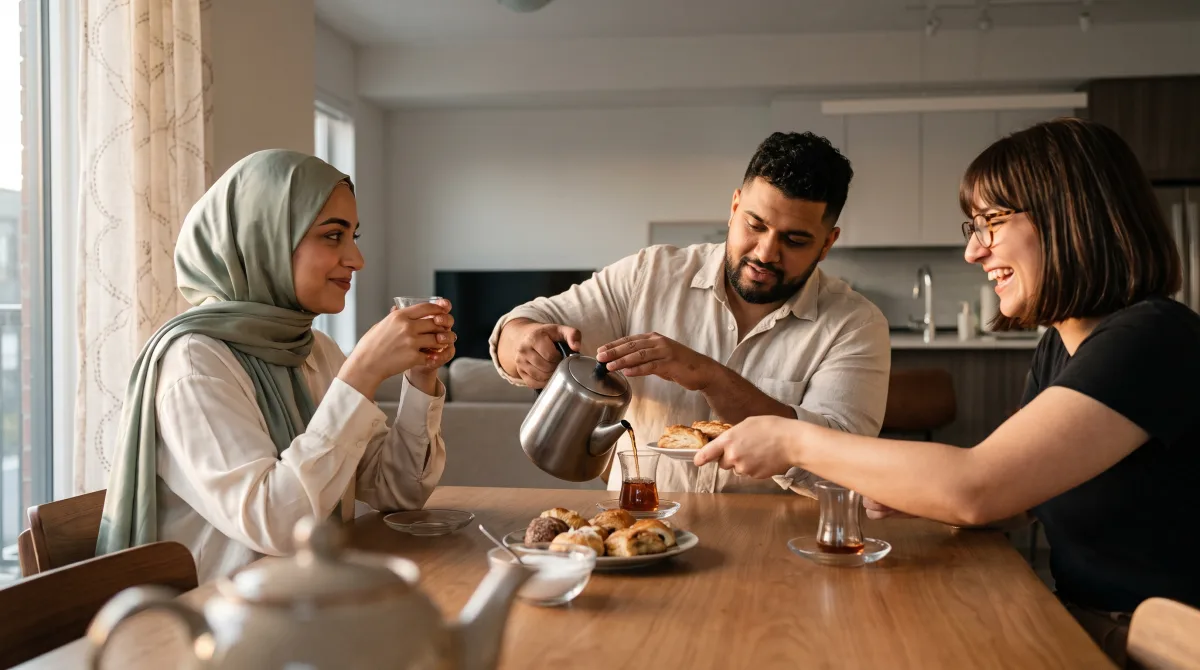
There will be tea, and there will be someone else at the table. What you actually get to decide is how much they already know before you sit down.
Unsure about writing? Try reading first.