Dating as a Hindu: Family Expectation, Caste, and Choice
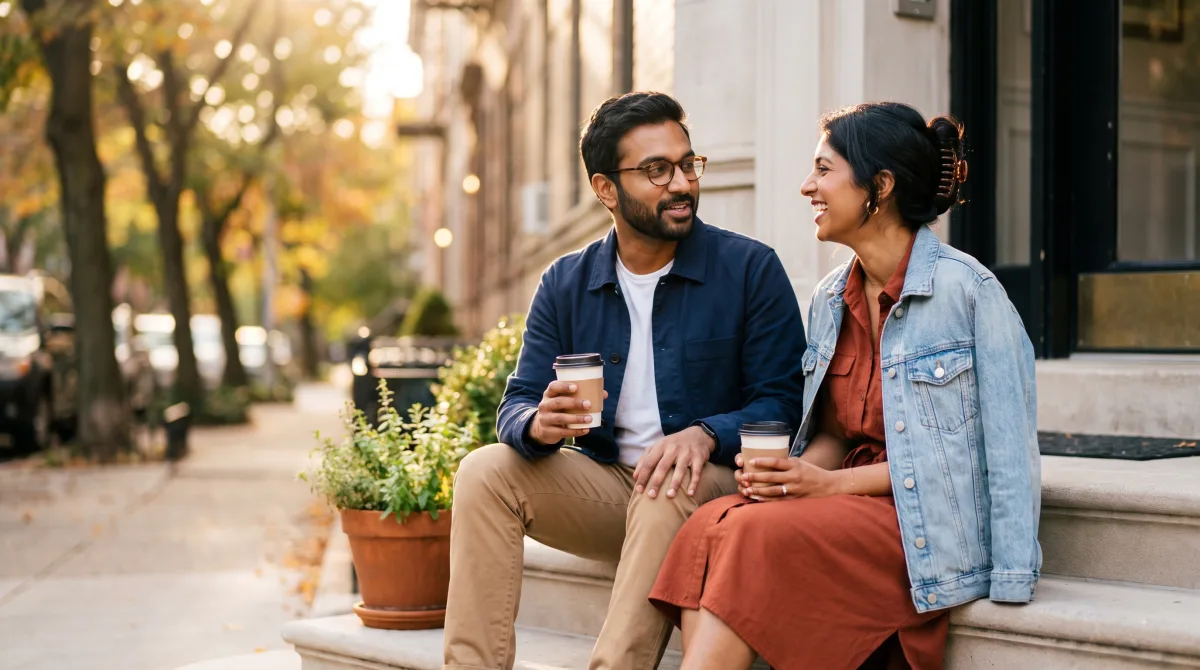
Meera's mother forwards her a photo and two paragraphs of biodata on a Tuesday night — a boy from Pune, an engineer, from a Vaishnav family on his father's side — and asks nothing else. Meera hasn't opened a dating app in six months. Both of those are dating, often for the same person in the same month.
Hindu dating today runs across an unusually wide range at once: family-run introductions, matrimonial biodata forms, temple-community networks, and ordinary apps. A 2012 study of 58 Indian-American adults — 28 in arranged marriages, 30 in marriages they had chosen themselves — found no differences in satisfaction, commitment or love between the two groups, which says less about arranged marriage being secretly ideal and more about how badly the punchline version of it has aged. This matters to anyone whose family still expects to be consulted, and who wants to write about that plainly instead of performing either rebellion or tradition for an app that has no field for either.
What's usually missing is somewhere to write the specific, complicated version of your own situation — not a biodata form's fixed rows, not a swipe deck's silence on any of it. A manuscript is long enough to hold what your family expects, what you've decided about it, and what you're still deciding — and you can try writing that part instead of leaving it blank.
Write the version of your situation a form can't holdArranged marriage remains widespread among Hindu families, and for a lot of people it is actively chosen rather than tolerated. The word covers a spectrum, though — from a single parental introduction followed by the couple's own courtship, to a fully negotiated match with limited say for either person. Most Hindu dating today sits somewhere in that range, not at either end of it.
| Form | Who chooses | What actually happens |
|---|---|---|
| Fully arranged | Parents and extended family | Families negotiate and finalize; the couple meets shortly before, or at, the wedding |
| Semi-arranged (introduction-based) | Family introduces, couple decides | A relative suggests a candidate; the two people date, video-call or meet repeatedly before agreeing |
| Love-cum-arranged | Couple chooses, family ratifies | Two people choose each other first, then bring it to their families for blessing — and often a formal matchmaking process anyway |
| Independent / love marriage | The couple alone | No family brokering at any stage; families may or may not be told before it's final |
What actually varies across those four rows is rarely named out loud:
- How many people the couple meets before deciding — one candidate, or a shortlist
- Whether meetings happen in person, by video call, or through a matrimonial site's own message system
- How much time passes between the first introduction and the wedding
- Whether either person can veto a match outright, or only register a preference
This is regional more than it is religious. A Tamil Hindu family checking horoscope and gotra compatibility before a first meeting is running a different process from a Gujarati family working through a community matrimonial network, which is different again from a Bengali family that leaves more of the search to a matrimonial site and less to a physical community circle. None of that is Hinduism the religion issuing instructions — it's regional practice riding alongside it, and it's exactly the texture that flattens when "Hindu dating" gets treated as one thing.
Yes, and it's better documented outside India than the assumption of a modernizing diaspora would suggest. A 2019 analysis of 313,000 matrimonial profiles, comparing India-resident and diaspora users of a major Indian matrimonial site, found that diaspora attitudes toward intercaste marriage were significantly less open, suggesting a bi-cultural model of integration — the opposite of the idea that distance from India loosens the rule. Caste filtering on matrimonial platforms is a documented mechanism of exclusion, not a preference like any other, and this piece treats it as exactly that.
Most second-generation Hindus aren't choosing between their family's plan and their own — they're running both at once, on their own private timeline, and telling each side only what it needs to know for now. The 2012 satisfaction finding above is one data point for a wider pattern: satisfaction has never tracked cleanly onto who did the choosing.
That's why treating one path as the free one and the other as the constrained one is closer to assumption than to finding. Someone can date privately for a year before picking the week to mention it, or take their mother's forwarded biodata seriously while still swiping on their own time. Read as intentional dating, a parent's introduction isn't obedience — it's one more input into a decision the person is still making themselves.
A biodata asks for your caste, your gotra, your height and your income, and calls that compatibility. It's efficient, and it's silent on the one thing that actually predicts whether two people get along: how each of them has worked out where family stops and their own decision starts. Anketta has no caste field and no horoscope score — there's no swipe either. You signal interest by underlining a line in someone's writing that lands, then pressing the heart; a match forms once that's mutual, on values written specifically enough to sort rather than checked as a box.
Because contact details stay blurred until you actually match, writing something specific about your family situation doesn't hand your phone number to a stranger — or to someone two degrees from your parents' social circle — along with it. You can open the editor and see how much more room that actually is than a biodata's fixed fields.
Say the part a biodata form has no field forIs "Hindu" the same as "Indian"?
No. Hinduism is a religion; India is a country. Most Indians are Hindu, but India also has large Muslim, Christian, Sikh, Jain and Buddhist populations, and Hindus make up a majority in two countries, India and Nepal — alongside sizeable communities in Sri Lanka, Bali, Mauritius, Trinidad, Fiji and diaspora cities worldwide, many of them generations removed from India.
Do all Hindus practice arranged marriage?
No single practice covers every Hindu. Arranged marriage stays common and is often actively chosen, but it ranges from one parental introduction to a fully family-negotiated match, and plenty of Hindu families leave the entire decision to the couple. Region, generation and the individual family shape it more than religion alone does.
What does "semi-arranged" marriage mean?
It describes a middle path: a relative introduces a candidate, and the two people then date, talk and decide for themselves whether to continue — closer to a set-up than a directive. It's plausibly the most common form among Hindu families today, though no platform publishes the actual split between it and the other forms.
Does caste still matter in Hindu matchmaking?
Yes, and it's documented rather than anecdotal: caste filtering appears openly on matrimonial platforms, and diaspora users have been found less open to intercaste marriage than users living in India. It functions as a real axis of discrimination, not a harmless preference, and this piece treats it that way rather than as color.
Do Hindu festivals matter for meeting someone?
They can. A Navratri gathering, a Diwali open house or a temple event puts people from the same community in a room in a way an app doesn't. None of that is universal or required — plenty of Hindu daters meet people the ordinary way, through apps, friends or work, with no festival involved at all.
Is a matrimonial biodata the same as a dating profile?
No. A biodata is a structured document — caste, gotra, height, income, family background — built for family-brokered introductions, and the term belongs specifically to matrimonial sites. A dating profile reads more like a pitch to a stranger; a manuscript reads more like an explanation, written for someone who is already curious enough to keep reading.
The biodata gets forwarded either way. The only real choice left is what you write back.
Unsure about writing? Try reading first.