Queer Dating Apps: What Changes When Text Comes First

One kind of dating app hands you a face in a fraction of a second and asks for a verdict. The other hands you a page of someone's actual sentences and asks you to read them before you decide anything at all. Both call the result a match. Only one of them has to survive being read.
On an ordinary photo-first app, a piece of writing is not competing on a level field. A 2025 conjoint study tracked 5,340 real swipe-style decisions by 445 daters and found that a good photo moved someone's odds of being picked far past anything else on the page — intelligence, height, job, the written self-description, and self-reported similarity were, together, 7 to 20 times smaller in effect than physical attractiveness alone (Witmer, Rosenbusch & Meral, 2025, Computers in Human Behavior Reports). Whatever you wrote about yourself never really got read. It matters most to anyone who has felt appearance decide things before anything else got a turn — a complaint that surfaces constantly in searches for a queer dating app, though it is not only a queer complaint. It is structural: it is what a photo-first funnel does to everyone standing in front of it, before it does anything else.
Nobody can filter you on sight if there is nothing to see yet.
Write the part of you a photo never had room forA dating surface built around writing instead of photos changes four things at once: what gets discovered before anyone talks, how a first message starts, whether the writer can be read accurately, and what a bad match costs afterward. Two studies below, from 2021 and 2025, measure how much of that ordering rides on the photo alone. None of the four is about who is using the app — they are about the order operations happen in, which is exactly why the shift shows up in searches for a queer dating app without being exclusive to one.
- Discovery — who gets seen before anyone reads a word, and whether a photo already decided that.
- First contact — what the opening message has to work with when there is nothing to comment on but a face.
- Being read accurately — whether the surface itself gives off any signal beyond how someone looks.
- The cost of a bad match — what a wrong decision costs when the decision took under a second to make.
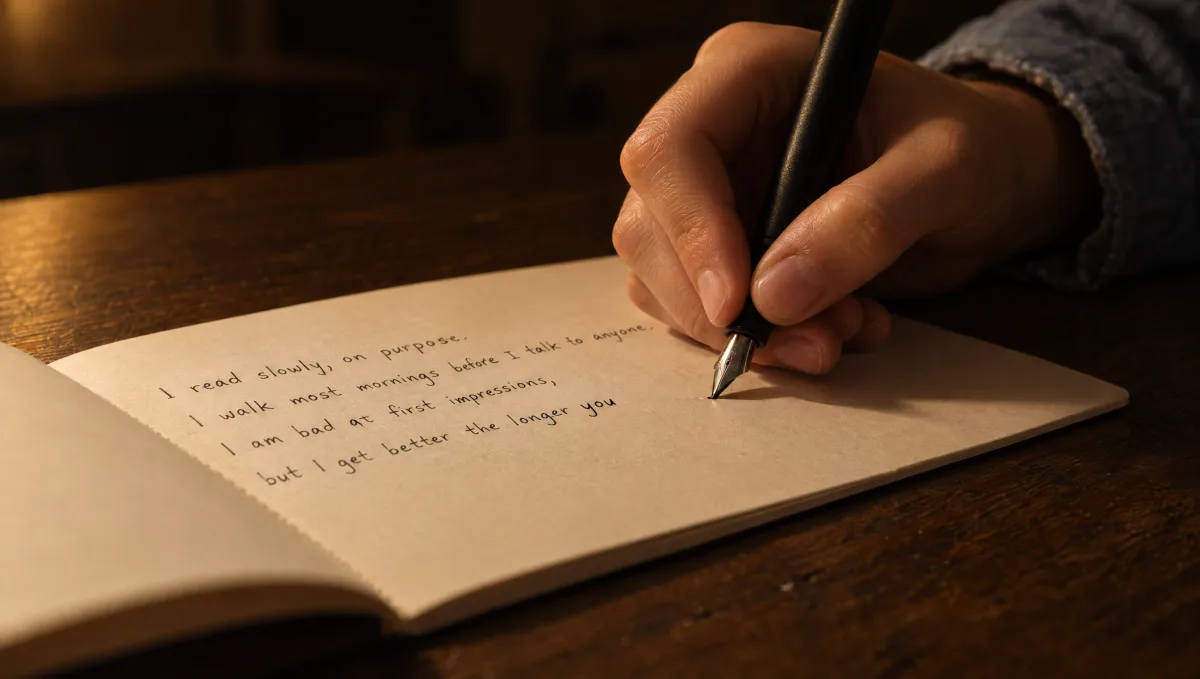
The fastest way to feel the difference is to open a blank page and see how far you get before a photo would have mattered at all.
Because a face is processed almost the instant it appears, and a swipe interface asks for nothing more than that instant. One study of real dating-app decisions found people decide in under a second — before personality, intent, or anything typed ever gets weighed (Chopik & Johnson, 2021, Journal of Research in Personality). Nothing about that speed is a flaw in any one app — it is what a photo, by itself, is built to produce.
A photo grid is built around that speed, not against it: reject in under a second, and the queue refills instantly. A page of paragraphs cannot be judged that fast, so a text-first surface cannot borrow the same one-second reflex even if it wanted to — someone has to actually read a sentence before the sentence can be dismissed.
On a photo-first app, the picture does the filtering before anything written is ever opened — which is why the study above found writing barely moves anyone's odds once a photo is in the frame. Take the photo out of the sequence and there is nothing left to filter on until someone has actually read something: the whole page gets a first look on its own terms, not on whatever a thumbnail decided first.
Eye-tracking research on real dating pages backs this up from the attention side: pictures pull the eye first, and more attractive pictures receive more attention, while a block of text gets read at close to the same rate regardless of how good the picture next to it is (van der Zanden, Mos, Schouten & Krahmer, 2021, Communication Research). Remove the picture and that head start disappears — the writing is the first thing there is to look at, because it is the only thing there.
A first message on a photo-first app usually has nothing to reference except a face, which is why so many of them read the same — a greeting, maybe a line about a shared interest tag. A first message written after reading someone's actual sentences can quote a line back to them instead, which is a different kind of opener entirely: it proves the message was written for that person and not copy-pasted down a queue.
On Anketta this is built into the mechanic itself: you underline a phrase in someone's manuscript that you responded to, then press the heart, and a mutual heart is what makes a match — there is no swipe gesture standing in for that decision. A manuscript can also be handed to someone directly, before either of you is inside a queue at all: once it is approved, it gets a shareable link with a QR code attached, a route into first contact a photo grid never had, because there was never a document to send in the first place. Anyone reading it who hasn't matched with the writer yet still sees the writing in full, with a phone number, email, or address quietly blurred out until they do, through PII blur — a protection a page of prose needs and a photo never did.
Yes, but not by the same shortcut. A photo carries almost no signal you can check against anything — attractive or not, there is nothing in it to analyze for honesty. Writing does: a 2010 study of real dating pages found that deceptive self-descriptions correlated with fewer self-references and fewer words overall than honest ones, a pattern a computer could pick out from word choice alone (Toma & Hancock, 2010, ACM CSCW). A misjudgment is still possible — but it leaves something behind to notice, which a face never does.
None of that makes reading foolproof. It just gives you more to go on than a face ever did.
Add a sentence worth underlining to the queueOn a photo-first app, a wrong decision is cheap to make and cheap to reverse — the whole exchange took under a second, so a queue absorbs thousands of them without anyone noticing the cost add up. It adds up anyway: in Pew's 2023 survey, ever-users of dating sites and apps came out close to split on how the whole experience felt, with slightly more calling it positive than negative — 53% to 46% (Pew Research Center, 2023).
Reading first does not make a bad match free — it moves the cost earlier instead of later. Writing something worth reading, and reading someone else's writing before underlining anything, takes real time a one-second swipe never asked for. What it buys back is a floor under how little information a decision can run on: nobody gets rejected, or accepted, on nothing at all. You can try writing the first paragraph yourself and feel what that floor actually does to the decision.
Line up the four mechanics side by side and the same pattern holds across every one of them: a photo-first surface resolves fast, on one signal; a text-first one resolves slower, on more of them.
| Mechanic | Photo-grid model | Text-first model |
|---|---|---|
| Discovery | A photo pre-filters before any text is opened | Nothing to filter on until the writing is read |
| First contact | Openers reference a face or a shared tag | Openers quote an actual line back |
| Being read | No checkable signal beyond the image itself | Word choice and length carry a detectable signal |
| Cost of a bad match | Near-zero per decision, absorbed by volume | Higher per decision, spread across fewer of them |
Neither model is a trick being played on the other. A photo-grid app is built for volume; a text-first one is built for what survives being read — and which cost a person would rather pay first is most of what decides which one they reach for.
Is a "queer dating app" the same thing as a text-first dating app?
Not automatically, but they overlap because appearance-based filtering carries a cost that shows up disproportionately in searches for queer dating apps specifically. Some queer dating apps still lead with a photo grid; text-first is a design choice about ordering, not a label any app earns just by serving queer users.
Do text-first apps get rid of photos completely?
Not necessarily — some remove photos entirely, others just delay them. On Anketta, photos are optional and capped at three, and none of them appear anywhere before a mutual match; the decision to match is made entirely on writing, and a face is something you earn access to afterward, not something you filter on first.
Why would removing the instant photo filter reduce appearance-based bias?
Because the bias measured in swipe studies happens in the same fraction of a second the photo is judged — before intent, personality, or anything written gets weighed at all. Take the instant judgment out of the sequence and there is no moment left in which appearance alone can decide anything on its own.
Is a longer written page always the safer bet?
No — length by itself is not the mechanism. What matters is that there is something to read at all before a decision gets made; a short manuscript still has to be read, while a photo, long or short, gets judged in under a second regardless of how much thought went into it.
Does reading before matching slow down getting an actual date?
It changes where the time gets spent rather than adding it outright. A photo-first app spends almost no time before a match and more time afterward sorting out who someone actually is; a text-first one spends that time earlier, before either side commits to anything.
Can you still see what someone looks like before you match?
On most photo-first apps, yes — that is the whole first screen. On a text-first app built around delayed photos, no: there is nothing to look at before the writing is read, and a face becomes visible only once a match already exists.
A photo grid asks to be glanced at. A manuscript asks to be finished — and by the time it is, whatever verdict a photo would have rushed has already had to wait its turn.
Unsure about writing? Try reading first.