Dating After 40: How to Date With Intent, Not Apology

Yes — and the difference works in your favor. Dating after 40 is the first time most people approach romance already knowing their non-negotiables and how little patience they have for performance. According to the Pew Research Center, about four-in-ten U.S. adults (42%) say online dating has made the search for a long-term partner easier (Pew Research Center, 2023). What changes after 40 isn't the tooling — it's that you finally read the room before you read the profile.
The trap is treating midlife dating as a remedial version of your twenties. It isn't. The clarity you've earned — about who you are, what bores you, what you'll never tolerate again — is the single biggest advantage anyone brings to the table, and most apps are built to ignore it. They reward a flattering photo and a snap judgment, then ask you to compete on the one axis time keeps changing. The smarter move is to date on the axis that improves with age: what you can say about yourself, and what you notice in someone else.
Photo-first apps run on rapid visual judgment, and that's exactly the game where a 25-year-old has a structural edge. The format asks you to lead with the thing age complicates and bury the thing age improves — your point of view. So the 40-plus dater ends up apologizing for the medium instead of using it. The apps aren't cruel; they're just optimized for a metric — first-glance attraction — that has almost nothing to do with whether you'll still want to talk to this person in a year.
There's a deeper mismatch underneath the photo problem. Swipe apps assume an abundance mindset — keep scrolling, someone better is one card away. After 40, most people have moved past that. They want fewer, better conversations, not an infinite deck. A 2019 study published in PNAS found that meeting online has become the most popular way U.S. heterosexual couples meet, eclipsing introductions through friends — about 39% met their partner online by 2017 (Rosenfeld et al., 2019). Online is where the partners are. The question is whether the format respects the kind of dater you've become.
Write the version of yourself you'd actually want to meetDating with intent means leading with your actual life instead of a curated highlight reel. It's stating, plainly, what you're building toward — and letting that filter out the people who aren't. After 40, the goal isn't maximum matches; it's the right match found faster, with fewer rounds of mutual disappointment. Intent is a feature, not a buzzword: it's what turns three real conversations into something, instead of thirty hollow ones into nothing.
The data backs the instinct. Pew found that divorced, separated, or widowed adults (36%) are more likely to have tried online dating than people who are currently married — the previously-partnered come to it with a reason, not boredom. A few principles that travel well into your 40s:
- Name the non-negotiables early. Kids, location, faith, whether you want marriage again — say it in the first paragraph, not the third date.
- Lead with a life, not a list. "I run a small bakery and read at the lake on Sundays" beats five adjectives every time.
- Treat clarity as kindness. Telling someone what you want spares you both the slow-motion mismatch.
- Stop auditioning. You are not the one being evaluated for the part. Neither is the other person.
- Let the format do the filtering so you spend your energy on people, not on swiping.
There's no universal timer, but the readiness signal is consistent: you're ready when you're dating toward something rather than away from loneliness. Post-divorce dating goes wrong when it's an anesthetic and goes right when it's a deliberate choice. The previously-married actually have an edge here — you know what a real partnership demands, and you know which compromises quietly corroded the last one.
The practical shift is from grief-driven to intent-driven. That's where a text-first approach helps: writing about who you are now — not who you were at the wedding — forces the kind of reflection that tells you whether you're ready. If you want the longer treatment, dating in your divorced 30s and 40s covers the emotional logistics in depth, and the same clarity applies whether there are kids in the picture or not. The point isn't to rush or to wait — it's to date on purpose.
| The old playbook (your 20s) | Dating after 40 |
|---|---|
| Maximize options | Optimize for fit |
| Lead with a photo | Lead with who you are |
| Play it cool, reveal slowly | Say what you want early |
| Fear of missing out | Confidence in walking away |
| Performance and audition | Honesty as the filter |
| Endless swiping | Fewer, deeper conversations |
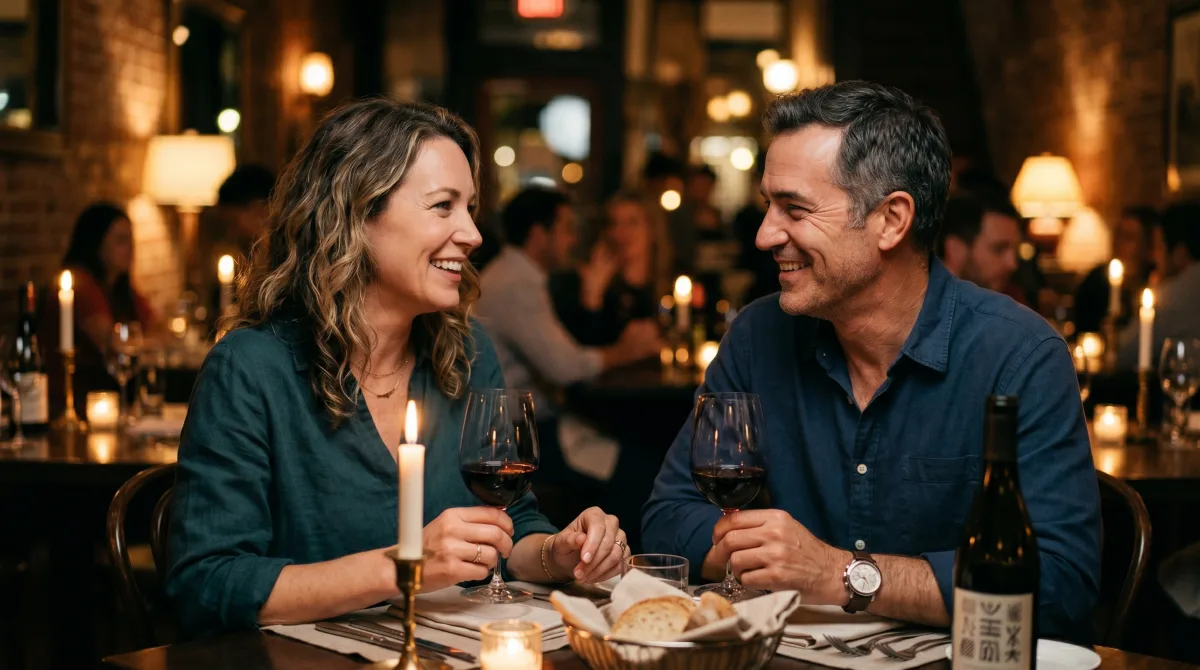
For someone who already knows what they want, text-first dating is the more honest format. Instead of a grid of faces, you read a person — their voice, their priorities, the way they think — before you decide anything. Anketta has no photo before you match: you're matched on a free-form written manuscript, so your first impression is made of sentences, not selfies. It's personality-first matching in practice: character leads, appearance comes a distant second. For a confident 40-plus dater, that removes the one game age makes harder and centers the one that age makes richer.
The mechanism is built for clarity. As you read other people's manuscripts and highlight the phrases that resonate — "loves to cook," "wants kids," "left the city for good" — the algorithm learns your real preferences from what you mark, not from a checklist you filled out once. The more you read and highlight, the more the queue narrows toward people who actually fit. It's the opposite of starting over from zero: your taste, refined over four decades, becomes the filter. If photo fatigue is your real complaint, the broader case for text-based dating lays out why words carry more signal than faces.
Let your words do the filtering — start your manuscriptYou protect it by choosing a format where less of you is exposed by default. By 40, most people have a career, a home, sometimes children, and a name worth keeping out of a stranger's screenshot. The safest first contact is one where contact details and identifying specifics aren't visible until you've both chosen to connect. That's a structural protection, not a setting you have to remember to switch on.
On Anketta, contact details like phone, email, and address are blurred for anyone who hasn't matched with you — the server simply doesn't send the raw text to non-matched viewers, so there's no inspector trick to reveal it. After a mutual match, it unblurs for both of you automatically. For a dater with a life to safeguard, that means you can write candidly about yourself without handing a stranger the keys — the same discretion that makes the format work for lawyers and other professionals with a reputation to protect. Privacy stops being a chore and becomes the default shape of the conversation.
No — slower-feeling dating is usually faster to the right person, because it spends less time on the wrong ones. The premise of slow dating isn't delay for its own sake; it's removing the noise that makes you waste weeks on mismatches. When the format front-loads who someone is, you skip the long ambiguous middle where you're texting someone you'd never have chosen if you'd known them first.
Anketta's matching adds a deliberate beat: when two people both signal interest, a 48-hour window opens to start talking. If neither walks away, the match becomes permanent and the app collapses to just that conversation — the browsing surface locks until it ends. For someone who's tired of juggling six dead-end chats, that single-focus design is the relief, not the constraint. You're not dating slower. You're dating one real person at a time.
Is it harder to find love after 40?
It's different, not harder. Pew found 42% of adults say online dating has made finding a long-term partner easier, and divorced or widowed adults try it more than married ones. The real obstacle isn't your age — it's using apps built to reward a snap photo judgment instead of the clarity you've earned.
What's the best dating app for someone over 40?
The best format for an over-40 dater is one that leads with who you are, not how you photograph. Text-first apps like Anketta match on a written manuscript and learn your preferences from what you highlight while reading — so your decades of self-knowledge become the filter, instead of a liability.
How do I start dating again after a divorce?
Start by writing about who you are now, not who you were married. Date toward something rather than away from loneliness, name your non-negotiables early, and pick a format that lets you read a person before you commit attention. Readiness shows up as intent, not as a fixed number of months.
Should I mention my kids or my divorce in my profile?
Yes — early and plainly. The previously-married come to dating with a reason, and stating your real situation upfront filters out mismatches before they cost anyone time. Honesty isn't a turn-off after 40; it's the single most attractive signal that you know what you want.
Is online dating safe for older adults?
It's as safe as the format you choose. The safest first contact keeps identifying details hidden until both people opt in — Anketta blurs phone, email, and address for anyone you haven't matched with, server-side, so there's no workaround. You control who learns the specifics, and when.
Do I need photos to date after 40?
Not on a text-first platform. Anketta has no photo before you match — you're matched entirely on what you write. For a dater who's tired of optimizing selfies, removing photos takes away the one axis that age complicates and centers the one that age improves: your point of view.
You spent forty years becoming someone worth knowing — write that down and let the right person read it.
Unsure about writing? Try reading first.