Dating for Chess Players: When Board Sense Backfires
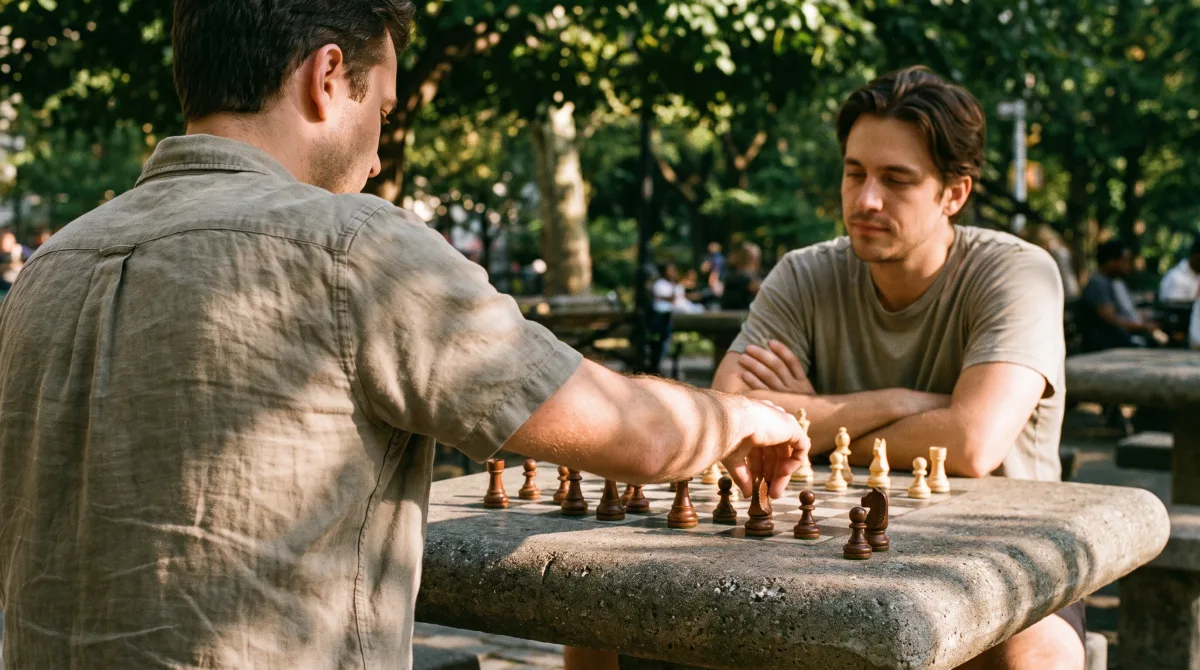
Chess trains you to evaluate a position before you commit to a move — check the threats, count the material, look a few moves past the obvious one. The average single spends $213 a month on dating, according to Match and the Kinsey Institute's Singles in America study (2025) — money that disappears fastest when you're reacting to a profile instead of reading it. Chess players already have the discipline that prevents that kind of waste. Most dating apps are built to switch it off.
On Anketta there's no photo to glance at before you decide anything, and there's no gesture to swipe. You read someone's manuscript, highlight the lines that actually land, then press the heart — closer to reading a position than reacting to a thumbnail. It tends to be the first dating format that rewards the instinct chess already gave you instead of asking you to override it.
Read a manuscript before you decide anythingBecause the two skills are opposites. Chess spends years teaching you to sit with a position and check candidate moves before acting. Dating apps run the other way: a 2021 Michigan State University study found that people size up a profile and decide interest in well under a second, mostly on looks — Chopik and Johnson (2021) put it plainly: daters are willing to decide whether they'd like to meet someone in less than a second.
That's not a small mismatch — it's the exact skill chess spends years training out of you. A 2025 study in the Journal of Intelligence tested club-level chess players against non-players on planning and cognitive-reflection tasks and found the chess group scored far higher on both. The same study found chess players chose a bigger, later reward over a smaller, immediate one more often, too — chess players (M = .493) chose the future option nearly twice as often as non-players (M = .238), according to Campitelli, Labollita and Bilalić (2025). That's a mind built around resisting the pull of right now. A profile card that vanishes if you don't decide in a second is built to reward exactly the opposite.
| Chess trains you to | What the swipe format rewards | What that means for you |
|---|---|---|
| Evaluate the whole position before you move | React to a photo in under a second | Reading fully feels like hesitation on an app built for speed |
| Calculate several moves ahead | Judge only the card in front of you | Long-game thinking has nothing to attach to |
| Resign, shake hands, reset for the next game | Disappear instead of saying no | The etiquette you already have has no equivalent here |
None of that means the instinct is wrong. It means the format is testing the wrong skill — and the format most dating happens in got a lot more crowded with chess players than it used to be.
The audience got bigger and a lot younger before it got any older. Chess.com's membership crossed the 200-million mark somewhere around the pandemic streaming wave and Netflix's The Queen's Gambit, and most of the new players found the game through a Twitch stream or a friend's phone, not a rated federation club. If your mental picture of "a chess player" is a retired grandmaster hunched over a board in silence, that picture is a decade out of date.
That matters for dating because the stereotype the format still carries — older, male, awkward around anyone who isn't also staring at 64 squares — describes almost nobody actually logging in this decade. Club nights that used to draw six regulars now draw sixty, and the median new member skews closer to college-aged than retired. Write this article for the club player who shows up three nights a week and the casual player with a 900 rating and a Discord server, not for a grandmaster — that's who's actually reading it.
Sometimes, yes — and it's the most common complaint chess players hear about themselves in dating. The habit that stops you from playing a move before you've checked it looks, across a table, like disengagement: a long pause reads as boredom in conversation the way it never does over a board. The fix isn't dropping the patience. It's narrating it — say what you're actually weighing instead of just weighing it silently.
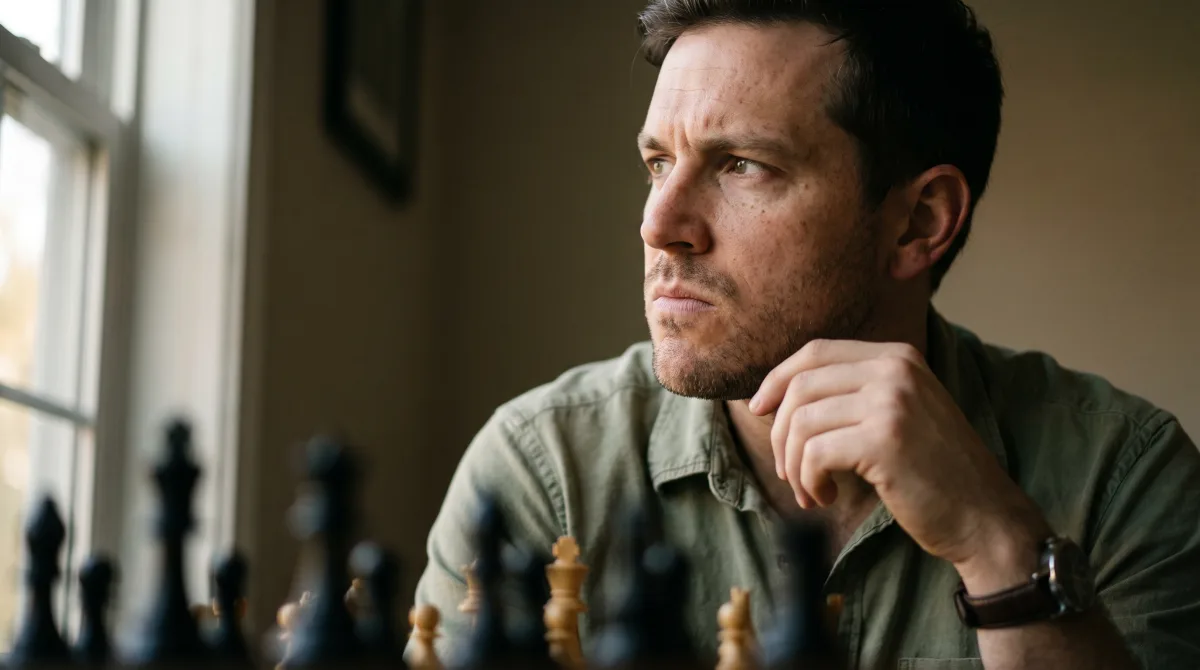
"Sorry, I was thinking" is a normal sentence at a chessboard and an alarming one on a date — unless you say the rest of it: what you were thinking about. A pause with a reason attached reads as attentive. A pause with no reason attached reads as somewhere else entirely.
Yes, and it's the second most common complaint. The instinct that calculates an opponent's plan can turn small talk into cross-examination — rapid questions, a correction mid-sentence, a first date treated like an opening you need to refute rather than a conversation you're having. None of that is unique to chess; it's what unmanaged competitiveness does in any hobby. Chess just trains it harder than most.
"The chess lesson for life is often framed as the importance of being one step ahead of your opponent, but I think that aim is to challenge ourselves to push beyond our cognitive comfort zone." — Jonathan Rowson, grandmaster and author of The Moves That Matter
That's a more useful reading of the game for a date than "stay one move ahead of them." The comfort zone chess is actually asking you to push past isn't your opponent's defenses — it's your own instinct to keep everything calculated. A first date isn't a position to solve.
Fewer of them are meeting anyone at a board at all, which is most of the problem — online play replaced the walk-in club for a lot of casual players, and online play doesn't introduce you to anyone. Five places still work, in roughly descending order of how likely they are to also produce a date:
- Local chess clubs. Post-boom membership means more clubs run a social night alongside the rated one — check for anything billed as "casual" or "blitz night," not just the tournament calendar.
- Chess.com and Lichess team leagues. Team battles and club chats build a real social layer around the games, not just a rating ladder — several club Discords have their own off-topic channel where people actually talk.
- Tournament weekends. Long time controls mean long breaks between rounds — the skittles room, where people replay their games and argue about the position, is a better environment to actually meet someone than the playing hall.
- Chess bars and cafés. A growing number of cities have one now — a room built around people who want to play a casual game with a stranger and then keep talking.
- A text-first dating app. For everything a board doesn't solve — meeting someone who isn't already in your club, at a time you actually choose — a format built around reading someone before you decide anything does more of the pattern-matching work chess already trained you to distrust.
Skip "I play chess." It's a fact, not a signal, and it's already in a third of the profiles a chess player will ever read. Write about one specific game, one specific loss, one specific rivalry — the concrete detail chess conversation trains you to reach for constantly and that dating profiles almost never contain.
- Don't: "I like chess and reading."
- Do: "Lost a completely winning endgame to a nine-year-old at a park table last spring, and I still replay the rook trade that did it."
The second version gives a reader something to ask about. The first gives them nothing to respond to except "cool." If intelligence itself is what you're actually optimizing for rather than chess specifically, dating for sapiosexuals covers the same photo-blindspot problem from a different angle.
Write the version with the rook trade in itTreat the invitation as the opening move, not the whole game — set a place and a time in the same message instead of leaving it open. "Let's play chess sometime" with no follow-up is the dating equivalent of thinking forever on move one: technically still your turn, practically over.
Naming a place removes the only real obstacle, which is that neither of you wants to be the one who suggests something and gets turned down. A board is also, unusually among first-date formats, one where silence is expected — which makes it one of the lower-pressure ways to meet the person behind a manuscript you already liked. The same logic runs through dating as a gamer: a shared game is a real activity you can actually do together, which is a far better first date than an interview across a small table.
Is chess actually a good way to meet people to date?
It's a good way to meet people, not automatically a good way to meet people to date — most club and online chess spaces skew toward the game first. Treat it as a place to build a normal social circle that occasionally produces a date, not a dating strategy on its own.
Should I put my chess rating in my dating profile?
Only if you can explain what it means in one sentence — a bare number reads as either bragging or gibberish to anyone outside the game. "I'm a 1400 who still loses to my little brother" tells a story a rating alone never does.
Why do chess players specifically struggle with swipe-based apps?
Chess trains you to evaluate fully before acting, and swipe apps are built to reward a decision made in under a second — Chopik and Johnson (2021) found that's roughly how long most people actually take. The two skills work against each other directly.
Is Chess.com or Lichess actually useful for meeting people?
Not directly — a rating ladder isn't a dating pool. The club and team-league features around both sites are the part that's actually social; look there, not at the play queue, if meeting people is the real goal.
Does the "chess boom" mean the pool of chess players actually changed?
Yes — it got much younger and far more casual. Most new players since 2020 found the game through streaming or a phone app, not a federation club, so "a chess player" now describes a much wider range of people than it did a decade ago.
How do I ask a chess player out without sounding like I want a rematch?
Be specific about the invitation, not the game — "coffee Thursday" beats "we should play sometime" for the same reason a concrete profile detail beats "I like chess": vague invitations get vague answers, and specific ones get real dates.
Chess doesn't need to be fixed for dating, and neither do you — the same patience that makes a five-hour game bearable is the same patience most modern dating formats have trained everyone to lose. If the interrogation habit or the long-pause habit sounds like it's coming from somewhere older than the board, an anxious attachment style can produce both, chess or not — worth knowing which one you're actually working with. Play the position in front of you instead of the one you're used to, and the rest of the game tends to follow.
Unsure about writing? Try reading first.