Dating for Gamers: What Co-op Play Reveals That a Bio Tag Never Will

Almost nothing, and the honest answer is worth sitting with for a second. "Gamer" on a bio is one word competing for space with "dog person" and "tries every new coffee shop" — it tells a match that a category exists, not what's actually in it. Someone who spends four evenings a week coordinating a raid with the same six people is filed under the identical tag as someone who plays one aggressive round of a shooter to unwind after work. The tag can't tell those two people apart, and a swipe app was never built to ask it to.
A 2025 study from the University of Washington's Human Centered Design & Engineering program, presented at the ACM Designing Interactive Systems conference, looked at how long-distance couples actually use games together — and found significant differences in couple play styles even among partners who both self-identify as gamers. Two people can share the hobby and still be playing two different games, emotionally. On Anketta there's no tag for "gamer" to begin with — the manuscript is free-form text, so the only way to talk about gaming at all is to actually describe how you play, which turns out to be the more useful information anyway.
Write the version of your gaming life a tag can't holdCo-op and competitive players are optimizing for different things, and that difference shows up off-screen too. A co-op player is used to splitting objectives, covering someone else's mistake without turning it into a whole conversation, and sharing credit for a win that took four people to pull off.
A competitive-ladder player is used to being evaluated on individual performance, tracking their own numbers, and treating a loss as information to work with rather than a group failure. Neither instinct is wrong — but a household where one partner reflexively shares and the other reflexively keeps score is a household that will eventually have that argument about something other than video games.
| Play style | What it looks like | What it tends to reveal | Pairs well with |
|---|---|---|---|
| Co-op | Splitting objectives, covering a teammate's mistake without comment | Comfort sharing credit, patience with someone else's learning curve | Another co-op player, or a competitive one who likes mentoring |
| Competitive / ranked | Solo climbs, tracked stats, replaying a loss to see what went wrong | How someone handles being outplayed in the moment | Someone who reads drive as drive, not as hostility |
| Party / social | Games as the excuse to be on a call with friends | Prioritizes company over the objective | Another social player — a rough fit for a solo completionist |
| Solo / completionist | Long single-player runs, every side quest before the main story | Finishing things fully, patience with a slow payoff | Someone who doesn't need shared screen time to feel close |
More than their behavior when they're winning, if you're paying attention. Anyone can be pleasant after a clean win — the interesting data point is what happens ninety seconds after a bad loss that wasn't their fault. Does the frustration land on the teammate who missed a call, or does it stay contained? Does the person ask "what do we try differently," or does the controller get set down mid-sentence?
None of this is really about the game. It's a low-stakes, repeatable preview of how someone handles frustration that involves another person — a preview most first dates never get to see, because nobody loses anything together on a first date. Attachment style research covers a version of the same pattern in higher-stakes settings; a video game just makes it visible early, cheaply, and often.
This is a scheduling-compatibility question wearing a gaming costume, and it matters more than most people admit up front. A fixed weekly raid night with the same guild is a standing commitment, the same way a recurring dinner reservation is — someone whose week doesn't bend for it is going to feel like they're competing with five strangers for attention.
Async, drop-in-when-you-can gaming is the opposite: lower commitment, lower friction, easier to fold around a partner's schedule, but also less of a shared ritual. Neither is better. They're just different answers to "how much of my week is already spoken for," and it's worth knowing which one you're actually looking at before three months in.
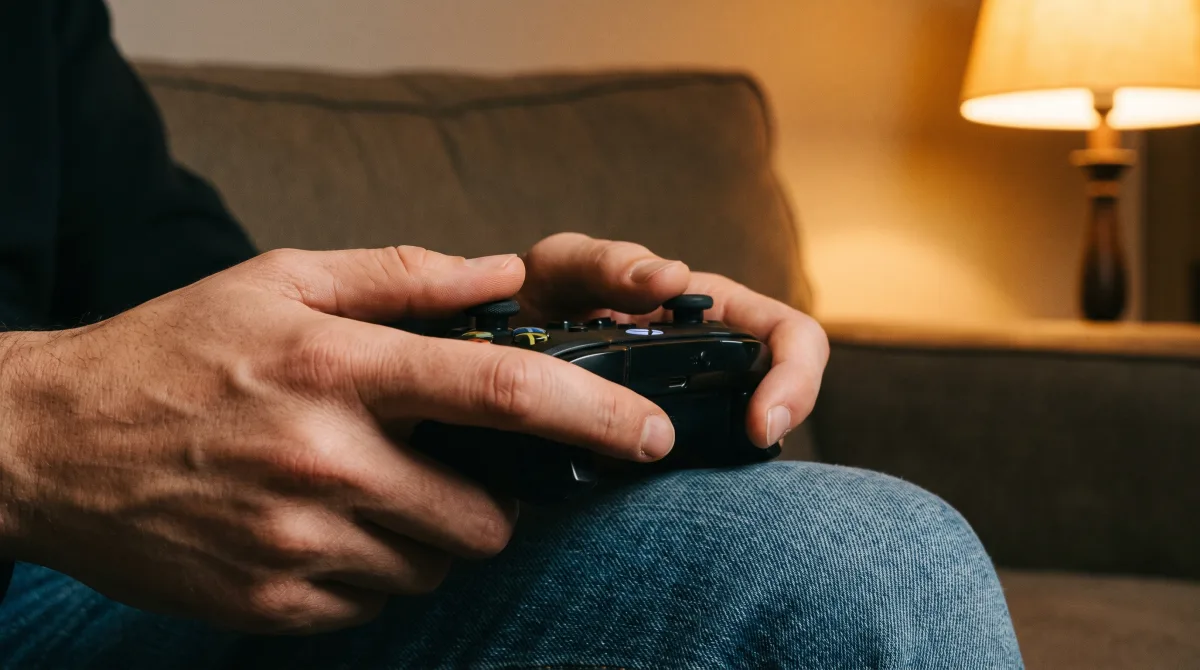
The research leans toward "it helps, with a condition attached." A 2020 dyadic study in Cyberpsychology, Behavior, and Social Networking, drawing on data from 6,756 couples across 16 countries, found that individual video game use was linked with improved rates of partner dyadic adjustment — but the effect depended on whether the non-gaming or less-gaming partner actually accepted the habit, not just tolerated it.
That's the condition dating apps skip past entirely: a "gamer" tag says a person plays. It says nothing about whether their partner needs to approve of that, or whether the couple has to actively negotiate around it. A manuscript that describes an actual gaming life — how many evenings it takes, what it means to the person writing it — lets a reader self-select into that condition before a first date instead of discovering it three months in.
Describe your gaming life the way it actually runsSpecificity is the whole trick, and it's the one thing a checkbox structurally cannot deliver. A manuscript that names games, habits, and what gaming actually means logistically will always out-signal the word "gamer" sitting alone on a profile.
- Name what you actually play, not the genre. "Co-op survival games with the same three friends since 2019" tells a reader something. "I like video games" tells them nothing they didn't already guess.
- Say what a normal week looks like. A standing Tuesday raid night is a different life than three unpredictable hours on a Sunday — write the one that's actually true, because the other person will find out either way.
- Mention how you play with other people, not just what you play. Whether you're the one calling shots, the one covering mistakes quietly, or the one who plays for the company more than the objective — that's the part dating for programmers readers will also recognize: the hobby is the container, the behavior inside it is the actual signal.
- Skip the defensive framing. Nobody who reads a full manuscript before matching needs "not a basement-dweller, I promise" — the writing itself already proves the point better than a disclaimer could.
Chess players hit the same wall from the opposite direction — a game with centuries of prestige behind it, still reduced to one word on a profile that says nothing about how the person behaves across a board.
The failure mode to avoid is writing "gamer" as if it's a complete sentence. It was never going to be one.
Is being a "gamer" actually a good thing to put on a dating profile?
It's not wrong, just incomplete — a single tag competing with dozens of other one-word interests for attention. Naming what you play and how you play with others carries far more compatibility signal than the label alone, and takes about the same effort to write.
Do competitive gamers make worse partners than co-op players?
No — the research points to fit mattering more than which style is "better." A competitive player paired with someone who reads their drive as intensity rather than aggression, or a co-op player paired with someone equally comfortable sharing credit, both work. Mismatched expectations about scorekeeping are the actual friction point.
Should I mention streaming or a public gaming profile in my manuscript?
If it's part of your real week, yes — and phone, email, and address stay server-blurred for anyone you haven't matched with, so writing about a public gaming identity doesn't hand a stranger your contact details along with it.
How much detail about gaming is too much for a dating profile?
There's no fixed length on Anketta's editor — no word count, no intake questions. The useful measure is whether a reader comes away actually understanding your week, not whether you've hit some target. A specific paragraph beats a vague one at any length.
Can two people with completely different play styles still be compatible?
Yes, as long as neither expects the other to convert. A competitive ladder player and a cozy-game completionist can coexist fine — the friction usually isn't the genre gap, it's one partner quietly expecting the other to eventually "get into" their game.
Does Anketta match people based on shared gaming interests?
Not on the game title itself. Highlighting a phrase in someone's manuscript as a like teaches the recommendation model to surface more writing that mentions similar things — so if you highlight the way someone describes their raid nights, you'll see more writing like that, without either of you ever filling out a hobby checkbox.
A raid night and a ranked ladder are both just an evening with a controller in your hand — write the sentence that says which one you actually are.
Unsure about writing? Try reading first.