Sikh Dating: When Your Faith Is the First Thing They See

A Sikh who keeps kesh and wears a dastaar carries his faith into the first frame of every photo, before a single sentence gets read — and a stranger's read of that frame is wrong more often than not. Stanford researchers working with SALDEF found that roughly 70% of Americans cannot identify a photographed Sikh man as Sikh at all (Stanford University & SALDEF, "Turban Myths," 2013). That gap between what a dastaar means and what a stranger decides in half a second is what this piece is about, for anyone who wears one and is trying to date.
On Anketta, that first frame doesn't happen yet. No photo appears anywhere before a match — not while browsing, not while reading someone's manuscript — so a dastaar sits behind the manuscript instead of in front of it. What a visibly Sikh dater controls first is the sentence, not the silhouette — you can test that yourself in a few lines.
Write the sentence a photo would have made for youSikhi is not a branch, sect, or reform movement of Hinduism, and it has no relationship to Islam either — it is its own religion, founded by Guru Nanak in 15th-century Punjab, with its own scripture, the Guru Granth Sahib, and its own line of ten Gurus. The confusion isn't academic on a dating profile: the same Stanford-SALDEF survey that measured turban misidentification found that about half of Americans believe Sikhism is a sect of Islam (Stanford University & SALDEF, "Turban Myths," 2013).
It shows up in small moments more than large ones — a match assuming the dastaar is a Hindu headwrap, or asking whether "Sikh" rhymes with "seek" because they've never seen the word written down. None of it is usually malicious. It's evidence of how thin the public information really is, which is exactly why naming the religion plainly, once, early, tends to do more work than paragraphs of explaining later.
No. Most Sikhs have Punjabi heritage, but Punjab is also home to large Hindu and Muslim populations, and there are Sikhs with no Punjabi background at all, in India and across the diaspora. The practical rule for dating writing: if a custom is regional Punjabi practice rather than Sikh religious practice, say which it is — the two get flattened into one identity constantly.
A wedding dance, a particular festival dish, a way of toasting a celebration — plenty of what gets filed online as "Sikh culture" is Punjabi regional culture that Hindu and Muslim Punjabis share too. The dastaar and the kesh are religious. The bhangra at a friend's engagement almost certainly isn't. Getting that boundary right matters more here than in most identity writing, because the conflation runs in both directions — Punjabi-ness read as automatically Sikh, and Sikh-ness read as automatically Punjabi — and blurring it repeats the exact error this piece is arguing against.
Several — treating them as one flattens something real. An Amritdhari Sikh has taken formal initiation, the Amrit Sanskar, into the Khalsa, and keeps all Five Ks, including the kirpan. A Sikh who keeps kesh and wears a dastaar without that initiation carries the same visible identity minus the formal commitment. A Sikh who has cut their hair carries the same faith with none of the visible markers at all. None of the three is the "real" version.
| Practice | What it looks like | What changes for dating |
|---|---|---|
| Amritdhari (initiated) | Uncut kesh, dastaar, all Five Ks including the kirpan | Faith is visible and a formal commitment is now part of daily life — questions about the kirpan tend to come up early |
| Kesh-keeping, not initiated | Uncut kesh, dastaar, no Amrit Sanskar taken | Faith reads just as visibly to a stranger, without the added layer of initiation — the misidentification risk above applies in full |
| Cut hair, no dastaar | No visible religious markers | Faith isn't legible on sight at all — the dating reality is closer to any other diaspora dater's, minus the specific problem this piece is about |
None of this is a hierarchy of devotion. It's a description of what a photo, or the absence of one, actually has to carry.
Documented harm, not hypothetical offense. A 2010 study of Sikh American men in the New York metro area found that turbans and long beards made them targets for verbal attacks and physical violence rooted in exactly the misidentification the numbers above describe (Ahluwalia & Pellettiere, Asian American Journal of Psychology, 2010).
A 2024 study of Sikh adults in the UK found the same pattern holding two decades later and an ocean away: its authors write that the turban has transformed from a sacred piece of attire for Sikhs to a target for discriminatory conduct (Brewer, Singh & Lyons, Journal of Interpersonal Violence, 2024) — appearance doing the targeting, not behavior. The pattern starts young. Sikh Coalition survey data, reported by American Community Media, found that an estimated 67% of Sikh American boys who wear turbans say they have been bullied at school for it — more than three times the general childhood bullying rate (Sikh Coalition data, via American Community Media, 2023). Whatever confidence someone carries into their twenties, some of it was built through exactly this.
None of it is universal, and it doesn't follow him into every room. Walk into a hall full of people who already share the context, and the reading reverses completely.
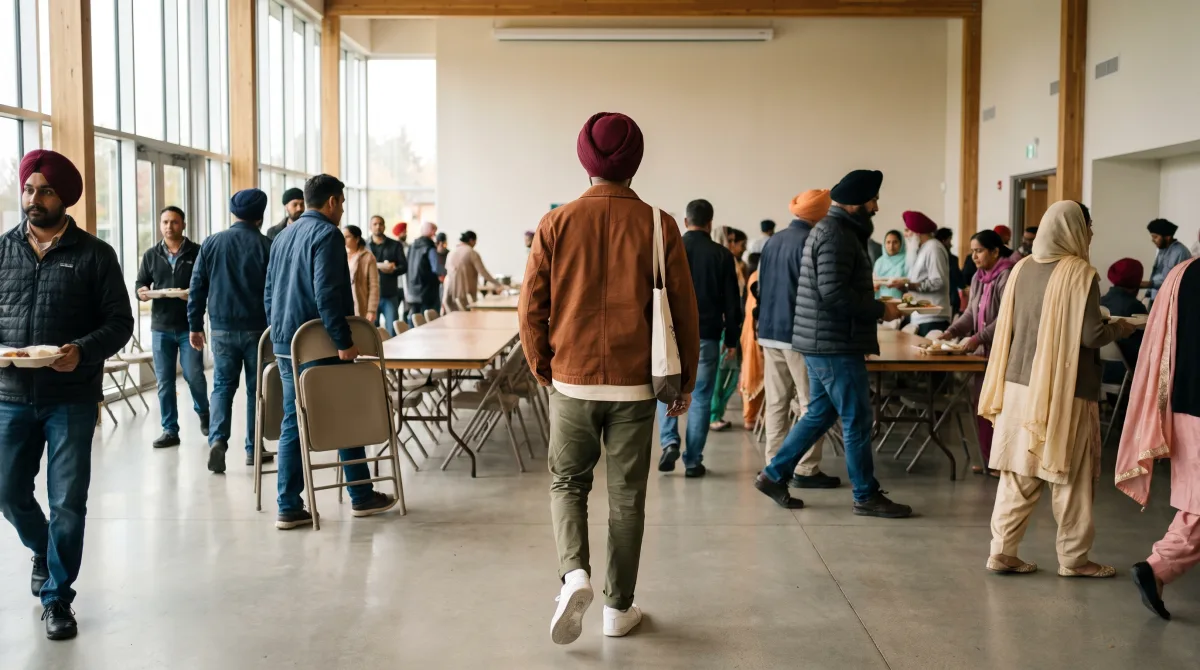
Dating sits in the gap between those two rooms — the one where he's a stranger's guess, and the one where he isn't a guess at all.
Enough to be legible as yourself, not enough to hand a stranger your whole life before they've earned any of it. Before deciding what to leave out, it helps to just open a manuscript and see the blank page for what it is. A manuscript rewards specificity — naming kesh, a dastaar, or a particular practice plainly does more work than a generic "spiritual but open-minded" line, because it answers the misidentification problem before anyone can misread a photo that doesn't exist yet.
- Name it plainly. "I'm Sikh" or "I keep kesh" does more work than any adjective standing in for it.
- Skip the biodata reflex. A Sikh matrimonial site collects a biodata — city, profession, age, height, the same census fields any biodata asks for regardless of faith. A manuscript asks a different question entirely: not the facts about you, but how you'd say them.
- Let one specific thing stand for the general. One real memory of serving in the langar teaches a reader more than a paragraph of religious vocabulary with nothing underneath it.
- Save the identifying details for after a match. Which gurdwara, which neighborhood, which employer — those can wait; pii-blur keeps them out of view for anyone who hasn't matched with you yet, so writing them costs nothing up front.
It changes the order, not the fact. A Sikh who wears a dastaar is still visibly Sikh the moment a match becomes a photo — nothing about text-first matching erases that. What changes is what comes first: a reader has already responded to a paragraph, a way of thinking, a specific memory, before a face enters the decision at all.
That's a small thing to promise and a real one to keep. Open the editor and write the paragraph a photo was never going to write for you — the specific langar memory, the joke about being asked if you're "that guy from the airport line" one too many times, whatever is actually true instead of generically spiritual.
Let the words carry the first impression, for onceIs Sikhi a religion of its own, or part of Hinduism?
Its own religion entirely, founded by Guru Nanak in the 15th century, with its own scripture, the Guru Granth Sahib, its own line of Gurus, and no doctrinal relationship to Hinduism or Islam. The conflation is common — plenty of Americans surveyed believe Sikhism is a sect of Islam — but it is a misconception, not a technicality worth skipping.
Is "Sikh" the same as "Punjabi"?
No. Most Sikhs have Punjabi heritage, but Punjab includes large Hindu and Muslim populations too, and Sikhs exist with no Punjabi background at all. Call something a Punjabi custom, not a Sikh religious practice, whenever that's actually the case — the two get flattened together constantly, in both directions.
What's the difference between an Amritdhari Sikh and someone who just keeps kesh?
An Amritdhari Sikh has taken the Amrit Sanskar initiation into the Khalsa and keeps all Five Ks, including the kirpan, as a formal religious commitment. A Sikh who keeps kesh and wears a dastaar without that initiation carries the same visible identity, and the same misidentification risk, without having taken that formal step.
What is a gurdwara, and what happens there?
A Sikh place of worship, built around the Guru Granth Sahib and open to anyone regardless of faith. Every gurdwara runs a langar — a free community kitchen serving a meal to all visitors — which is a core Sikh practice of equality, not an optional side event attached to it.
What is Anand Karaj?
The Sikh wedding ceremony — literally "blissful union" — performed in the presence of the Guru Granth Sahib and built around four rounds called Lavan that the couple takes together. It is a religious ceremony with its own liturgy, distinct from the separate question of how two people found each other.
Does a photo help or hurt a visibly Sikh dater on Anketta?
Neither — there isn't one to help or hurt until a match already exists. Photos appear only after a mutual match, and only to someone who has shared one back, so the dastaar or kesh a stranger might misread is never part of the decision that gets made first.
Is dating harder for a visibly Sikh man than for a Sikh woman who doesn't wear a dastaar?
The visibility gap is real and asymmetric — a dastaar and an untrimmed beard read instantly to a stranger in a way a woman's kesh under a dupatta, or a modern haircut, usually doesn't. That doesn't make either experience easier, just differently shaped: one gets misread on sight, the other more often gets assumed non-religious entirely.
A dastaar has never asked anyone's permission to be seen; what changes here is which sentence gets read first.
Not ready to write your own version yet? Reading first costs nothing, and it shows you exactly how much of this plays out in someone else's words.
Unsure about writing? Try reading first.