Dating for Coffee Lovers: Why 'Grab a Coffee' Tells You Nothing

Ten past seven, third in the queue, watching the door more than the menu. "Let's grab coffee" became the default because it is the cheapest hour with the easiest exit — a decision about logistics, not about coffee. It is also the least informative date format there is. A 2023 study in Scientific Reports played recordings of real places to 22 pairs of adults in a lab, clocked the café scene at 71.7 dB, and found they moved closer and lifted their voices inside the first 5 to 10 seconds (Miles et al., 2023).
Anketta has no interests field where somebody ticks "coffee" and moves on. The manuscript is a blank document, so a person whose Saturday runs on a grinder and a scale has to write that down in their own sentences — and a reader can tell that paragraph apart from the word "coffee" sitting in a list of six other words.
Write the Saturday morning, not the word "coffee"It is not a delivery system for caffeine. Four experiments published in Psychological Science in 2013 found that people who performed a small ritual before eating or drinking rated what followed as better than people who skipped it — and that the ritual had to be your own hands (Vohs et al., 2013).
That last part is the whole problem with the coffee date, stated by a lab that was not thinking about dating. Watching a barista do it is not the same event as doing it. The same experiments also found that waiting after the ritual made the eventual taste better still (Vohs et al., 2013) — which is a fair description of standing in a kitchen at seven in the morning while water finishes coming off the boil, and a terrible description of a takeaway cup handed to you mid-sentence.
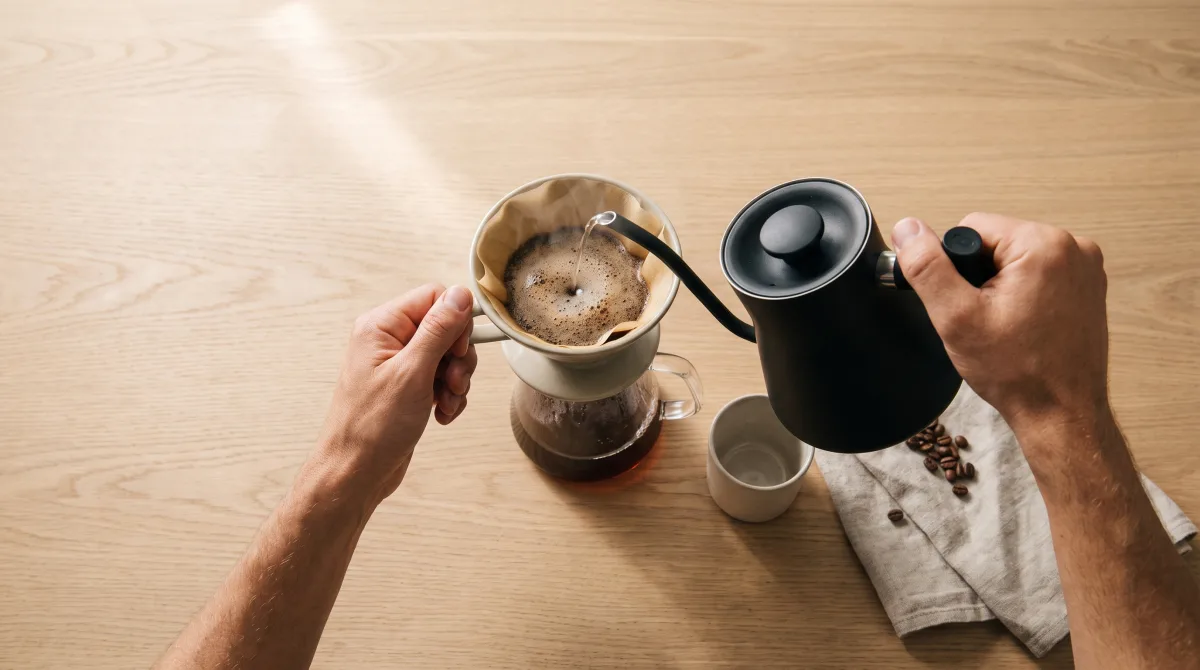
So the thing a coffee person loves is quiet, slow and mostly performed alone. Put it in the middle of a first meeting and it becomes something else: a prop to hold while you decide whether to stay.
Because the room starts working on both of you before either says anything worth hearing. In the same 2023 experiments, speakers raised their level by 3.2 dB the moment a partner signalled they had missed something, and past 78 dB the number of breakdowns climbed sharply (Miles et al., 2023). At 71.7 dB, a café sits just under that edge — close enough that nothing fails outright and everything costs a little more effort.
The effort goes somewhere, and it is worth naming what it comes out of:
- Volume, which flattens anything said carefully or half-seriously
- Distance, because you lean in for logistics rather than for warmth
- Repair, since every third sentence gets asked for a second time
- Attention, which is now split between the person and the grinder behind them
None of that ruins an hour. It does, reliably, push the conversation toward the sentences that survive being said twice at volume — which are rarely the interesting ones.
Structurally it is an interview, and a 2017 paper in the Journal of Personality and Social Psychology found that the interview is what gets rewarded. Across live conversations including a round of speed dates, people who asked more follow-up questions were better liked, and the speed daters who asked more of them were likelier to secure a second date (Huang et al., 2017).
Good news for the format, and bad news for the drink. An hour built around asking and answering is an hour where the cup is furniture. Nobody stops mid-question to notice that the cup in front of them has gone thin and papery as it cooled, and if they did, the other person would reasonably wonder where their attention had gone. Better to say the thing about the cooling cup in writing first, where noticing it costs nobody an awkward pause.
They use the same word and they are not the same hour. In one, coffee is an ingredient, and the hour exists to serve it. In the other, coffee is a room booking with a small bill attached, and the drink is whatever happens to be on the table while two people work out whether to keep talking.
| Coffee as the thing you love | Coffee as the cheapest meeting slot | |
|---|---|---|
| What the hour is for | The cup | The assessment |
| Pace | Unhurried, and often alone | Sixty minutes with a clean exit |
| Where attention goes | The grind, the pour, the first sip | The other person's answers |
| Who performs the ritual | You | Someone paid to, behind a counter |
| What the invitation promises | Nothing about coffee | Exactly what it delivers |
Neither column is the wrong way to spend an evening. The trouble is that "let's grab coffee" is the same eight letters in both, so the invitation carries no information at all — which is a strange fate for a drink some people plan their mornings around. This is the same reason dating with actual intent starts with saying what you are there for, before the venue gets to imply it for you.
Not a different café — a different shape of hour. The repair is not a better roaster or a quieter room; it is taking out the exit the format was built around. What does that is a second cup, a walk attached to the meeting, or a table nobody wants back before eight.
The first cup gets drunk badly and fast, while both of you are still nervous. The second arrives once that has worn off, and it is the first honest thing either of you tastes. A walk to the roaster works by the same trick: you buy beans, nobody has to sit across a small table performing interest, and the talking happens sideways instead of face-on. A terrace in the late afternoon removes the clock — the table is not wanted by anybody else, so the pauses stop being a problem to solve. That is the slower kind of meeting the format usually forbids: not a longer interview, but an hour where somebody can stop talking without it reading as a verdict.

The order changes, and the order is most of it. On Anketta there are no photos before a match and no swipe gesture; you read someone's manuscript, underline the lines that landed, and only then press the heart. So the first hour is not spent establishing that you both drink coffee. That was settled in writing, by whoever wrote the paragraph about the grinder that is slightly too loud for the flat at six in the morning.
The underlining is also what the recommendation engine watches. Mark "the second cup is the honest one" as a line you liked and the queue tilts toward manuscripts that talk that way, not toward manuscripts carrying a "coffee" tag. And once your own writing is approved, it gets a link you can hand over offline — a QR at a tasting, a URL in a message — with phone numbers and addresses blurred server-side until you actually match. Anketta's whole argument is that being read is a better introduction than being seen, and starting is free.
Is a coffee date a bad first date?
It is a good meeting and a bad venue for the drink. The format was chosen for its price and its exit, which makes it easy to accept and easy to leave — and also makes it the least revealing hour on offer, because everyone accepts it for different reasons.
Why do coffee lovers dislike the coffee date?
Because the ritual they care about is hand-made, slow and usually solitary, and a first date turns it into a prop. The 2013 Psychological Science experiments found the effect depends on performing the ritual yourself; watching a barista is a different event entirely.
Is a café too loud for a first conversation?
Louder than people assume. The 2023 Scientific Reports study measured a café scene at 71.7 dB, just below the 78 dB point where communication breakdowns start climbing steeply. Nothing fails outright — every sentence just costs a bit more, and the careful ones cost most.
What is a better first date for someone who loves coffee?
Anything with a second cup in it, or a walk to a roaster, or a terrace where the table is not wanted back. The point is not a fancier café. It is an hour where a pause is allowed to be a pause.
How do you signal you actually love coffee rather than just suggesting coffee?
Write one specific true thing — the grinder, the scale, the bag you finished too fast — instead of the word itself. Specifics cannot be faked by somebody who wanted a cheap hour, and they give a reader something to underline.
Does Anketta have a filter for coffee lovers?
No, and deliberately. There is no interests checklist to tick; the manuscript is a blank document. What you write is what gets matched on, so the paragraph about your morning does the work a tag never could — which is what makes writing it worth the evening.
The queue at the counter moves at the same speed either way. What changes is whether the person at the front is still watching the door.
Unsure about writing? Try reading first.