How to Write a Love Letter That Actually Gets Kept
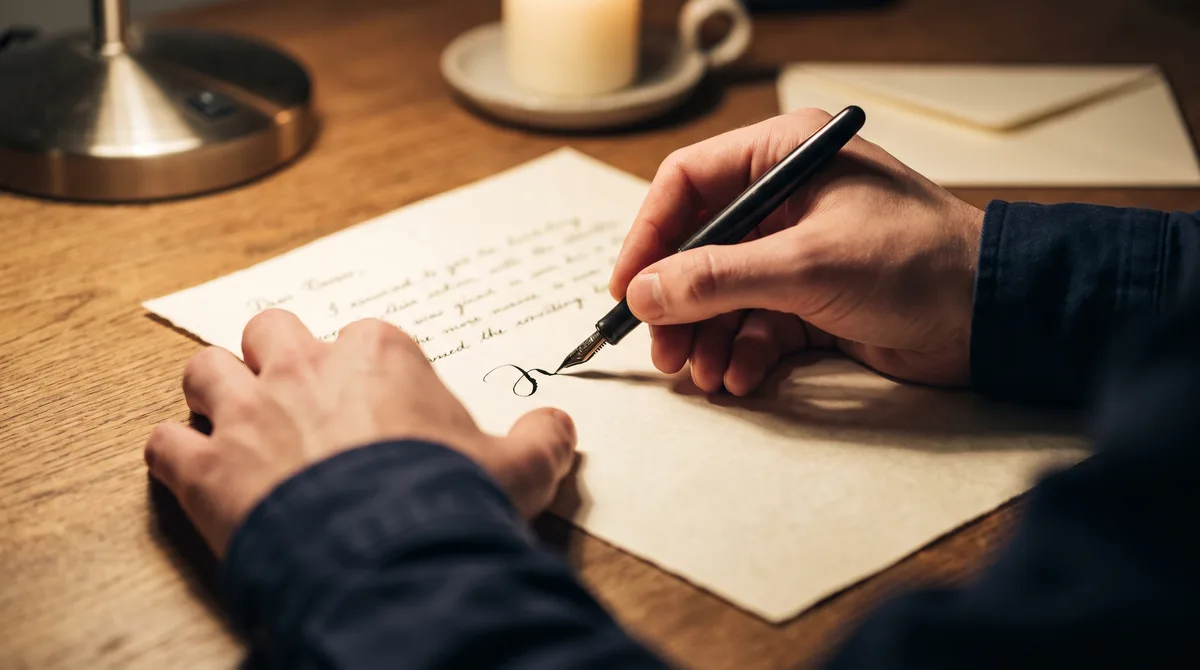
Say you've been together five years, and every card in the drugstore aisle says something a stranger wrote for a stranger. A love letter is what you write instead of buying one of those — one true, specific sentence about the actual person, addressed to no one else who could ever receive it.
It doesn't need rhyme, and it doesn't need a reveal. In two 5-week trials, healthy college students who spent 20 minutes writing about their affection for someone, three separate times, showed a measurable drop in total cholesterol by the end — the paper is titled, without any hedging, "Affectionate Writing Reduces Total Cholesterol" (Floyd, Mikkelson, Hesse & Pauley, 2007). The letter does something to the person writing it before it ever reaches the person reading it — which matters whether you're keeping a five-year relationship warm or trying to say, on paper, a thing you've never once managed out loud.
This isn't the job a dating profile essay does — that essay has to work on a stranger scanning past a hundred others. A love letter only has to work on one person who already loves you back, which is a smaller task and, honestly, a kinder one.
If putting the feeling into words doesn't come naturally on a blank page, it comes more naturally somewhere you're already writing every day, about someone specific, instead of performing for an audience.
Practice the specific sentence, not the card-aisle one.Floyd, Mikkelson, Hesse & Pauley (2007) ran two separate trials on healthy college students: an experimental group wrote about the people they felt affection for, a control group wrote about ordinary, unrelated topics, and the experimental groups showed statistically significant drops in total cholesterol. In a separate stress study described by ASU News, Floyd compared people who wrote an affectionate letter to a loved one with people who only thought about someone they love, and the letter-writers' stress dropped sharply compared with the other groups.
"It's not just thinking about the person, but conveying feelings that produces a response." — Kory Floyd, associate professor, Hugh Downs School of Human Communication, Arizona State University, ASU News (2007)
That's the useful part for anyone staring at a blank page: you don't have to feel ready, and you don't have to get the wording right on the first try. You have to actually put the feeling into sentences, because the sentence is doing work the private feeling wasn't.
Not the relationship in general — one piece of it. Algoe, Kurtz & Hilaire (2016) recorded 370 couples thanking each other out loud and found the effect wasn't gratitude in general — it was praising something specific the other person had actually done. "Thank you for always being there" barely registered. Naming the exact Tuesday they showed up did.
A dating profile earns points for being broad enough that a stranger can picture themselves in it. A love letter does the opposite: the narrower it is, the more it proves you were paying attention to one person and nobody else. Pick a memory, not a montage — the drive to the hospital, not "you're always there for me." Name a behavior, not a virtue — "you called your mother back even though you were exhausted," not "you're so kind." The specific version costs you more to write and it's the one they'll actually keep.
There's no template that survives contact with a real relationship, but there's a reliable order of operations: pick the moment, name the feeling, name the behavior, say what you hope for, and stop. Five steps, none of them requiring a gift for language.
- Pick one memory, not the whole relationship. A single Tuesday does more work than five years summarized — the reader can see one moment; they can't see a montage.
- Say what it made you feel, plainly. Use the words you'd actually say out loud in the room, not the ones that sound like they belong in a letter.
- Name one specific thing you love — a behavior, not an adjective. "Kind" is a label. "You texted my mother on her birthday before I remembered to" is a fact only you noticed.
- Say what you hope comes next, as a wish, not a request. "I want more Tuesdays like that one" reads differently than any version of a demand.
- Stop before you summarize. Let the last line be the specific detail, not a recap of the four before it — the reader doesn't need reminding what they just read.
None of this needs a special occasion; the next blank page works just as well as an anniversary does. If distance is the actual reason you're writing instead of saying it out loud, the same logic holds for long-distance relationships: one specific detail travels better than a page of general reassurance.
Try writing the specific version instead of the safe one, and see what you actually think when it's on the page.Kumar & Epley (2018) found that people writing an appreciation letter consistently overestimated how awkward it would land and underestimated how positive the recipient would actually feel reading it. The format you deliver it in matters far less than that anxiety suggests — but the two formats do signal different things.
| Handwritten | Typed or printed | |
|---|---|---|
| What it signals | Time was spent; a crossed-out word stays visible | Neat, easy to revise, easy to get the wording exactly right |
| Best for | An anniversary, a big year, something meant to be kept in a drawer | A daily note, or anything sent while you're apart |
| The real risk | Illegible if it's rushed; feels forced if you hate your own handwriting | Reads as copy-pasted if every sentence is too polished |
Neither format fixes a letter that has nothing specific in it, and neither ruins one that does.
Don't:
- Open with a line lifted from a song or a movie — it proves you found the right words somewhere else, not that you meant your own
- List every year you've been together like a résumé
- Apologize for the letter before anyone's read it — "this is probably cheesy, but" undercuts the sentence that follows it
Do:
- Let one sentence be four words long
- Leave a feeling unresolved instead of tying it into a neat ending
- Send it, or hand it over, even though it isn't perfect — the gratitude research above says the recipient will read it more generously than you're braced for
How long should a love letter actually be?
Long enough to name one memory and one specific thing you love — often a single page. A four-page letter usually means several vague sentences padding out one real one; a shorter letter with one true detail keeps better than a longer one with none.
Is it okay to type a love letter instead of handwriting it?
Yes. The recipient responds to the specificity of what you wrote, not the format you delivered it in. Handwriting signals that time was spent; typing signals that the wording is exactly what you meant. Neither beats the other on its own.
What if you don't think of yourself as a good writer?
The research on affectionate writing didn't select for writing talent — it worked on ordinary college students describing ordinary affection. A plain sentence about a real moment reads better than an elaborate one about a general feeling.
Should a love letter mention problems in the relationship?
Not this one. A love letter is a single-purpose document — naming what you love and why. Save the harder conversation for its own moment; folding a complaint into a love letter undercuts both.
Does a love letter need a special occasion?
No. Anniversaries make it easier to remember, but the letters people keep longest are often the ones written on an ordinary Tuesday, for no reason except that something specific happened worth naming.
Can you write one for someone you're not officially together with yet?
That's a different piece of writing, aimed at someone who doesn't yet know your handwriting or your habits — an essay meant to introduce you, not a letter meant to remind someone of what they already know.
A drugstore card gets recycled with the wrapping paper. The one sentence that was actually about them ends up folded in a drawer for a decade.
Unsure about writing? Try reading first.