The Future of Dating 2027: Seven Forecasts Worth Betting On

The future of dating in 2027 comes down to seven shifts already visible in the 2024-2026 data: text-first matching crosses into the mainstream, multimodal AI matching (text plus voice plus behavior) ships on premium platforms, regulators force liveness verification that closes the deepfake loophole, AI companions stabilize as a separate category rather than eating real dating, professional matchmaking keeps growing, video-first dating keeps shrinking, and verified-only premium platforms emerge as a privacy tier. None of these is a moonshot. Each is a straight-line extrapolation of a curve that's already bending.
The honest framing matters here. A one-year industry forecast is six trends extrapolated at once, and direction is far more predictable than magnitude. What this piece adds is a product-mechanics lens: where most 2027 predictions describe what swipe apps will do, several of these forecasts describe what swipe apps are trying to replace — and text-first platforms like Anketta already run on the architecture the rest of the industry is slowly drifting toward.
Write the version of yourself a 2027 algorithm can actually readDating apps are shifting because their core users are exhausted, and the numbers say so. Pew Research found that 54% of women who recently used a dating app felt overwhelmed by the volume of messages, and 22% of Americans believe online dating has made finding a long-term partner harder, not easier Pew Research (2023).
That fatigue is the engine behind every forecast below. When a third of your users feel worse after using your product, the market starts hunting for alternatives — slower formats, human matchmakers, written profiles, anything that feels less like a slot machine. We've written about the broader picture in the state of AI dating in 2026, and the forecasts here pick up where that snapshot left off.
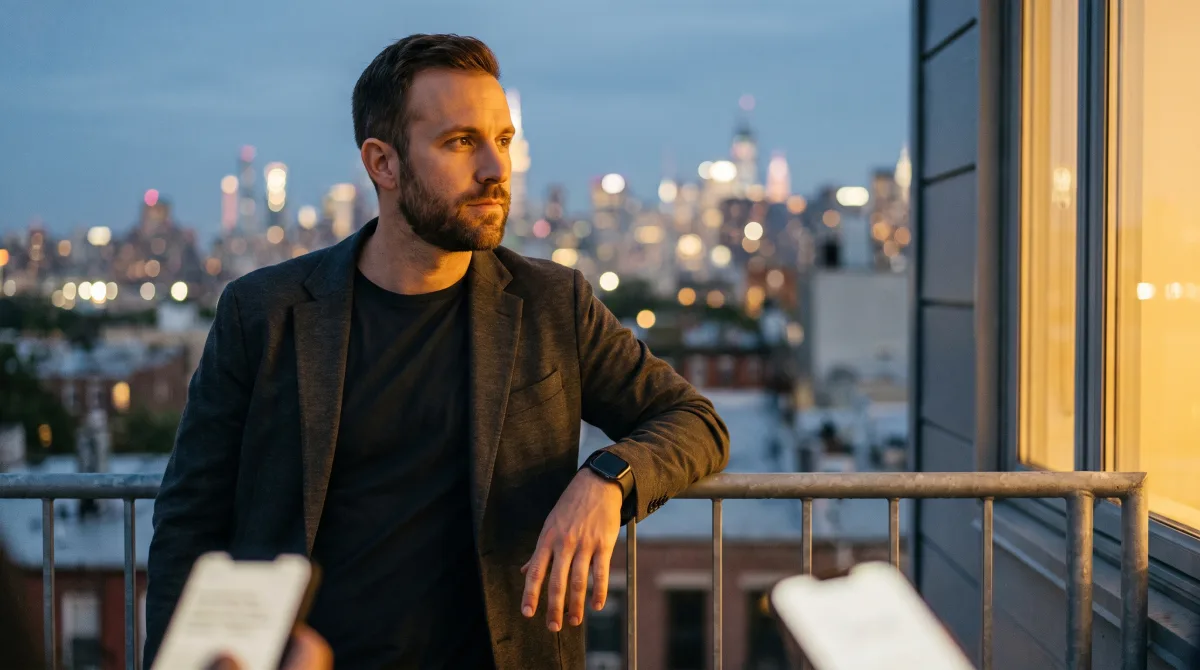
Text-first dating crosses into the mainstream in 2027. The category — apps where your profile is what you wrote, not the photos you picked — has grown from a curiosity to a recognized lane, and burnout with the photo-grid model is pushing more people to try it every quarter.
The mechanics are the appeal. On a text-first platform like Anketta no profile photo enters the matching decision; you're matched on a written manuscript, and the algorithm learns what you want by watching which phrases you highlight as you read other people's writing — not by asking you to rate a face in half a second. That's a different physics of attraction. It rewards people who are interesting on the page over people who are photogenic in the queue, which is exactly the swap a burned-out swiper is looking for.
Three drivers carry it into 2027:
- Swipe fatigue — the Pew burnout numbers above are the demand signal.
- Better semantic matching — large language models can now read a paragraph and find genuine topical overlap, not just keyword matches.
- Structural deepfake resistance — where no photo enters the matching decision, a face-swap scam has nothing to work on at the point of choice.
If you've never seen what a written profile looks like, the fastest way to understand the shift is to open the editor and try it. For the longer argument, see why text-based dating works.
Multimodal AI matching — fusing text, voice, video, and behavioral signals into a single matching representation — ships on premium platforms by 2027. The leaders are piloting it now; by 2027 it becomes table stakes at the top of the market.
Technically this is the dating industry catching up to what general AI labs already shipped: models that read text, hear audio, and watch video in one pass. Applied to matching, the inputs fan out:
- Text — the essays and chat that already drive text-first apps.
- Voice — pacing, warmth, the acoustic texture of how someone talks.
- Video — verification plus subtle behavioral cues.
- Behavior — response times, engagement patterns, what holds attention.
There's a real catch, and it's privacy. Multimodal collection dramatically expands the personal data a platform holds, and regulation will brake adoption hard. Which brings us to the forecast that may matter most.
Regulators close the deepfake loophole in 2027. The EU AI Act already requires it: under Article 50, "deployers of an AI system that generates or manipulates image, audio or video content constituting a deep fake, shall disclose that the content has been artificially generated or manipulated," and the relevant transparency obligations take effect 2 August 2026 EU AI Act, Article 50.
The reason this is urgent isn't abstract. The U.S. Federal Trade Commission reported that romance scammers stole $1.14 billion from Americans in 2023, with a median loss of around $2,000 per victim FTC via BOXX (2024). Deepfaked photos and live video are the modern delivery mechanism for exactly that fraud. By 2027, expect mandatory liveness verification on large platforms — and a structural answer in the platforms that never had photos to fake in the first place. If you want the threat model in plain language, we covered how to avoid dating scams and the same logic runs through this forecast.
AI companions do not cannibalize real dating in 2027 — they stabilize as their own category. The AI companion market was sized at roughly $37 billion in 2025 and is projected to grow at a 31% CAGR toward the hundreds of billions over the following decade Precedence Research (2025).
That's a big number, and the easy panic-take is "AI girlfriends replace dating." The more defensible read: companionship-AI and human-matching settle into distinct, mutually-understood lanes by 2027. One is a product you talk to; the other is a product that helps you meet a person. They serve different needs at different moments. The overlap is real but bounded — and the platforms that win human-matching are the ones that lean into what an AI companion can't give you: an actual second human who chose you back. We've drawn that line in the matchmaking renaissance of 2026, where the value proposition is explicitly human.
An AI companion talks back instantly. A person you matched with chose you on purpose — write something worth choosingProfessional matchmaking keeps growing in 2027, and the driver is the same burnout that's reshaping everything else. Busy professionals, privacy-sensitive careers, and people who simply refuse to swipe anymore are paying humans to do the filtering that apps made exhausting.
Two forces compound it. AI lowers the cost of running a matchmaking service — automating the grunt work of screening and shortlisting — which lets matchmakers drop prices and widen their audience. And a steady stream of swipe-disillusioned users keeps the top of the funnel full. The slow-dating movement is the consumer-side mirror of the same shift; we unpacked it in slow dating in 2026. The throughline across matchmaking and slow dating is identical: people will pay — in money or in patience — to make dating feel less like volume and more like intention.
Video-first dating keeps declining in 2027, settling into a niche tool rather than a primary format. The use cases that survive are specific — long-distance relationships, a pre-meet sanity check, light deepfake defense — but video as the main event of getting to know someone continues to lose ground.
The reason is plain once you've felt it. Video front-loads the highest-pressure version of a first impression — appearance, lighting, the awkward silence — before any actual compatibility has been established. Text-first inverts that order: you find out whether someone is interesting before you find out what they look like on a webcam at 9pm. For most people, most of the time, that order is simply more humane.
Verified-only premium platforms emerge as a distinct privacy tier by 2027. These require real-name verification, government-ID checks, and multi-step authentication, and they target privacy-sensitive professionals, high-net-worth users, and public figures who can't afford to be on a wide-open app.
Prototypes already exist in invite-only and credential-gated form. By 2027 the segment matures into a recognizable premium lane with its own pricing and its own trust promise: everyone here is who they say they are. The interesting wrinkle is that text-first and verified-only solve overlapping problems from opposite directions. Verified-only spends heavily on identity proofing; text-first sidesteps part of the threat by removing the photo entirely and server-blurring contact details until you actually match — so a stranger reading your manuscript can't extract your phone number or email even with DevTools open. Different architectures, same underlying anxiety: can I trust who's on the other side?
The biggest risks to any 2027 dating forecast are regulatory pressure, monetization squeeze, deepfake-fraud waves, and an AI backlash if a high-profile deception goes viral. Each could bend the curves above — usually by slowing them, occasionally by snapping them.
- Regulation tightens. Enforcement of the EU AI Act, a patchwork of U.S. state privacy laws, and stricter data rules globally force big platforms to reorganize budgets around compliance rather than growth.
- Monetization squeeze. Subscription fatigue, ad blockers, and privacy law together make the old "freemium plus boost" model harder to run. Platforms drift toward partnerships and specialized verticals.
- Deepfake-fraud waves. If 2026-2027 produces a few viral mass-deception cases, the result could be regulatory panic and a spike in user anxiety that outruns the actual risk.
- AI backlash. If AI-ghostwriting or AI-coaching becomes a public scandal, it could pre-emptively discredit legitimate AI use in dating before the helpful applications get a fair hearing.
The platforms that prepared for these in 2024-2026 are the ones positioned to win in 2027. The ones that bet everything on a single format — endless photos, endless swiping — are the ones with the most to lose.
This is a trend forecast and dates quickly. Refresh due Q3 2027 — recheck the market sizes, the regulatory timeline, and whether the text-first and verified-only lanes played out as called.
What are the seven dating forecasts for 2027?
Text-first matching going mainstream; multimodal AI matching (text plus voice plus video plus behavior); regulators closing the deepfake loophole with mandatory liveness verification; AI companions stabilizing as their own category; professional matchmaking continuing to grow; video dating continuing to decline; and verified-only premium platforms emerging as a privacy tier.
Which technologies will lead dating in 2027?
Multimodal matching representations, real-time AI fraud detection, behavioral biometrics for liveness verification, and privacy-preserving matching architectures. The common thread is using AI to reduce noise and fraud rather than to maximize swipe volume — a meaningful shift in what the technology is optimized for.
Will AI companions replace real dating by 2027?
No. The evidence points to two distinct, mutually-understood categories rather than one eating the other. AI companions serve conversation and presence; human-matching platforms serve the goal of meeting an actual person. The market is large enough — around $37 billion in 2025 — to support both without one cannibalizing the other.
Why is text-first dating growing so fast?
Because the photo-grid model is burning people out — Pew found 54% of women felt overwhelmed by message volume — and text-first inverts the formula. You're matched on what you wrote, the algorithm learns from what you highlight rather than what you swipe, and there's no photo to fake, optimize, or get rejected over while anyone is deciding.
Are dating apps going away in 2027?
Not disappearing, but diversifying. Mainstream swipe apps fragment into specialized verticals and add AI features defensively, while new lanes — text-first, verified-only, AI-assisted matchmaking — pull off users the old model was losing anyway. The single-format era is ending; the multi-format era is starting.
What's the safest dating format against deepfake scams in 2027?
Formats that remove the attack surface. Liveness verification helps, but where no profile photo enters the matching decision a face-swap scam has nothing to work on in the first place, and server-side blurring of contact details until you match removes the data a scammer is fishing for. Architecture beats detection.
The most reliable prediction for 2027 isn't a market-size number — it's that the people most tired of dating apps will be the ones who define what comes next.
Unsure about writing? Try reading first.