Dating With Social Anxiety: Why It Isn't the Same as Shyness

Shyness is a personality trait — most people feel a version of it in unfamiliar rooms, and it fades once they warm up. Social anxiety is different in kind, not degree: the National Institute of Mental Health estimates it affects 12.1% of U.S. adults at some point in their lives, and familiarity doesn't reliably fix it (NIMH, 2024). That matters here specifically — the advice that helps a shy dater, like practice or "just say hi," can misfire when a nervous system reads an ordinary interaction as an actual threat.
That mechanism problem gets worse, not better, on a typical swipe app. A 2025 study in JMIR Formative Research examined how dating-app design — gender disparities in match volume, addictive engagement loops, and algorithmic match throttling that paces who you're shown and when — feeds into loneliness, depression, and anxiety, disproportionately for men (Balki, JMIR Formative Research, 2025). For someone whose baseline is already anxious, a format engineered to keep you swiping and guessing why your queue slowed down isn't neutral. It's an amplifier.
Write at your own pace — no one watches you draft itThe clearest evidence comes from a large NIMH-funded youth survey: only 12% of teens who called themselves shy also met clinical criteria for social phobia in their lifetime — and about 5% of teens who did not consider themselves shy met the same criteria anyway (NIMH, 2011). In plain terms: being shy and having social anxiety disorder overlap far less than people assume, and one doesn't reliably predict the other.
The clinical line, roughly: shyness makes an unfamiliar room uncomfortable; social anxiety disorder makes a familiar one feel dangerous — a persistent, disproportionate fear of judgment that doesn't ease with repetition, sometimes with real physiological symptoms (racing heart, blushing, a locked throat) severe enough to shape what someone avoids. It's also worth separating this from introversion, which is about energy rather than fear — see dating for introverts if a quiet recharge is the bigger issue, not a fear of judgment. This article isn't a diagnostic tool, and nothing in it should be read as one — it exists because a genuinely different mechanism deserves a genuinely different set of options, not because a label is required to date the way that actually works for you.
Three mechanics in mainstream swipe apps map directly onto what social anxiety fears most, and none of them are accidental — they're the same engagement design the JMIR analysis above ties to worse anxiety and depression outcomes:
- The unpredictable reward. A queue that speeds up, slows down, or goes quiet with no visible reason trains the same hypervigilance as waiting on a verdict — did I do something wrong, or is this just the algorithm?
- The live, unrecoverable moment. A blank message box facing a stranger's photo, with a clock running whether you feel ready or not, is close to the exact scenario social anxiety is built to flag as dangerous.
- The standing comparison. A photo grid ranks you against everyone else in the queue before a word is exchanged — a stage for the "fatal flaw will be seen" fear that defines the condition, not a warm-up for it.
"A population of young, productive men... grow tired of using dating apps to find a partner and come out feeling lonely, depressed, and anxious." — Eric Balki, Lancaster University, JMIR Formative Research (2025)
None of these three require a diagnosis to feel bad. They're just bad design for a nervous system already primed to expect judgment.
It helps, not as a workaround but because the format changes what's being asked of you. A 2023 Media Psychology study found that people with higher social anxiety consistently preferred texting over face-to-face conversation across every exchange type studied, more so as the conversation got harder (Chen & Toma, Media Psychology, 2023). The researchers traced this to editability: drafting, rereading, and revising before anything sends removes the exact demand — instant, unrecoverable, watched — that social anxiety reacts to.
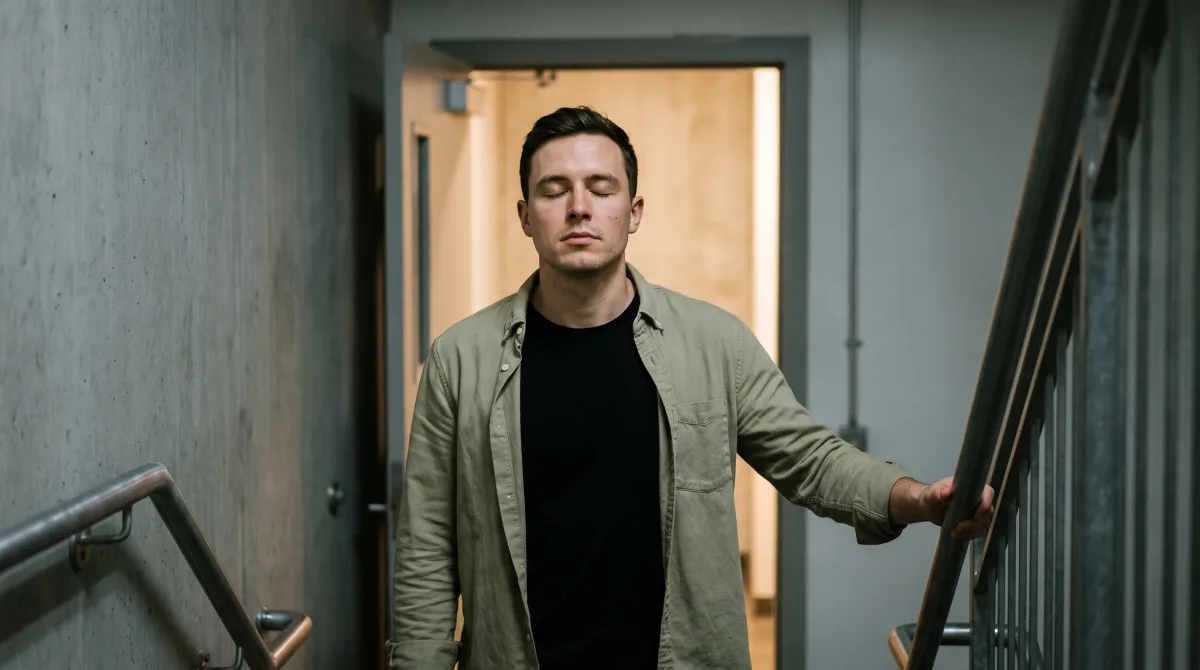
That's not the anxiety disappearing. It's the format stopping asking for the one thing that triggers it. A message you can write, leave, and come back to isn't a lesser version of a real conversation — for someone whose fear is specifically about the live, unrecoverable moment, it's the version where an honest answer is actually possible.
No live opener to panic over — just the line you highlightAnketta has no swipe gesture, no live message box, and no algorithmic queue that throttles or gamifies who you see next. You're matched on a written manuscript — a free-form piece with no fixed intake schema to get right — and to signal interest, you highlight a phrase that resonates, then press a heart. There's no opener to compose live and no visible ranking mechanism to wonder about.
| What social anxiety reacts to | Standard swipe app | Anketta |
|---|---|---|
| The unpredictable queue | Matches speed up or vanish with no visible reason | No throttling mechanic — highlight, then heart, on your own clock |
| The live, watched moment | A blank box, a stranger's photo, a clock running | A manuscript you draft, leave, and revise before anyone reads it |
| Being ranked on sight | A photo-grid comparison before a word is exchanged | What you wrote, read at the reader's pace — contact details server-blurred until you match |
| The catastrophizing loop | Re-reading a sent message for hours, no way to fix it | Nothing sends until you choose to publish it |
The point isn't that Anketta makes the fear disappear. It's that it stops asking for the specific performance — instant, live, watched — that social anxiety is wired to flag as dangerous, and lets the part you may actually be good at, writing something true at your own pace, carry the introduction instead.
Set a stopping point before you start, not after. Social anxiety doesn't usually block the first draft — it blocks the fortieth revision, the one where every sentence starts sounding like evidence against you. A few things that help specifically:
- Decide the length before you write, and stop there. An open-ended "make it good" invites endless re-reading. A fixed target — three short paragraphs, say — gives the anxious editor in your head a finish line.
- Write the honest draft somewhere that isn't the final page. Get the true version down first, away from the sense that it's already being judged, then move over the parts worth keeping.
- Let one imperfect detail stay. A manuscript scrubbed until it's inoffensive reads as guarded, not calm. One specific, slightly risky sentence — a real interest, a real quirk — does more work than five safe ones.
- Publish before the twentieth re-read, not after. The read-through that catches a typo is useful. The eleventh read-through is anxiety, not editing — Anketta's editor doesn't require either.
No, and it isn't trying to be. Anketta is a dating format — it removes a specific kind of pressure from meeting people, and that's the whole claim. It doesn't diagnose, treat, or reduce social anxiety disorder itself, and nothing on this page should be read as a substitute for that. If the fear is persistent, disproportionate, and shaping what you avoid well beyond dating — work, friendships, ordinary errands — the evidence-based path is a licensed therapist, and cognitive behavioral therapy in particular has a strong track record for social anxiety specifically.
What a lower-pressure format can reasonably do is remove one recurring trigger from one part of life, so you can start writing without dating being the arena where the fear gets rehearsed every single week. That's a smaller, more honest promise than "fixing" anxiety — and it's the one worth making.
Is social anxiety the same as being shy?
No. Shyness is a personality trait that tends to ease with familiarity. Social anxiety disorder is a distinct, sometimes diagnosable condition affecting an estimated 12.1% of U.S. adults at some point in their lives, marked by a persistent, disproportionate fear of judgment that doesn't reliably fade with exposure. The two overlap far less than people assume.
Can dating apps actually make social anxiety worse?
Research on dating-app design links algorithmic match throttling, addictive engagement loops, and constant visual comparison to worse loneliness, anxiety, and depression outcomes, particularly for men. None of that is a character flaw in the user — it's the mechanics of a swipe queue built to maximize time spent, not comfort.
Do I have to tell someone I have social anxiety before meeting them?
No, and there's no single right answer. Naming it in your own words — "I take a while to warm up in person" — tends to land better than either hiding it entirely or leading with a clinical label. What matters more is choosing a format that doesn't force the disclosure at the worst possible moment.
What's the best dating format if I have social anxiety?
An asynchronous, text-first one. Research finds socially anxious people consistently prefer texting to face-to-face conversation, and the preference strengthens under pressure specifically because editing removes the instant, unrecoverable, watched quality that triggers the fear. A format with no live opener and no visible ranking removes the two biggest triggers at once.
Does writing instead of talking just delay the anxiety to the first date?
Some of it, yes — writing changes the first move, not the eventual in-person meeting. But it moves the hardest moment later, to after there's already a real reason to want to show up, which is a materially easier position than opening cold on nerve alone.
Is this a treatment for social anxiety disorder?
No. A text-first dating format can remove a specific, recurring source of pressure from one part of life, but it doesn't diagnose or treat the underlying condition. If the fear is persistent and impairing beyond dating, a licensed therapist — cognitive behavioral therapy has strong evidence here — is the appropriate next step, not an app.
The bravest version of dating with social anxiety isn't forcing yourself through a room full of strangers — it's writing one honest paragraph somewhere quiet enough to actually mean it, and letting that go first.
Unsure about writing? Try reading first.