Dating for Volunteers: Love Through a Shared Cause
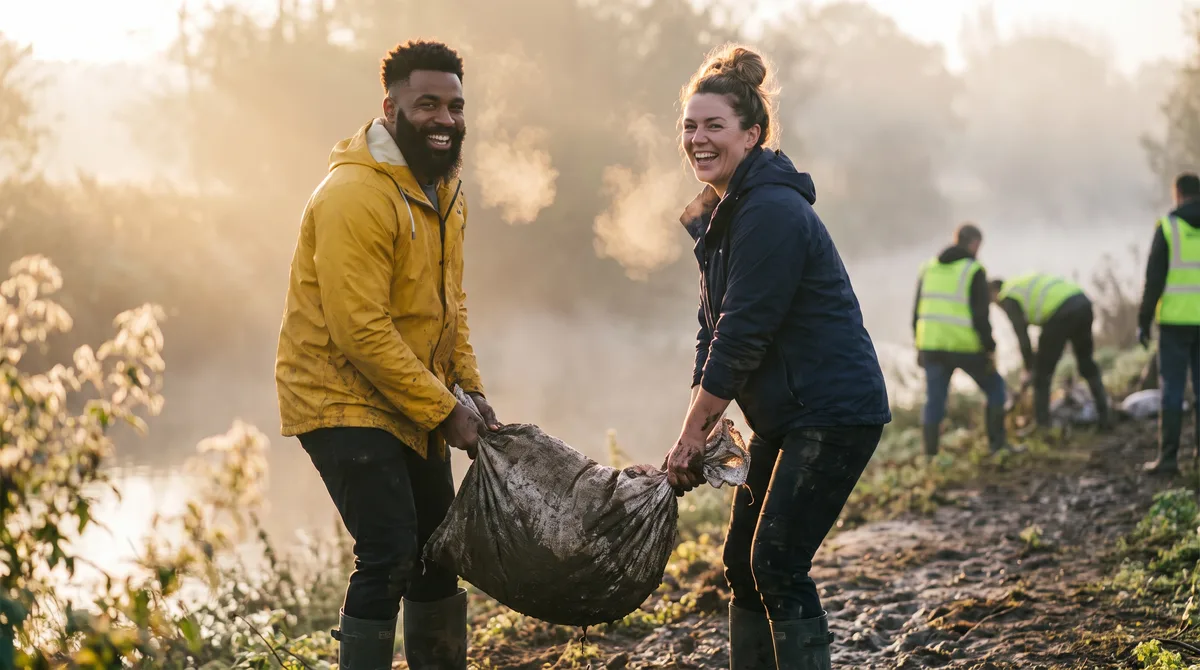
Seven on a Saturday morning at a river cleanup, two strangers drag the same torn sack up a muddy bank because neither will be the first to let go. Neither lets go. Nobody has asked what the other does for a living. Yes, people meet partners this way, and the pool is large: 28.3% of Americans formally volunteered through an organization in 2023 (AmeriCorps, 2024).
A shared cause tells you something real about how a person spends a free Saturday. It does not yet tell you whether they have anything left on Sunday for you.
Write what you give your hours to, and whyAnketta's manuscript is built for that second question: the reason behind the Saturdays, in full sentences, not a tag.
It differs a great deal, mostly because the counting differs. The American figure above counts people who gave time through an organization over a year, which is why it reaches more than a quarter of adults. In Russia, the number Rosstat reported for 2021 was far smaller: 3.9 million volunteers (Izvestia, 2023), citing Rosstat data in a report on the Economic Development Ministry's forecasts.
Do not compare the two numbers as if they were measured the same way. Each tells you that volunteering is a normal, ordinary way to spend time in its country, and a normal way to meet people. Whether you live in Chicago or Kazan, you are not hunting a rare animal, because the habit is already everywhere and the only scarce thing is the particular person who does it for reasons you would recognize at the end of a long, cold shift. You are looking for one particular person inside a very common habit.
Partly, and the research is more careful than the folk wisdom. Across five studies, Van der Wal and colleagues found that the endorsement of self-transcendence values, meaning benevolence and universalism, was related to higher romantic relationship quality (Van der Wal et al., 2024). The values-first instinct has a basis.
Read the finding closely, though. In their dyadic analysis, those values mostly influenced a person's own relationship quality, not the partner's. Caring about others makes you a better partner in your own relationship. It does not show that two people who care about the same river will fit each other.
Both, and the work is separating them. A cause shows you what someone chooses when nobody is watching. It also shows you a rota, a group chat and a social circle, which can be pleasant and still not be compatibility.
| Same cause | Same values | |
|---|---|---|
| What you know | Where they spend their Saturdays | What they will give up for something |
| What you do not know | Why they started, what they would stop for | Whether their daily habits fit yours |
| Easy test | Ask about the last shift they hated | Ask what they would refuse to do, even for a good cause |
| Common trap | Mistaking the group's warmth for the person's | Mistaking the vocabulary for the practice |
A cause is where you met. Values are what you find out at the second coffee, when nobody is wearing a tabard.
It looks like generosity until the day it does not. A study of volunteers found that the time dedicated to volunteering predicted higher levels of burnout, while values-driven motivation and life satisfaction were negatively related to it (Moreno-Jiménez & Villodres, 2010).
Two things follow. More hours is not more virtue, and more hours is the strongest warning sign in that study. And the protective factor is the reason a person started, not the amount they give. A volunteer who can say why, and where the limit sits, has more to offer a partner than one who simply never says no.
The evidence is hopeful and unfinished. A systematic review of 40 papers found that cohort studies showed volunteering had favourable effects on depression, life satisfaction and wellbeing, but not on physical health (Jenkinson et al., 2013). The same review says the effects were not confirmed in experiments.
A person who feels better about their life is often easier to be near. But those are observational findings, and the review itself calls the causal mechanisms unclear. Volunteering may help. It also attracts people who were already doing well. Date the person, not the halo.
Decide the shape before you meet someone, not after you like them. The point is not to give less. It is to know what you give, so a partner can see the edges.
- Name your fixed commitments: the shifts you will not move, in a sentence a stranger could follow.
- Name your flexible ones, the ones you take on when you are asked and could decline.
- Pick one evening a week that belongs to no cause, and tell your date it exists.
- Say what you do when a crisis hits your cause, so a cancelled dinner is not a surprise.
- Ask the same four questions back. A partner who shares the cause needs the same limits.
Writing these down before the first date is easier than negotiating them over dinner, when you both want the evening to go well. The same advice sits behind dating when you are a caregiver: the people most likely to give everything are the ones who need to say where the line is.
Say the particular thing, not the category. "I volunteer" is a tag. "I drive the van for a food bank on Thursdays and I am still not good at the paperwork" is a person. On Anketta, readers underline a line that lands in a manuscript, so the concrete detail is the part that gets noticed, and the vague phrase is the part that gets skipped. There are no swipes to hide behind.
Put your Thursday van, not just your cause, in writingValue-based matching works best when the values are written as behavior: what you did, what it cost, what you would do again. A reader who recognizes that is a better lead than one who shares a hashtag.
Is it a good idea to date someone you volunteer with?
It can be, and it carries a cost the other options do not. You share a friend group, a schedule and an exit problem if it ends. Agree early what happens to the shifts, and who does not leave the cause if the relationship does.
Do shared values really matter for lasting relationships?
Evidence says they matter, with limits. Van der Wal and colleagues linked benevolence and universalism to higher relationship quality, mostly for the person who holds them. Shared values help, but a person's own values carry more of the weight than a match on a cause.
How many hours of volunteering is too many to date?
No study sets a number, and the Moreno-Jiménez study only shows that more time predicts more burnout. A workable test is whether you can name one evening a week that is not spoken for. If you cannot, the schedule is the problem.
Should I tell a date I have a demanding volunteer role?
Yes, early and in plain words. Say how many hours, what the crisis days look like and what you will not move. A date who hears that on the first coffee has time to decide. A date who learns it after three cancellations does not.
Can volunteering be good for my mental health while dating?
Observational research links volunteering to better depression and life-satisfaction outcomes (Jenkinson et al., 2013), though experiments did not confirm it. If volunteering gives you a sense of purpose, it can steady a dating life. If it exhausts you, it works the other way.
What if my partner does not share my cause?
Most couples do not share a cause, and many do well. What the research supports is values, not causes: that you both care about other people in practice. A partner who respects your Thursdays and has their own fixed point is a good sign.
Unsure about writing? Try reading first.A cause can fill every evening you have. A person only needs one of them, held back on purpose, like a chair left out at the end of a table.