Texting Style Is the New Dress Code 2026

In text-first dating, the first thing anyone learns about you is how you write — your punctuation, your vocabulary, the pace of your replies, your emoji habits, your tone. It's the digital equivalent of how a stranger reads you offline through clothes, posture and the way you talk. When the entire opening act of meeting someone happens in text, style stops being decoration and becomes the content.
This isn't a vibe. There's a measurable link between how people use words and who they are. In a large-scale study of 694 bloggers — over 100,000 words each — psychologist Tal Yarkoni found "pervasive correlations with personality" across a broad range of word choices, replicating offline findings and surfacing new associations down to individual words (Yarkoni, 2010, Journal of Research in Personality). You leak personality through writing whether you mean to or not. The difference in 2026 is that dating moved into the channel where that leak is the whole first date.
On Anketta no profile photo appears before a match. You're read entirely on what you write, so the dress-code metaphor isn't a metaphor here — the manuscript is the outfit. That changes the stakes of every word.
Write the version of yourself that reads exactly like you.Six signals do most of the work: vocabulary range (reading habits, education), punctuation choices (carefulness, conscientiousness), reply pace (self-regulation), emoji use (emotional warmth, extraversion), message length (engagement and investment), and dialect or slang (regional and cultural identity). None of these is a verdict on its own. Together, across a few exchanges, they paint a surprisingly sharp picture.
1. Vocabulary range. A wider, more varied vocabulary reads as more reading, more curiosity, more intellectual discipline. A flat, repetitive one is a signal too — just a quieter one. Yarkoni's work showed even single words track personality, so range isn't about sounding fancy; it's about texture.
2. Punctuation. This one has hard evidence. In a Binghamton University study, text messages that ended with a period were rated as less sincere than the same messages without one — an effect that vanished in handwritten notes, so it's specific to digital text (Klin et al., 2016, Computers in Human Behavior). Em dashes and semicolons quietly signal a reader. No punctuation at all reads as casual — or careless, depending on the room.
3. Reply pace. Instant replies, 24/7, can read as over-availability or anxious attachment. A consistent rhythm with a steady delay reads as healthy boundaries. A sudden, unexplained drop-off is worth noticing — sometimes it's the opening move of a slow fade rather than a busy week.
4. Emoji use. Heavy emoji use leans warm and extraverted. A total absence can read as formal, or as introversion. And the specific emoji you reach for — 😂 versus 🥲 versus 🙃 — is one of the clearest generational tells there is.
5. Message length. One-word replies read as low engagement or an introvert's economy. Two or three paragraphs read as investment. The mismatch — your three paragraphs answered with "haha yeah" — is itself a signal, and usually a true one.
6. Dialect and slang. Regionalisms, in-group slang and idioms flag where you're from and which rooms you've spent time in. For diaspora communities especially, the way you code-switch in text carries a lot of identity in very few words.
If you want to see how these signals compound into something a person can actually feel, why text-based dating works walks through the underlying psychology.
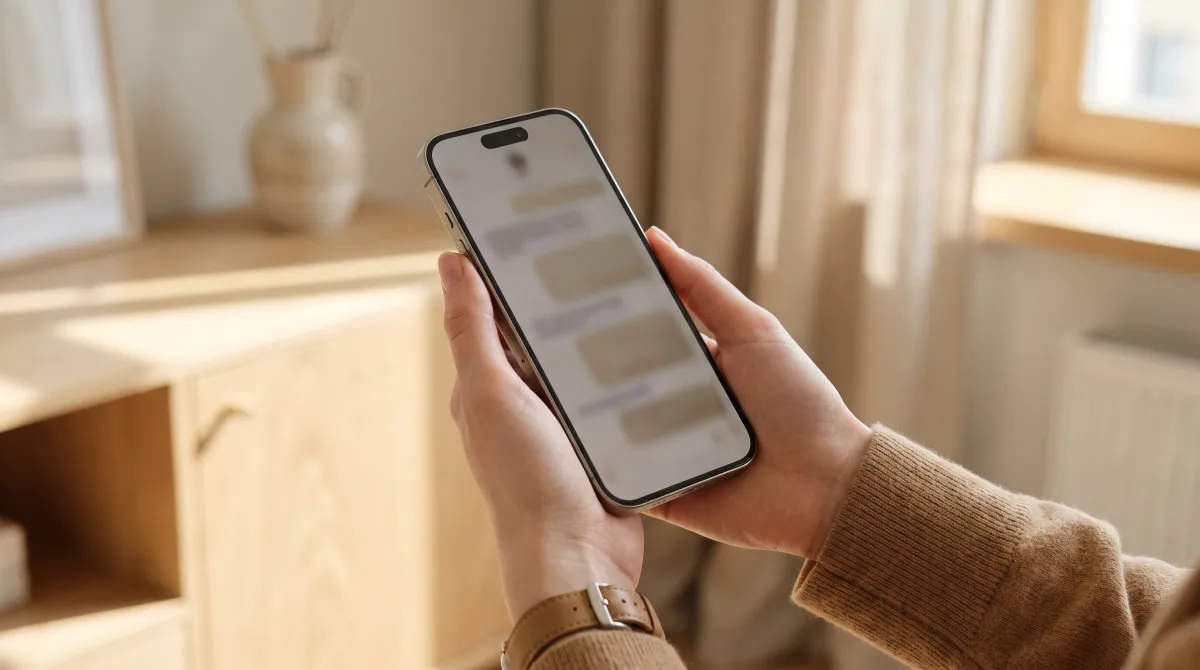
Read patterns, not single messages. Watch how someone writes across ten to fifteen exchanges, pay attention to inconsistencies more than to any one habit, and remember that style is a signal — not a sentence. The most common mistake is diagnosing a whole personality off two texts sent on a bad day.
Read the pattern, not the message.
- One short reply might just mean "busy."
- Consistently short replies are a pattern.
- A conversation that narrows over time is a signal worth trusting.
Notice the inconsistencies.
- A sudden shift from expressive to clipped can be an emotional reaction, not a personality.
- A swing from casual to formal usually reads as distance opening up.
Style is not a verdict.
- A narrow vocabulary doesn't mean "not smart" — it can mean a pragmatic communicator who says what's needed.
- A huge vocabulary doesn't mean "smart" — sometimes it's just performance.
- Style tells you how someone communicates, not who they are. Hold it loosely.
The same restraint applies to your own openers. How to write a first message and these conversation starters that aren't "hey" are about sending a clear signal, not engineering a perfect one.
The style that works is specific, warm and consistent: concrete detail instead of vague summary, real warmth without emoji spam, and reply patterns people can actually rely on. It's not about a "correct" answer — it's an honest signal of who you are. The goal is legibility, not performance.
Concrete beats generic:
- Don't: "Love travel and staying active."
- Do: "Spent two days last week on a ridge trail with a view that made the climb feel like a bargain."
Warm without overdoing it:
- Don't: Five emoji per message.
- Don't: Zero emoji in an obviously casual thread.
- Do: One or two at the emotional beats, warmth carried mostly by the words.
Reply patterns people can read:
- Don't: Instant all day, then a three-day silence with no explanation.
- Do: A steady rhythm — say, lunch and evening — that the other person can map.
Honest length:
- A lot to say? Write the three paragraphs.
- Genuinely little? Keep it short, but don't go cold.
- A persistent length mismatch is worth naming out loud rather than guessing about.
Here's the part that's easy to miss: trying to fake a style that isn't yours is the one move guaranteed to backfire, because style is the densest authenticity signal you send. If you'd rather just write plainly and let the words do the reading, open the editor and start from there.
Skip the polish. Write the way you'd actually talk, and let that be the signal.Platforms are rebuilding matching and interface around text signals: text-first apps treat the semantics of what you write as the primary signal, mainstream apps bolt on voice prompts and structured text icebreakers, and AI-detection grows to tell authentic writing from generated copy. The center of gravity is shifting from the photo grid to the sentence.
Text-first architecture. Apps built around writing match on the meaning of everything you've written. On Anketta this runs on semantic matching: when you highlight a phrase in someone's manuscript as a "like," the model surfaces more manuscripts that mention that phrase, and down-weights what you cross out. Style isn't scored for tone — it's the raw material the recommender reads. How AI reads text compatibility breaks down what that actually measures.
Voice prompts. Mainstream apps are adding voice clips as icebreakers — a partial move toward "voice as signal." It's a real shift, just a different channel; voice messages in dating 2026 covers where that's heading.
Structured text icebreakers. Replacing the blank "hey" with prompts lowers the floor on first messages and gives style something to attach to. The opener stops being a coin flip.
AI-detection systems. Platforms are building detection not mainly to block, but to understand: which signals a person gives authentically, and which arrive pre-engineered by a chatbot. As AI messaging assistants in 2026 get better, the authentic-versus-generated line becomes the thing platforms most want to see — a tension the state of AI dating in 2026 places at the center of the whole industry.
The backdrop to all of it: roughly three-in-ten U.S. adults have used a dating app, one-in-five partnered adults under 30 met their partner on one, and 54% of women report feeling overwhelmed by the sheer volume of messages (Pew Research, 2023). When the inbox is that loud, a clear, honest writing style is how you stop being noise.
Is texting style really the new first impression?
In text-first dating, yes. When there's no photo and no in-person read, the first thing anyone gets is your writing. Research on word use and personality (Yarkoni, 2010) shows style reliably carries identity — so in this channel, how you write is what people meet first.
What does my texting style signal to a match?
Vocabulary range hints at reading and curiosity, punctuation at carefulness, reply pace at self-regulation, emoji at warmth, message length at investment, and slang or dialect at where you're from. No single one is a verdict — the picture forms across a handful of exchanges.
Does ending a text with a period really seem cold?
Often, yes. A Binghamton University study found period-ending texts were rated less sincere than the same messages without one — and the effect was specific to digital text, not handwriting. Context matters, but in casual threads a hard stop can land sharper than you mean it to.
How should I read someone else's texting style?
Read patterns across ten to fifteen exchanges, not single messages. Watch for sudden shifts in tone or length, which usually mean more than any one habit. And treat style as a signal, not a sentence — it tells you how someone communicates, not who they are.
What texting style actually works best?
Specific, warm and consistent. Concrete detail instead of vague summaries, genuine warmth without emoji spam, and reply patterns people can rely on. Most of all, honest — faking a style that isn't yours is the fastest way to read as off, because style is your densest authenticity signal.
Where does an expressive writing style pay off most?
On text-first platforms where writing is the whole profile. Apps like Anketta match on the meaning of what you write rather than on a photo, so a richer, more specific manuscript simply gives readers more to connect with — and the matching model more to learn from.
When the words are all anyone gets, the kindest thing you can do is write like yourself and let that be enough.
Unsure about writing? Try reading first.