Dating for Cinephiles: Why the Film List Isn't the Real Signal

Because a list measures agreement, and agreement isn't what makes two people feel close to each other. Decades of attraction research keep landing on the same uncomfortable finding: it isn't how much two people actually have in common that predicts whether they click — it's how much they believe they have in common. A profile can hold four movie titles. It cannot hold the feeling those titles are supposed to produce, because that feeling gets built in the exchange, not printed on the list.
A 2012 speed-dating study put this to a direct test. Researchers measured both real and perceived similarity between daters before and after a series of four-minute conversations, then checked which one actually predicted attraction. Perceived, but not actual, similarity significantly predicted romantic liking — people who felt aligned with a date grew more attracted to them, independent of whether a separate personality survey said they overlapped at all (Tidwell, Eastwick & Finkel, 2012). A shared five-star rating for the same film gives you agreement. It doesn't give you the feeling of being understood — that still has to be earned in how the two of you talk about it.
Write the manuscript a fellow cinephile would actually finish.Mostly, it signals the person you'd like to be read as. A four-title list gets curated for an audience the same way a bio photo does: one film gets swapped out for feeling too obvious, another gets kept because it sounds serious, and something you genuinely love gets dropped because admitting to it feels embarrassing. That isn't dishonesty. It's just what a field with no room for reasoning turns into.
There's nowhere on a bio-line to explain why a film matters, so the list does the only job a list can do: perform. It says "I have taste" without showing any of the thinking that taste is supposed to come from. The fix isn't a longer list — a longer list is still a list. It's a format that lets someone write past the title in the first place, which is the whole premise behind text-first dating: give a person room to explain a choice, and the explanation tells you more than the choice ever could.
More than the title alone, but less than most people assume. A 2025 cross-sectional study of college students found that genre preference correlates with measured personality traits — people drawn to mystery films scored meaningfully higher on openness to experience, the trait most linked to curiosity and tolerance for ambiguity (Menon et al., 2025). Genre is a real signal. It's just a weak one on its own — which is why the more useful read comes from watching how someone engages with what they watched, not which shelf it's filed under.
Three behaviors say more than any title ever will:
- Can they sit with an ending that doesn't resolve? Someone who can describe an ambiguous ending without immediately deciding what it "really means" is comfortable with unresolved things — a trait that shows up again the first time a relationship hits a genuinely open question.
- Do they need to be right about a film? There's a difference between someone who argues a reading of a film because they find it interesting and someone who argues it because losing the argument would sting. The first person is curious. The second is going to need to win most disagreements, and not just about movies.
- Do they watch to escape, or to sit with something hard? Media researchers describe this as a split between hedonic viewing (pure pleasure) and eudaimonic viewing — choosing a film as a way of sitting with something difficult rather than avoiding it (Oliver & Raney, 2011). Neither instinct is wrong. But knowing which one someone reaches for on a bad week tells you something a genre tag can't.
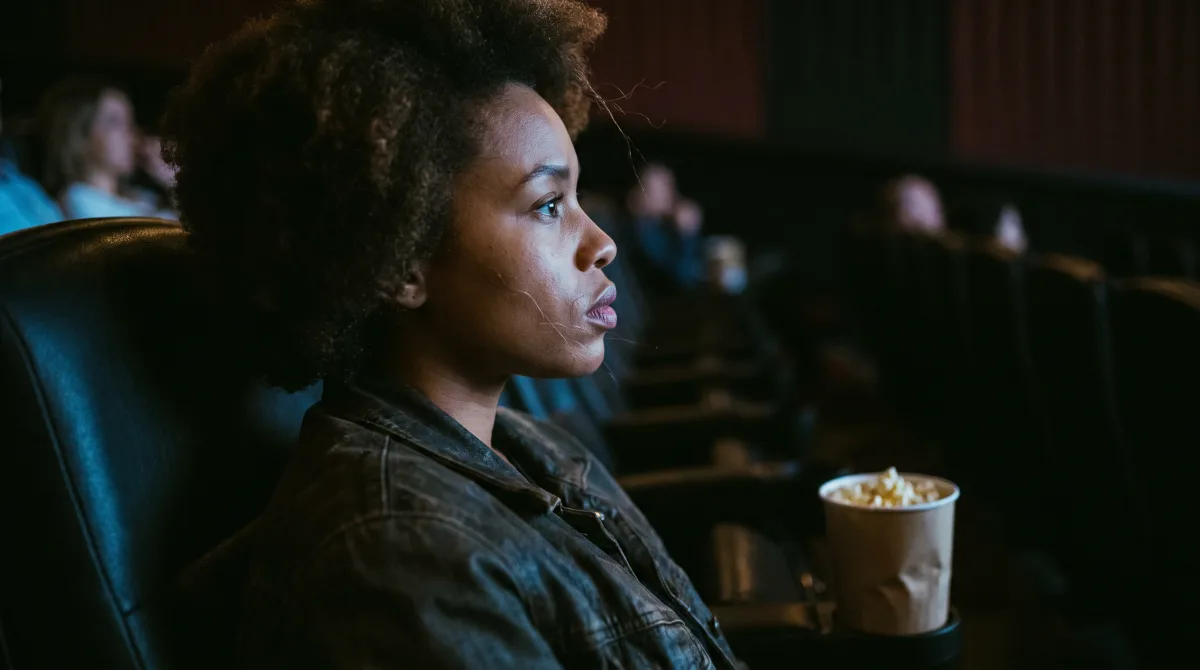
Because reasoning is the only part of taste a stranger can actually evaluate. Anyone can copy a title off a listicle. Almost nobody can fake, in three honest sentences, why a specific scene stayed with them for a week — that takes having actually watched, thought, and remembered, in that order.
"For me, the movies are like a machine that generates empathy." — Roger Ebert, film critic, 2005
Ebert's point wasn't really about film quality. It was about what watching does to a person who watches closely — it practices the exact skill dating runs on, sitting inside a perspective that isn't your own until it makes sense. Someone who can tell you what a film made them understand about a person unlike them is demonstrating that skill in real time, in a way a title never could. That kind of writing is easier to produce in a manuscript built for paragraphs than in a bio built for four bullet points, which is the entire argument for a text-first format in the first place.
No — matching on genre is optional. Matching on how you each think about what you watch is not. Two people who've never seen the same film can still recognize the same instinct in how the other explains a choice; two people with an identical top-four list can still talk past each other completely.
| Dimension | Bio-line profile | Manuscript (Anketta) |
|---|---|---|
| First signal | Four titles, ranked in seconds | A paragraph you read at your own pace |
| What it captures | Agreement or disagreement on a list | How someone reasons about what they watched |
| Room for nuance | One line, no follow-up | As much as the writer wants to give |
| What the algorithm learns from | Nothing — the field isn't matched on | The exact phrases readers highlight |
| Decision speed | Instant swipe | A 48-hour window to actually read |
On Anketta there's no favorites field to fill in, and no swipe gesture either — you highlight a phrase in someone's manuscript as a "like," then press the heart. Mark "still defends the ending of that film nobody else liked" as something you love, and the matching model stores that exact phrase and surfaces more manuscripts that mention it; cross out a line and it downweights the opposite. Nobody's face enters the decision either way — photos stay out of the feed entirely until there's already a match, so you read the reasoning first and the picture comes after.
Match on how you watch, not what you list.Name the scene, not the title — and let the reasoning show its work. A title is a badge; a specific memory is proof the badge is real. The swap costs nothing extra to write, and it's the single easiest edit that turns a performed list into something worth reading. A few habits that carry the reasoning instead of just the taste:
- Name a scene, not a title. "I still think about the boat scene" tells a reader more in six words than "Jaws" tells them in one.
- Admit a film you loved and can't fully defend. A guilty pleasure you're willing to argue for is a more honest signal than a prestige pick you're reciting.
- Say what you watch when you don't want to think. Comfort viewing is real information about a real person on a real Tuesday — leaving it off the list doesn't make you more interesting, it just makes the list less true.
Then say so. A comfort rewatch reveals exactly what a defended arthouse ending reveals: what someone reaches for when they don't want to be challenged, which is genuinely useful information about a person, not a lesser category of taste.
The same argument holds for readers who return to the same worn paperback every year — comfort media isn't evidence of a smaller mind, it's evidence of a person who knows what steadies them. Writing well about a rom-com you rewatch every winter takes the same honest reasoning as writing well about a three-hour Tarkovsky film — naming the specific beat that works and admitting why, instead of hiding behind the label. The same trap waits one shelf over, where "I love wine" is doing identical work on a profile — a near-universal filler interest that only becomes informative once someone says what the ritual is actually for. If a date's first move is a raised eyebrow at your comfort pick, that flinch is worth noticing early, the same ick as any other reflexive contempt — because someone who needs your taste to flatter theirs before they'll take you seriously was never actually asking what you watched. They were auditioning you.
Do dating apps exist specifically for movie lovers?
Not really as a distinct category — most "for film fans" branding sits on top of the same photo-and-swipe mechanic everyone else uses. What actually serves cinephiles is format, not branding: a text-first platform that lets you write about why a film matters gives film-lovers room a genre badge never could.
Should I list my favorite films on a dating profile?
If the format only gives you a line, list them — it's better than nothing. But if you have the option to write a paragraph instead of a list, take it. The paragraph is where the actual signal lives; the list is just the index.
What if my date has completely different taste in film?
Different taste isn't the problem worth watching for. Watch instead for whether they're curious about why you like what you like, or whether they need you to come around to their opinion. That instinct predicts more about a relationship than any overlap in a watchlist.
Is loving mainstream movies a dealbreaker for a "real" cinephile?
No — gatekeeping mainstream taste is a much stronger red flag than mainstream taste itself. Someone who can talk with real specificity about why a blockbuster works is showing you more thought than someone who can only namedrop festival winners without saying anything about them.
How can I tell if someone actually watches films, or just performs taste?
Ask about a scene, not a title. Someone who's actually watched something can describe a specific moment and why it landed; someone performing taste can usually only supply the poster-level facts — director, year, festival, prestige.
Does Anketta have a favorite-films field on the profile?
No — the manuscript has no fixed fields at all, just headings and paragraphs you write yourself. If film matters to you, you write about it the way you'd write about anything else that matters, in as much or as little space as it deserves.
A comfort rewatch and a defended, unresolved ending are the same test in two different costumes — the question was never which film, only whether you can say why.
Unsure about writing? Try reading first.