Dating for Wine Lovers: What the Ritual Actually Reveals
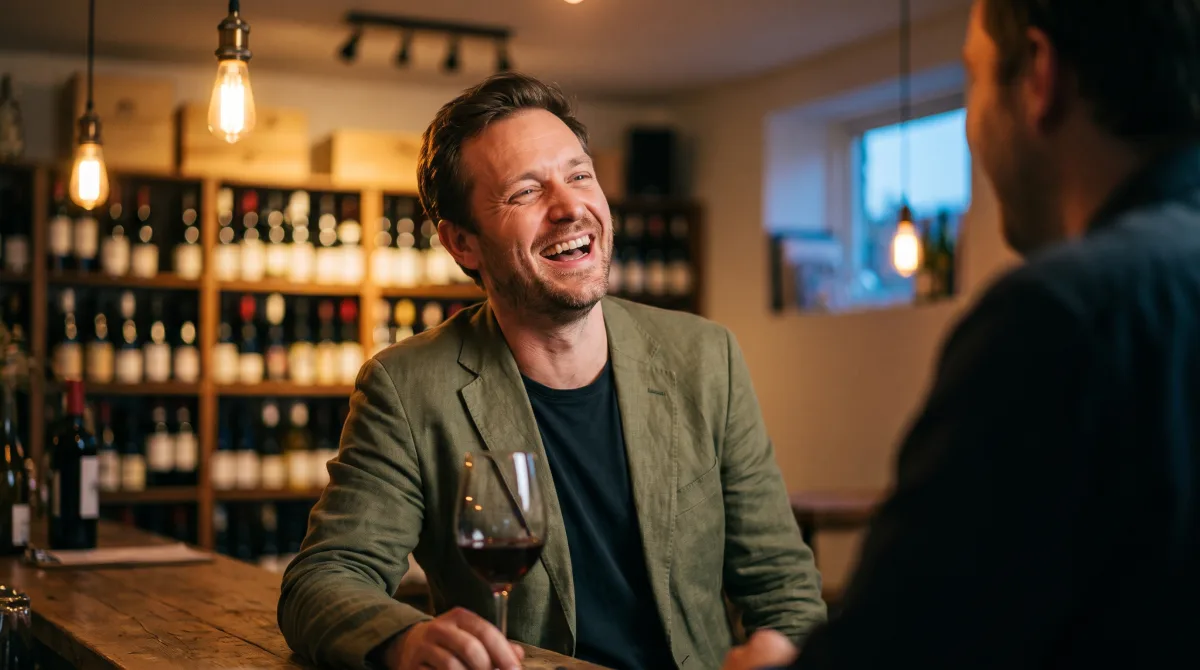
"Wine" shows up on more dating profiles than almost any other interest — filed somewhere between hiking and true crime, and about as informative. A 2017 study in Adaptive Human Behavior and Physiology looked at what actually made people feel closer to their dinner companions, and it wasn't the menu. The evenings that produced real closeness involved more people, more laughter and reminiscing, and — specifically — alcohol (Dunbar, 2017). The bottle wasn't the variable that mattered. The shape of the hours around it was.
That's exactly what "wine" as a listed interest can't tell you, and the ritual around it can. Anketta's manuscript has no interest checklist to fill — no box marked "wine" for a reader to skim past. Someone who actually cares about the ritual has to write it, in their own sentences, and a reader can tell the difference between three unhurried hours at a table and a fast glass on the way to somewhere else. Slow dating was built for exactly that gap.
Write the evening you actually want, not the interest tagBecause nearly everyone who's ever been on a date has said some version of it. As a stated interest, "wine" filters out close to no one — it's just as compatible with a person who tracks vintages as with a person who orders whatever's cheapest on the list and means it sincerely. What actually separates two people isn't the interest. It's what they do with a glass once it's in front of them: treat it as a reason to sit still, or as a formality on the way to somewhere else.
That's also where the two obvious traps live. One is the connoisseur trap — deciding the wine itself is the personality, and turning a date into a tasting-note recital nobody asked for. The other is treating "I like wine" as a whole character trait, the same way a profile might lean on "I love to travel." Neither trap is really about wine. Both mistake an interest for a signal.
On a date, the same glass does opposite jobs depending on who's holding it. Some people order wine to ease into three unhurried hours of talking, refilling slowly, treating the table as the destination rather than a stop on the way to one. Others order two drinks in forty minutes to get past the nerves faster — the wine is a shortcut, not a setting. The vintage is often identical. The ritual around it isn't, and the ritual is what predicts whether two people actually want the same kind of evening.
| Drinking to slow the evening down | Drinking to speed it up | |
|---|---|---|
| What the glass is for | A reason to stay at the table longer | A shortcut past the nerves |
| How the conversation moves | Circles back, follows a tangent, doubles back | Heads in a straight line toward a decision |
| What "one more glass" signals | Not ready for the evening to end | Wanting to feel looser, faster |
| What it predicts | Fit with a long, unhurried structure | Fit with efficiency more than depth |
Neither column is the wrong way to drink. They're just different evenings wearing the same bottle — which is exactly why the interest listed on a profile can't distinguish between them.
Curiosity and performance can produce the same order at the bar and completely different evenings. Someone who wants to learn asks the other person what they're tasting, admits when a wine surprises them, treats the list as a shared discovery. Someone performing expertise treats the list as a stage — correcting pronunciation, steering the conversation back to what they already know, watching for a reaction instead of listening for one. A lab study out of the University of Pittsburgh and Carnegie Mellon put strangers through this exact fork under controlled conditions: over 36 minutes, alcohol measurably increased laughter, positive affect, and self-reported bonding among people who'd never met, compared with a placebo (Sayette et al., 2012). The effect came from sharing the experience, not from anyone in the room impressing anyone else.
That's the same distinction Anketta's text-first format is built around: a manuscript rewards someone who actually writes about the evening they want, not someone assembling a list of credentials. A reader can highlight the paragraph about a wine that surprised you and skip past the one that reads like a sommelier's cheat sheet.
"The causal direction runs from eating together to bondedness, not the other way around." — Robin Dunbar, evolutionary psychologist, University of Oxford
Most modern dating is optimized for speed — a forty-five-minute coffee audition, three photos and a bio scanned in under ten seconds, a decision made before either person has finished a full sentence. A sit-down wine evening runs on the opposite assumption: no fixed end time, a menu that invites lingering, a structure that expects the conversation to wander before it lands anywhere. It's one of the few social forms left that still assumes an unhurried evening as the default — the exact assumption slow dating tries to rebuild everywhere else.
Try the version of dating built around the whole eveningThis is where a wine-centered date quietly becomes an accessibility problem, and it's worth naming plainly: plenty of people are sober, sober-curious, or simply don't want to drink on a first date, and a venue built entirely around a wine list can leave them navigating a menu that isn't for them. 62% of U.S. adults under 35 currently drink, down from 72% two decades ago (Gallup, 2023) — not a niche preference, a real and growing share of the dating pool.
The fix isn't turning drinking into a compatibility requirement, and it isn't a lecture about moderation either. It's separating the ritual from the substance: what actually works about a wine bar date is the pace and the setting, not the alcohol content, and both survive intact at a tea counter, a dessert bar, or two coffees stretched over ninety minutes. If wine genuinely matters to you, say so in your own words rather than assuming the other person will match it.
Most of this decision already happens before the invite goes out — in how deliberately you describe what you actually want from the evening, not in the venue itself.
- Pick the venue for conversation, not the wine list's depth. A long counter with low music beats an intimidating cellar list — you're choosing a place to talk, not a place to be tested.
- Order what you actually like, not what signals taste. The performance trap starts here. Order the glass you'll enjoy.
- Ask about pace, not palate. "Are you someone who likes to sit for a while?" tells you more than any question about vintages.
- Let the evening run long if it's working. Don't watch the clock for an exit point that isn't there yet.
- Have a real non-alcoholic option ready before you sit down, so it never becomes an awkward mid-date negotiation.
By the end of a good wine date, nobody remembers the label. What they remember is whether the hours felt long in the good way — the kind of evening slow dating has been trying to put back into modern dating all along, with the bottle as little more than a prop for something slower that was the actual point. It is the same reason "favourite films" tells you so little on its own: the list is the costume, and the reasoning underneath it is the person.
Is liking wine actually a meaningful signal on a dating profile?
Barely, on its own — it's one of the most commonly listed interests, so it filters almost nobody out. What's informative is the ritual around it: whether someone drinks to slow an evening down or speed it up, and whether they want to learn or perform expertise.
What's the real difference between a "wine person" and someone who just likes a glass?
Not much, usually — the label does more work than the behavior does. The better question is what someone does with the time around the glass: do they linger, ask questions, let the evening wander, or move through it quickly toward a decision.
Is a wine bar a good first date if one of you doesn't drink?
It can work if the venue and the plan don't center alcohol as the point — a wine bar with good food and comfortable seating works fine for a non-drinker. It works less well if the whole evening's structure assumes everyone's ordering off the wine list.
How do you avoid sounding like a sommelier on a first date?
Ask more than you state. Admit when something surprises you instead of explaining why you expected it. The performance trap gets triggered by trying to sound like an expert, not by actually knowing about wine.
Does sharing a bottle actually make two strangers feel closer, or is that a myth?
Research backs it up under lab conditions — alcohol shared in a group setting measurably increases laughter and self-reported bonding compared with a placebo. But the effect comes from the shared time and attention, not from the alcohol on its own.
Should a first wine date start with a glass or a bottle?
Start with glasses. A shared bottle assumes a pace and a length of evening neither of you has agreed on yet — glasses let either person order a second, order something different, or call it an early night without it reading as a statement.
Somewhere between the first pour and the last one, the wine stops being the point of the evening — if it ever really was.
Unsure about writing? Try reading first.