When to Move From Texting to a Call Without the Pressure
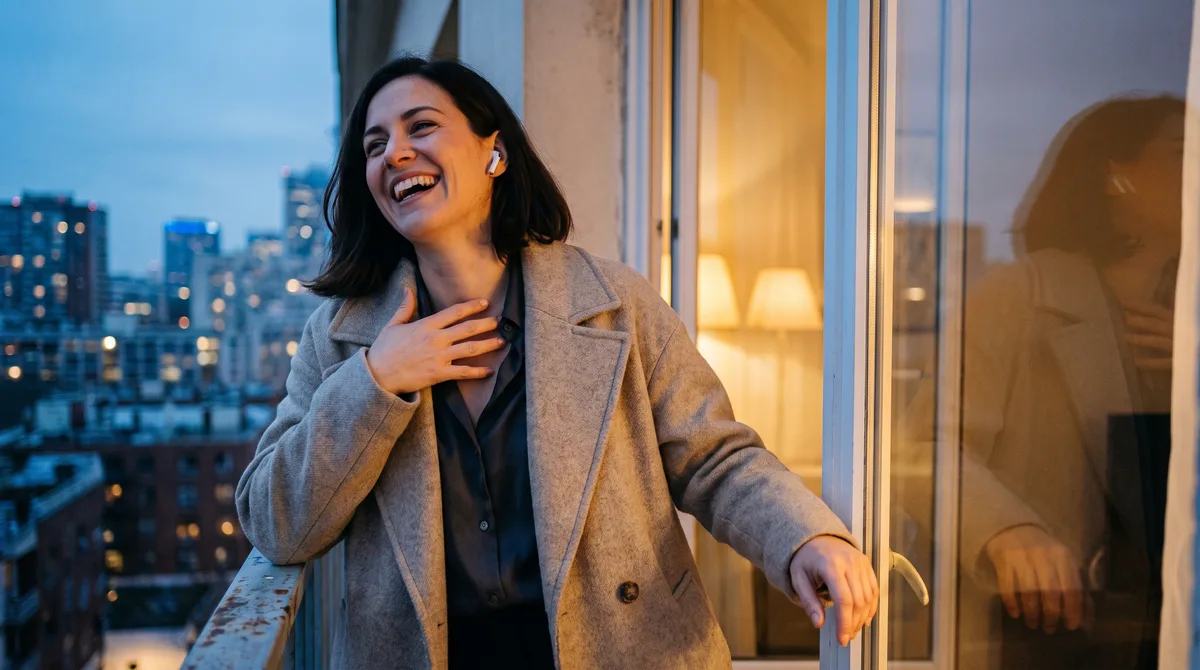
The surprise in the research is that a voice does more than add warmth: it makes the person on the other end seem more thoughtful. In 2017, across four experiments, Schroeder, Kardas & Epley found that hearing someone explain a view made them seem more capable of thought than reading the same words. So the moment for a call is not a day count. It is the point where the thread has enough in it that a voice can finish the picture.
That matters most if you text well and tend to stay there.
A voice carries the part of a person that is hardest to type: pace, hesitation, laughter that arrives before the sentence ends. In the 2017 paper, a fourth experiment identified paralinguistic cues in the human voice as the channel doing the work. The effect was strongest where people were perceived as relatively mindless, such as when they disagreed with the evaluator. Dating is not that setting, so read it as a direction, not a dating statistic.
The reverse problem is older. Kruger and colleagues (2005) ran five experiments and concluded that people believe they communicate over e-mail more effectively than they actually do, because the sender hears the tone they meant. A joke you wrote as dry can arrive as cold, and the thread gives you no sign which one happened.
A call gives that sign back within the first minute. You hear the laugh, or you hear the pause.
If you want the craft of keeping a thread alive until then, how to keep a conversation going over text covers the part that comes first.
Write the page worth calling about.No study sets a number of messages or days, and anyone quoting one is guessing. What you can check is whether the thread has the raw material a voice needs. A conversation is ready when both of you are writing more than you have to, when a topic has outlived the day it started, and when you have caught yourself wanting to say something out loud instead of typing it.
- Replies have started to grow. One-line answers turned into paragraphs, on both sides, without anyone asking for more.
- A thread survived a gap. Something from Tuesday came back on Friday, unprompted. That is the callback, and it means the conversation lives outside the moment.
- You have disagreed about something small. A tiny argument over a film or a route home tells you more about tone than a week of agreement.
- Typing has become the slow part. You wrote three messages and deleted two because the thought would be shorter spoken.
- Someone has already named a plan. "We should talk about this properly" is an invitation sitting in plain sight.
- You would not mind hearing them be boring. The call will have flat patches. If that sounds fine, you are ready.
On Anketta, a match opens a 48-hour window and becomes permanent only if both people wrote to each other, so by the time a thread is still alive it has already passed a small test. That is a better clock than the calendar, though the call itself happens on whatever you both choose to use.
Make the ask small, specific and easy to decline. Attach it to something already in the thread, offer a short window, and leave a real exit. "That story needs a voice, are you free for twenty minutes Thursday evening?" does the work. It names a reason, a length and a time. Compare it with "we should talk sometime", which hands the other person an open task and no way to say no kindly.
A few shapes that hold up:
- Tie it to the thread. "I keep wanting to argue about the ending of that film out loud."
- Cap the length. Twenty minutes feels like a coffee. "Let's talk" feels like a summons.
- Offer a time, not a question. "Thursday after seven?" beats "when are you free?"
- Leave the exit visible. "No pressure either way, the thread is fun as it is."
Do not suggest it as a test of seriousness or an alternative to being vague. Do not ask at midnight. And do not ask in the same message that closes a flat exchange; ask when the conversation is warm, not when it is thinning.

Neither wins everywhere, and one finding cuts against the instinct that more channels is always better. Antheunis, Schouten & Walther (2020) put 39 speed-daters through 95 pairings and found more social attraction after text than after video, with romantic attraction declining once pairs switched to meeting face-to-face. It is a small sample, and it says text can flatter, not that text is better.
| Step | What it gives you | Where it misleads |
|---|---|---|
| Text | Time to compose, a record to return to, room for specificity | Tone can be misread in either direction, and a polished writer can seem warmer than the room will feel |
| Voice call | Pace, laughter, hesitation; no face to perform for | Awkward silences feel louder; no visual cues to cover a flat patch |
| Video call | Voice plus face and surroundings | Can feel like an interview; the screen adds its own stiffness |
| In person | Everything at once | The highest stakes; read the guide to when to meet first |
A voice call sits where the stakes are low and the information is high. For many people it is the easier step to say yes to. If you are weighing it against video, the piece on video dates is the place to weigh the trade.
An awkward call is normal data, not a verdict. First calls have a stiff first minute because both of you have been performing a smoother version of yourselves in text. Sprecher (2021) found that pairs who started in text and then moved to face-to-face contact increased their liking and closeness, while pairs who went the other way saw no change or a drop in fun. That study tested face-to-face, not phone, so treat it as a direction rather than a promise.
The move from text to a richer channel tends to land well when the text came first.
What helps in the moment: start with something already in the thread, so the first thirty seconds have a topic. Let a pause be a pause for two beats before you fill it. Say out loud that it is odd, once; people usually laugh. If at minute fifteen there is nothing, end warmly and early. "This was nice, I should let you go" does not close a door.
Take the no at face value and keep the thread going. Some people hate the phone, some are anxious before meeting, and some are slower to trust a voice. A no to a call is information about comfort, not about interest. Offer a gentler version once: a voice note, or a short call after a specific day.
If you hear the same answer three times with no reason and no warmth, you are not being asked to wait, you are being asked to stay in text indefinitely, and that is your cue to decide whether the thread is enough for you. People who keep a conversation on text forever are not always hiding something. They are also not always going anywhere. For a related rhythm, see slow dating.
How many days of texting before a call?
There is no researched number. Advice columns tend to say a few days to a week of real conversation, but the better test is the thread itself: longer replies, a callback that returned, and a wish to say something aloud. Move when it is warm, not when a calendar says so.
Should I text first to ask if they want to talk?
Yes, a short text beats an unannounced ring. Offer a specific window and a length, such as "twenty minutes Thursday after seven?" That respects the fact that many people dislike surprise calls and gives them a clean way to say yes, no, or "later this week."
Is a voice note the same as a call?
Not quite. A voice note carries the voice but not the live back-and-forth, so it is a useful half step for someone nervous about the phone. The 2017 voice research was on speech heard, not on whether a reply could come in real time. Treat it as a bridge, not a substitute.
How long should a first call last?
Plan for twenty to thirty minutes and let it end early if it should. A call that ends warmly at twenty leaves both people wanting more, which is easier to build on than a call that drags to an hour because neither wants to be the one to hang up.
What do I talk about on a first call?
Start with something from the thread, a story that deserves a voice, then ask one open question that cannot be answered in a word. Avoid interview mode. Trade a small true thing of your own before asking for a second one of theirs, and let the conversation wander.
Should I call before the first date?
For many people it helps, because it replaces a stranger's text voice with a real one and lowers the stakes of the date. It is optional, though. If you both feel ready to meet and the thread has substance, a call is a comfort, not a requirement.
You wrote your way to each other, and the voice is only the next sentence.