Beautiful Dating Profiles: Why Precision Beats Polish

"Golden hour, good coffee, better company" is a beautiful sentence. "I reheat the same cup three times a morning" is not, and it is the one a stranger answers. Researchers at Cornell (ACL, 2012) built 2,200 matched pairs of movie lines — same character, same scene, same word count, one remembered and one forgotten — and found the memorable half ran on ordinary grammar and unusual word choices. Beauty in a line is a property of accuracy.
That distinction has a mechanism behind it here. An Anketta manuscript is free-form text with no bio grid and no word target, and readers underline individual lines inside it. You can only underline something definite. A borrowed line has nothing to mark, because it belongs to nobody in particular.
The fastest way to test that is on your own page: open a blank one and write a sentence nobody else could have written about themselves.
Write the one sentence nobody else could have writtenPolish is averaging. In Scientific Reports (2025), 400 raters judged a hundred faces and attractiveness tracked averageness of shape rather than symmetry — the least distinctive faces scored highest. Sentences behave the same way. "I value honesty" reads well because everyone writes it, and every polishing pass moves a line closer to the version everyone already has.
There is a one-minute check for this that editors call portability. Take any line from your profile and drop it into someone else's. If it fits without a single edit, it was never yours — it is a common phrase you happened to type, and a reader will scroll past without registering that they scrolled.
Ornament also promises more than it delivers. "Looking for someone with real depth" sounds like a confession, but it hands over no fact: not what you do on a Wednesday, not what you refuse to forgive, not what wore you out this year. There is nothing there to answer, so nobody answers.
Concrete things. A study in the Quarterly Journal of Experimental Psychology (2025) ran 15 million Twitter posts and over 50,000 Reddit posts through a concreteness measure: more concrete wording drew more reshares and more upvotes, and a controlled experiment confirmed concreteness was doing the work. Abstraction slides off. An object, a time and a place stay put.
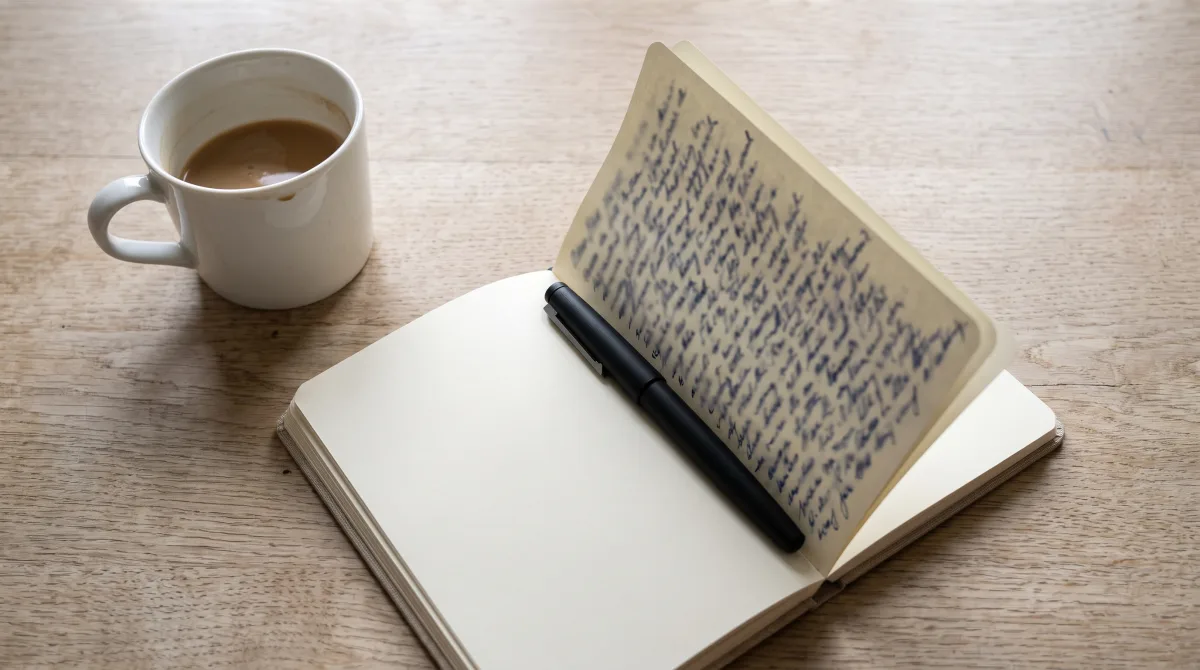
"I'm thoughtful" is a conclusion a reader is asked to accept. "I've had the same barber for eleven years and I still don't know his last name" is a scene a reader draws the conclusion from, and people trust conclusions they reached themselves.
Notice that the second line is not pretty. It has no rhythm, no image, no borrowed wisdom — a span of years, a small failure of curiosity, and a haircut. That is exactly why nobody can lift it.
Keep the meaning and delete the verdict. Nearly every ornamental line is a conclusion about yourself — warm, spontaneous, a good listener — dressed as description. The precise version is the occasion the conclusion came from: one day, one place, one detail you would slightly rather not admit. Five pairs, ornament on the left and the same claim said accurately on the right.
| Ornamental line | Precise rewrite |
|---|---|
| "Golden hour, good coffee, better company" | "I reheat the same cup of coffee three times a morning and I've stopped calling it charming" |
| "Fluent in sarcasm" | "I argued with a stranger about a bus timetable for eleven minutes in March. I was wrong." |
| "Looking for my partner in crime" | "I want someone who'll tell me the haircut is bad before I leave the house, not after" |
| "I love deep conversations" | "I read the last page of a novel first. I know. I'd rather not discuss it." |
| "Adventure is out there" | "My passport has one stamp in it and it's from a work trip to Cleveland" |
The right-hand column is no longer than the left and sounds distinctly worse. What it has is an address — a March afternoon, a bus timetable, Cleveland — and a reader can stand in those places. Nobody can stand inside "adventure is out there."
There is a practical bonus too. The right column is faster to write, because an ornamental line has to be invented and a precise one only has to be remembered.
Yes, and the limit is real. In Scientific Reports (2025) researchers analysed 8,977 headline A/B tests (35,910 headlines) on the news site Upworthy: where headlines were vague, added concreteness lifted clickthrough by roughly 5.5%, and where they were already concrete it cost almost 10%. That is news headlines rather than dating profiles, but the shape of the warning carries.
Precision stops working the moment it turns into an inventory. A paragraph listing your coffee brand, your bus route and the year you bought the bike is as faceless as "I love to travel," from the opposite direction. The number of details is not the variable. What the detail is for is.
One detail per idea is the working rule. A specific is there to let a reader understand something you did not state outright — and the moment it stops doing that, you are writing a packing list.
Read the profile out loud to another person. Not for their verdict — for the places where your own voice slips into someone else's. The ornamental sentences announce themselves: your delivery goes formal, and the listener nods without asking anything. A good line makes someone interrupt. The five tests below take about ten minutes and strip out most decoration.

- The transplant test. Paste the line into someone else's profile. If it survives unedited, cut it: it was never about you.
- The question test. After each paragraph, ask what a stranger could ask about it. No question available means the paragraph is closed.
- The wince test. Keep at least one detail you feel faintly embarrassed to include. It will be the most convincing thing on the page.
- The date test. Swap "I love" for "last month I." The line either becomes a scene or falls apart, and if it falls apart it was empty.
- The quotation test. Delete any borrowed quote and see what is left standing. If very little is, the quote was holding the profile up instead of you.
Start with the line where your reading voice dropped out of its formal register and went ordinary. That one is already true.
Write down the line where your voice stopped performingBecause two readers work through the same text: a person and the matching. The manuscript is free-form — headings and paragraphs, no required fields, no length target — and it passes a quality and authenticity review before it goes live. Readers underline individual lines, and what gets underlined becomes the signal matching learns from. A generic sentence emits no signal at all.
Only definite things can be underlined. Nobody marks "I value honesty," because everyone would sign it. Someone marks "I read the last page first" because they do it too, and those are the people who turn up in your feed afterwards. The precise detail earns twice over: it catches a human reader and tells the system what there is to talk to you about.
The sequence follows from that. Underlining a stranger's line does not commit you to liking them, but you cannot like anyone without underlining at least one of their lines — text first, decision second. That ordering is what intentional dating looks like as a mechanism rather than a mood. If the writing wants to run longer than a few paragraphs, the guide to essay dating covers how to keep a long piece alive.
A finished manuscript can also leave the app: once approved it gets its own link and QR code, with phone, email and address blurred server-side for anyone you have not matched with. The wider argument sits on our about page, and the blank page itself is one tap away.
What are the best lines to put in a beautiful dating profile?
Ideally none that you found somewhere. A ready-made line is polished because thousands of people wore it smooth before you, so a reader recognises the phrase before they notice you. Replace it with something from your own week — same meaning, plus a time, a place and a detail nobody else owns.
Should I put a quote in my dating profile?
A quote tells a reader about the person who wrote it, not about you. If you keep one, add what it did to you afterwards. "I reread it and spent six months annoyed about it" carries far more of you than the quotation it follows, and it cannot be copied off anyone.
How do I write beautifully about myself if my life is ordinary?
Ordinary is the material. The reheated coffee, the barber's unknown surname, the argument about a timetable — those read as alive. Beauty in a profile comes from the accuracy of the naming rather than the size of the event, and small details are the hardest ones to fake.
Does a beautiful profile have to be long?
No. Anketta enforces no length target either way; a fuller manuscript simply gives other people more places to catch on. One paragraph carrying a single exact detail outperforms a page assembled from elegant phrases, because the page gives a reader nothing specific to answer.
What if the precise details feel too personal to publish?
Choose the uncomfortable detail rather than the painful one. Between "I had a hard year" and "I still haven't opened one box from the move," the second is both more honest and safer. Contact details in a manuscript stay blurred to anyone you have not matched with anyway.
How do I know the profile came out well?
Hand it to someone who knows you and see where they stop. If they never interrupt, the text is smooth and empty. If they interrupt on the detail you almost deleted for being too small, that detail was the whole profile.
The truest sentence about yourself tends to arrive at a window with nothing in your hands, and then you spend the rest of the evening deciding it is too small to be worth writing down.
Unsure about writing? Try reading first.Sources:
- You had me at hello: How phrasing affects memorability (ACL, 2012)
- Concrete language enhances sharing of social media posts (Quarterly Journal of Experimental Psychology, 2025)
- When curiosity gaps backfire: headline concreteness and information selection (Scientific Reports, 2025)
- Averageness and femininity predict facial attractiveness judgments (Scientific Reports, 2025)