Dating for Anime Fans: Naming It Beats the Vague Tag
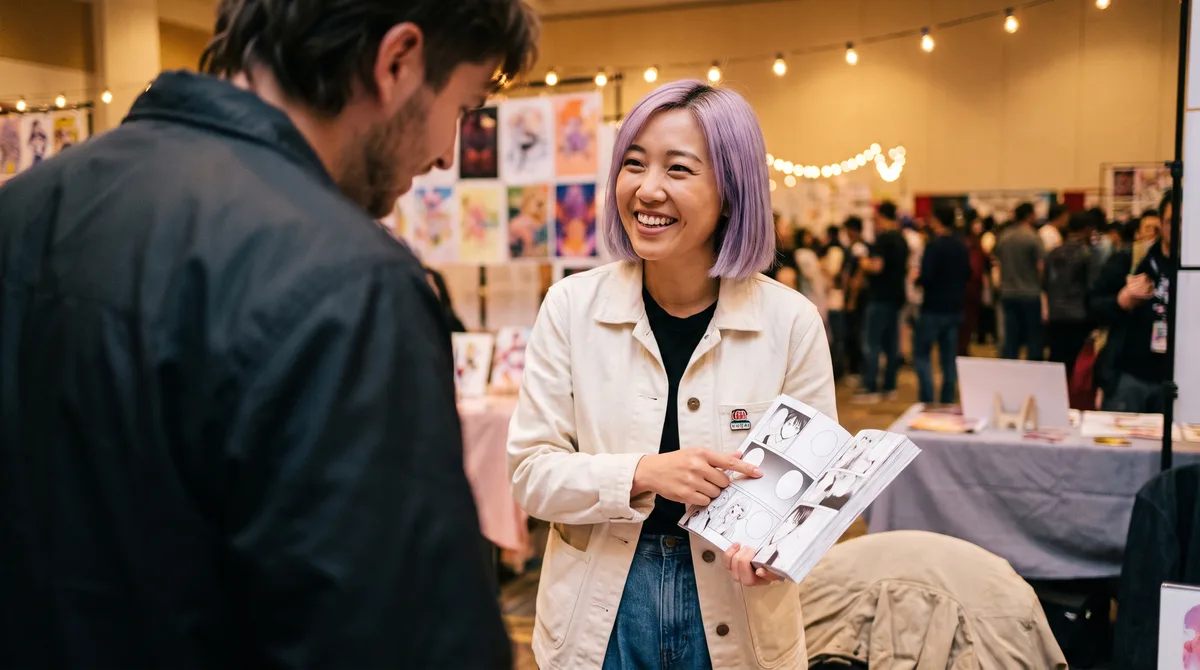
A bio can say "into anime" in three words. What decides whether two anime fans actually connect is never those three words — it's whether either of them says anything specific enough to place them: which series, which arc, which con, why now. A 2018 study of 3,122 self-identified anime fans, recruited at a Dallas convention and from online anime communities, found that cosplayers — who disclose their fan identity to non-fans more than non-cosplayers do — reported higher life satisfaction and self-esteem, and lower depression (Reysen, Plante, Roberts & Gerbasi). Statistically, that openness accounted for part of the cosplayers' well-being edge, though a one-time survey can't prove it caused it.
That finding sounds abstract until you notice what a dating bio does instead. It compresses a whole fandom — the show that got someone through a bad year, the con they've saved for since January — into an adjective. Hiding it in shorthand isn't neutral. It's the side the research links with lower well-being.
Write the actual series, not the adjectiveBecause it's still treated as a punchline. The same research team that ran the disclosure study built their case on a documented pattern: anime fans are largely stigmatized, and researchers have found the same stigma toward anime and cosplay in North America, Taiwan and Japan. Unlike a visible minority identity, being an anime fan is concealable — you can just not mention it, and plenty of people don't.
That concealment is a cost sports fans rarely pay. Nobody hides being a Cowboys fan in their bio. An anime fan editing the interest down to a single safe word is managing a stigma that a lot of daters outside the fandom never have to think about.
Yes, and the same study measured how openly fans say it to different people. Participants rated how openly they disclosed their anime identity to people outside the fandom, in five contexts, each on a 7-point scale:
- Non-fan friends — the most open of the five, at 5.36.
- Non-fan family — next, at 4.77.
- A stranger or new acquaintance — which is what a first message to a match actually is — near the bottom, at 3.06; only a work supervisor scored lower.
| Disclosure context | Mean (1–7 scale) |
|---|---|
| Non-fan friends | 5.36 |
| Non-fan family | 4.77 |
| Work peers | 3.45 |
| A stranger or new acquaintance | 3.06 |
| Work supervisor(s) | 2.84 |
A first message sits near the bottom of that table, between a coworker and a boss. That's the same pull that makes a vague tag feel safer than a real sentence — and the vague tag is also the least convincing thing on the page.
Because the fandom itself skews the way most of its enthusiast communities do. The same 3,122-person sample was 68.2% male, with cosplayers making up 34.4% of the group. A straight woman scrolling for someone who reads the same panels she does is picking from a noticeably smaller pool than a straight man is — and a straight man who assumes the interest alone will narrow the field for him is making the same mistake in reverse.

None of that makes the fandom a bad place to look. It makes the odds worth being specific about, instead of assuming three words will do the sorting for you.
Name the con, the arc, the actual eveningThe data draws a real line between the two. In a 2021 survey of 1,191 anime convention attendees, published in 2022, 69% of respondents said the lack of cons in 2020 and early 2021 affected their social lives to some degree — 34% "somewhat," 35% "noticeably" (Alberto & Tringali, 2022). The researchers' own conclusion was blunt: the con experience "cannot be fully replicated online" (Alberto & Tringali, 2022).
A separate multi-fandom comparison backs the same pattern from another angle: online anime fans were the most likely of any group studied to be single, fantasy sport fans were the least likely, and furries and convention-going anime fans fell in between (Furscience / IARP). Scrolling alone and showing up somewhere are not the same fandom, socially speaking, even when the interest is identical.
Explain it, not bury it — and don't expect it to read as strange to someone who actually studies it. Connor Leshner, a psychology PhD candidate at Trent University who co-authored a study of anime fans' attachment to fictional characters, put it plainly:
"People do have the capacity for these relationships. Sometimes they are based in physical attraction, especially for men, while others are based on platonic, personality-based attraction, especially for women." — Connor Leshner, PhD candidate, Trent University, PsyPost (2026)
Leshner also pushed back on the idea that any of this is new: "These relationships aren't weird, and we've been discussing similar relationships for centuries" (PsyPost, 2026). A partner who reacts to a favorite character with contempt instead of curiosity is telling you something worth hearing early, not something to argue them out of.
You write the detail a tag can't hold. A manuscript has no box for "interests" to check off "anime" and keep moving — the space is blank until someone fills it with an actual sentence. That sentence can do the three things a tag never manages:
- Name the actual series or arc, not the genre — "still not over the Fullmetal Alchemist ending" tells a reader something "into anime" never will.
- Name the actual behavior — the con you've gone to every year since a specific year, the group chat that's been running since before the pandemic.
- Name what it costs or asks of a partner — an evening a month, a shelf, a running joke they won't get for the first year.
Writing that paragraph before the first message does the sorting a tag can't: a reader either recognizes the specific thing and highlights it, or they don't, and either answer is more useful than a polite match on a word both of you used loosely. That's a different problem than dating as a gamer, where the schedule and the console argument dominate — anime fandom runs on the show itself, the specific feeling it left, and whether anyone else got that far in.
The matching works the same way behind the scenes. Anketta doesn't ask what your interests are; beyond hard filters like age and city, its matching learns from which lines a reader highlights. Someone highlighting the sentence about the Fullmetal Alchemist ending, rather than the word "anime," is telling the system something a checkbox never could — and it's closer to choosing a person on purpose than any tag-matching filter gets. Writing the actual sentence is what has to happen before any of that can work.
Is naming the specific series better than just saying "into anime"?
Yes. A vague tag can't be recognized or ruled out by anyone reading it, so it does no sorting at all. A specific title, arc, or character does — someone either knows what you mean and lights up, or they don't, and you've learned something real either way.
Should the fandom go in the bio, or wait for the first message?
Put the general shape in the bio and save the specific, vulnerable detail — the favorite arc, the con story, the waifu — for after there's some reason to trust the reader with it. Disclosure research on anime fans found strangers near the bottom of five audiences for openness, above only a boss; a first message is exactly that audience.
Why does the anime dating pool feel so male-skewed?
Because the fandom itself is. One large study of self-identified anime fans found the sample was 68.2% male. That doesn't make the pool unworkable, but it does mean assuming shared fandom alone will narrow the field is optimistic in one direction and overly cautious in the other.
Is mentioning a waifu or husbando a dealbreaker to bring up?
Not to a partner worth keeping. Researchers who study these attachments describe them as a normal extension of how people form connections, not a red flag — the actual test is whether a partner reacts with curiosity or contempt when you explain it.
Do conventions matter if my partner doesn't go to them?
They matter for your own social life either way — one survey found most con-goers said losing conventions during the pandemic affected their social life to some degree, and the researchers concluded the con experience can't be fully replicated online. A partner doesn't need to attend to understand why you do.
What if the person I'm talking to has never watched anime at all?
Then the specific sentence is doing even more work. "Into anime" means nothing to someone outside the fandom, but a sentence about why one arc mattered to you translates regardless of whether the reader has ever opened the show.
Does cosplaying make someone more likely to date within the fandom?
The research doesn't say — nobody in that study was asked who they date. What it did find: cosplayers in the 3,122-person sample disclosed their fan identity more openly than non-cosplayers did, and that openness partly accounted for their higher well-being. Showing up visibly tends to invite the kind of conversation a quiet bio never does.
Unsure about writing? Try reading first.The show that got someone through a bad year rarely fits in three words, and it was never supposed to. On Anketta, it doesn't have to — it gets a paragraph, and a reader who highlights the right line instead of the word "anime."