Dating With a Disability: What Actually Works
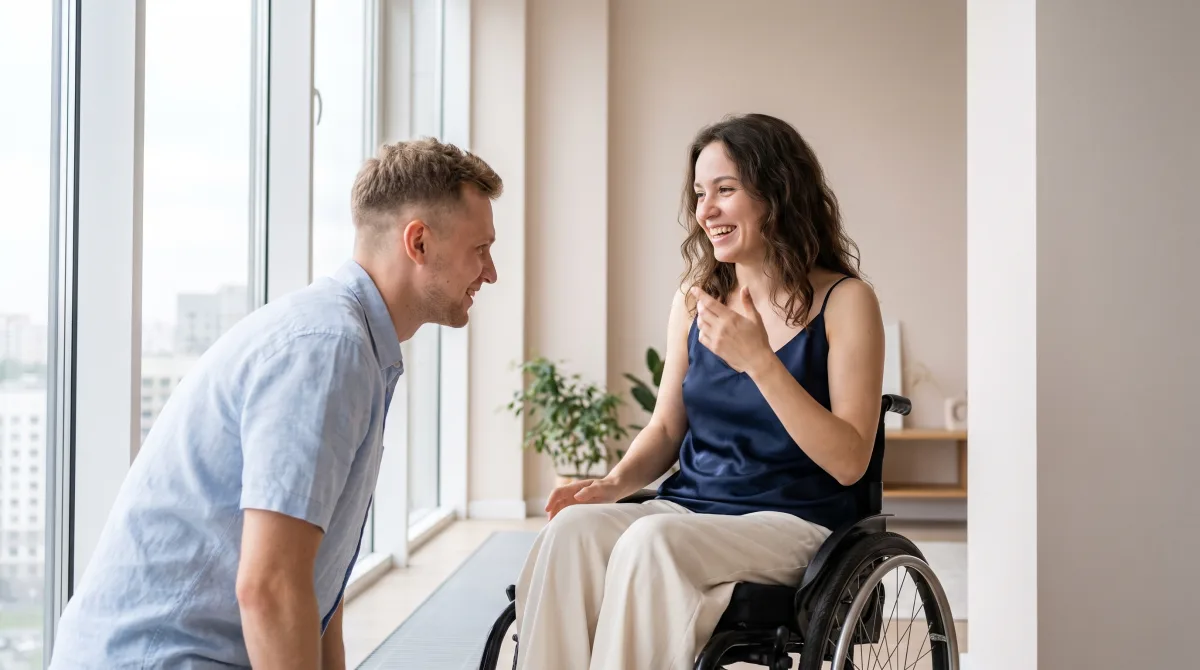
It isn't a separate category of dating — it's dating, with one extra decision layered on top that most nondisabled people never plan for: whether, when, and how much to say about a disability before a stranger decides what to make of it. A 2024 study by Australia's national criminology research agency found that 88% of disabled dating-app users had experienced some form of online harm — significantly more than users without a disability. That's not a fact about disability. It's a fact about a format that shows a stranger a body before anyone's read a sentence.
This is where Anketta's ordering does real work, and not for a sentimental reason. On Anketta, manuscripts are read before any photo is shown — a match forms on writing, and a photo, if someone chooses to add one, only appears afterward, inside that match. There's no field anywhere in the editor asking about a disability, and no length requirement pushing anyone toward a shorter or longer answer than the one they actually meant to give.
Start a manuscript — let the words go firstNo. There's no legal requirement and no universal norm, and "not yet" — or "never" — is a legitimate answer for plenty of people. What the disclosure research keeps finding is that the decision is personal and situational, not a one-time choice: some people lead with it, some wait for real interest first, and many decide differently depending on the app, the person, and the day.
The calculation splits along one real line: what a photo would already show. A wheelchair, a cane, a service animal, a visible difference — something a stranger would see before reading a word, whether or not the writer meant to mention it. A chronic pain condition, a learning disability, a hearing loss covered by hair, a mental health diagnosis — none of that shows up in a photo at all, so the decision stays fully in the writer's hands either way. Both situations deserve their own answer. Neither one is simpler just because it's less visible — either way, drafting the sentence somewhere private first beats deciding it out loud, mid-conversation.
Because a photo-first format puts appearance ahead of everything else by construction. A face, a mobility aid, a wheelchair, or a hearing aid all register in the same glance a stranger uses to decide whether to keep looking — before there's a sentence to read, a joke to land, or a shared interest to notice. A visible disability becomes the whole profile instead of one detail inside a longer one.
Emily Ladau, a disability rights advocate and author of Demystifying Disability, has described making that exact tradeoff deliberately, on purpose, on her own dating profile:
"You couldn't miss it on my profile. And that was very intentional — I hoped it would help rule out people who would write me off just because of my wheelchair. But it also meant I opened myself up to a ton of ableism." — Emily Ladau, author of Demystifying Disability
That's a strategy, not a complaint — she chose to filter early rather than be filtered late. It's also exactly the tradeoff a photo-first format forces on every visibly disabled person using it: screen for reactions to your body before anyone has met your sense of humor, or don't screen at all and take your chances live.
Write your manuscript — the words carry the introductionThe sequence flips. A manuscript is read, matched on, and moderated before any photo enters the exchange, so whatever earns someone's attention first is a sentence, a joke, or a way of describing a Tuesday — not a mobility aid in a thumbnail. The disability isn't hidden. It's just no longer the first thing anyone reacts to.
- Nothing in the editor asks. There's no disability field, no accessibility checkbox, no medical-history prompt anywhere in onboarding — leaving it unmentioned isn't concealment, because nothing ever asked for it.
- Length is the writer's own call. A disability can be one clause in a longer sentence or its own paragraph, and there's no minimum or maximum pushing either way.
- Photos wait for the match. A photo, when someone adds one, is only visible inside an active match, and only to someone who has shared one too — so a mobility aid isn't the first data point a stranger gets.
| Where a disability might come up | Photo-first swipe app | Bio-based dating app | Anketta's manuscript |
|---|---|---|---|
| What a stranger sees first | A photo, instantly, on every profile | A short bio next to a photo | Writing — no photo until a match forms |
| Who decides if it's mentioned | Whatever the photo already shows | The writer, in a tight character count | The writer, at whatever length they choose |
| When a photo enters the exchange | Before the first message | Before the first message | Only inside a match, and only if both sides share one |
| What prompts a disclosure | Nothing built in — improvised | Nothing built in — improvised | Nothing — there's no field to skip |
Yes, in one specific way: asynchronous writing removes the requirement to be sharp, present, and available the exact moment someone else happens to message. A reply can wait for whichever hour of the day actually has energy in it, rather than needing an instant, in-person-quality response the second a notification lands — which matters for chronic pain, fatigue, or any condition where a "good hour" isn't guaranteed in advance.
Unpredictable energy isn't unique to disability, either — single parents run into a version of the same mismatch, fitting a search for connection around a life that doesn't clear its own calendar for anyone.
For an actual first meeting, the practical version of this is different from the emotional one: step-free entry, a quiet spot instead of a loud bar, a bit of extra time to get somewhere. That's not a vulnerability to manage. It's logistics, and logistics land better typed out in advance than negotiated on a doorstep.
Sometimes, and it depends what you're optimizing for. A 2022 peer-reviewed content analysis of 26 disability-focused dating sites found they can offer a more welcoming venue where members are less likely to face ableism or explain a disability from scratch. But the same researchers found these niche platforms often narrow representation instead of widening it — favoring certain kinds of disability, and certain kinds of bodies, over others.
A general-purpose app reaches more people. A disability-specific one reaches people who've already opted into the conversation you want to have. Neither is automatically right, and the choice says more about what you're actually looking for than it does about the disability itself.
There's no universal script, but one finding repeats across the disclosure research: control over the moment matters more than the specific moment chosen. Some people put it in the first paragraph so it's never a surprise later. Others wait until there's real interest worth having that conversation for. Both are legitimate — what actually helps is choosing on your own terms, not improvising it live while somebody else is already typing a reply.
There's a practical safety layer worth knowing about too. Contact details — phone, email, address — are blurred from anyone you haven't matched with, on any manuscript, disability mentioned or not. Given how disproportionately disabled daters get targeted for harassment online, that doesn't erase ableism. But it does mean a phone number isn't just sitting there for a stranger who hasn't earned a conversation yet.
Do I have to mention my disability before meeting someone?
No. There's no legal or app-level requirement, and plenty of disabled daters never lead with it. The honest answer is that the decision belongs entirely to the person living it, on whatever timeline actually feels right for them.
Does it matter whether my disability is visible or not?
It changes the shape of the decision, not whether you get to make one. A visible disability is something a photo would show regardless; a non-visible one stays entirely under the writer's control until they choose to mention it, in either a photo-based or a text-first format.
Is it wrong to wait until later to bring it up?
No — timing preference isn't a moral question. Some people disclose early to filter reactions quickly; others wait for real interest first. Both patterns show up throughout the research, and neither one predicts how a relationship actually turns out.
What if someone reacts badly once they find out?
That reaction is useful information, delivered earlier than it would have been otherwise. A bad reaction to a fact about your life is a reason that person wasn't a match — not a verdict on whether you should have said anything at all.
Are disability-specific dating apps worth trying?
They can be, especially if a mainstream app has felt exhausting. They tend to draw people who've already thought about disability and dating together — the tradeoff is a smaller, sometimes narrower pool than a general-purpose app offers.
Does using a mobility aid hurt my chances on dating apps?
On a photo-first app, it can shape first reactions before there's any writing to counter them with. That's a property of showing appearance first, not a fact about anyone's actual desirability — which is exactly why the order writing and photos appear in matters.
Nobody owes a disability explanation to a stranger's timeline — a format that reads the writing first just means the terms of that explanation, if there is one, were always the writer's to set.
Unsure about writing? Try reading first.