Mere exposure effect
The phrase "mere exposure" was fixed in place in 1968, when the social psychologist Robert Zajonc argued that mere repeated exposure of the individual to a stimulus object enhances his attitude toward it. In plain terms: the more often you meet something, the more you tend to like it, with no argument or persuasion involved. It matters to anyone who has ever warmed to a person they first dismissed.
The word "mere" is doing a precise job there. It means contact and nothing more, no conversation required, only that the thing was within reach of your attention.
Write something worth meeting twiceThat precision is also the reason the effect gets misread. It does not say that anyone will grow on you; it says that familiarity is one of the ordinary ways liking forms, and that a first look at a person never gets the chance to use it.
It comes from a monograph Zajonc published in the Journal of Personality and Social Psychology in 1968, and he defined his own term carefully. By "mere" exposure he meant a condition making the stimulus accessible to the individual's perception. The evidence he gathered was mostly about words and nonsense symbols, which people rated more favorably the more often they had seen them.
His opening, though, was a story from a newspaper. On February 27, 1967, the Associated Press reported from Corvallis, Oregon: "A mysterious student has been attending a class at Oregon State University" wrapped in a big black bag, with only bare feet showing. The professor knew who was inside. The twenty students did not. Over two months, the report said, the class's attitude changed from hostility toward the Black Bag to curiosity and finally to friendship.
A newspaper anecdote is not an experiment, and Zajonc used it as a question rather than proof. The experiments came after: the paper reviewed four kinds of evidence, from word-frequency counts to controlled showings of unfamiliar faces and symbols.
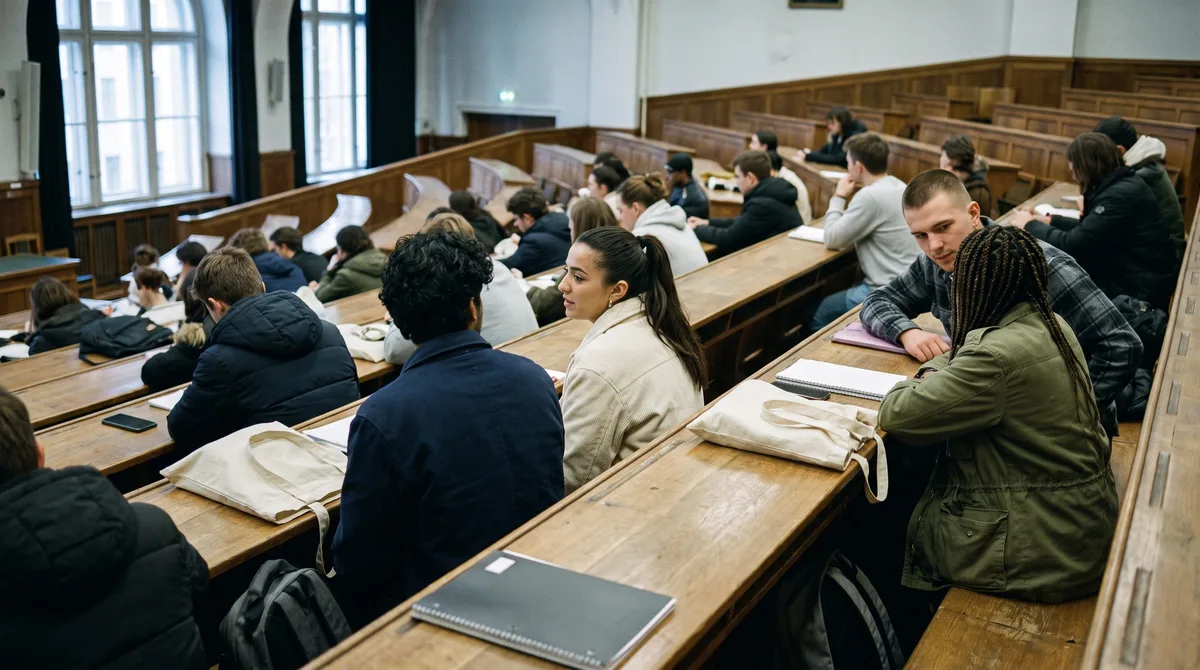
The best-known test of the idea on real people is Moreland and Beach's classroom study, published in 1992 in the Journal of Experimental Social Psychology (Moreland and Beach, 1992). Four women of similar appearance attended a large lecture course as though they were students, each coming to a different number of sessions, from none up to fifteen. Students later rated photographs of them, and the women who had been in the room more often were rated more positively.
Treat that as the study's direction, not as a number to quote: the publisher's page was closed to us, so the figures are left out on purpose.
What the design shows is how little contact the effect needs. The women never spoke to the students. Their only offence, or charm, was sitting in the same room again and again, and a room is the least demanding form of contact there is.
Both claims have a paper behind them, and the disagreement is the useful part. Norton, Frost and Ariely found that more information about others leads, on average, to less liking, because each new trait is a fresh chance to find a difference. Reis and colleagues answered with live conversation: the more participants interacted, the more attracted they were to each other.
The two sit side by side without cancelling. Norton's volunteers read lists of traits about a stranger, while Reis's pairs of previously unacquainted people actually talked. Reis traced the gain in liking to three processes:
- Perceived responsiveness: the sense that the other person was listening and answering.
- Comfort and satisfaction during the interaction itself.
- Perceived knowledge: feeling that you had come to know the person.
| Mere exposure (Zajonc, 1968) | Reading a list of traits (Norton et al., 2007) | Live interaction (Reis et al., 2011) | |
|---|---|---|---|
| What the person gets | Repeated contact with the same stimulus | More and more facts about a stranger | Talking with a stranger for varying lengths of time |
| Direction of liking | Rises | Falls, on average | Rises |
| Why | Accessibility to perception | Each fact is a chance to find dissimilarity | Responsiveness, comfort, perceived knowledge |
Information about a person and time spent with a person turn out to be different things. Exposure grows liking when the contact is shared and low-stakes, and it can sour when it arrives as a checklist.
It stops working when there is too much of it. A 2017 meta-analysis by Montoya and colleagues pooled 268 curve estimates from 81 articles and found the effect was characterized by a positive slope and negative quadratic effect consistent with an inverted-U shaped curve. Liking climbs with the first repetitions, flattens, then can drop. The fifteenth sighting does not work like the first.
That is why the effect is not a licence for persistence. A person who messages someone ten times is not running a mere exposure experiment; the other person knows they are being worked on, and the contact has stopped being mere. Repeated contact helps when it is available and unpressured, and it is the invitation that makes it low-stakes.

A glance gives the effect no time to start. It has one exposure, usually under a second, and it asks for a verdict on that single look. Swipe culture turned that into a habit: the decision arrives before the second sight, before the third, before the thing that was going to grow on you has had a chance to.
There is a second cost. The first look is the one least like the person. It carries a camera angle and a mood of the day, and almost none of what makes someone a good conversationalist. Text and photo pull in different directions here, because words can be returned to and a single picture mostly cannot be learned any further.
None of this says that first impressions are always wrong. It says that a dating format which only permits one of them, and then moves on, has removed the mechanism that corrects them. The people most hurt by that are the ones who do not look like their best photograph in the first second: the reserved, the slow to warm, the person who becomes funny in the third message.
Give a stranger more than one lookOn Anketta you meet someone through their manuscript, a written document you read in full rather than a card you pass in a second. You underline the lines you like, and underlining a line is not the same as liking the person: you can mark three lines and still pass. A match opens a 48-hour window, and it becomes permanent only if both people actually wrote to each other. Photos come after the match, and only if both have shared one.
None of that is a mere-exposure machine, and the app does not claim the effect as a feature. What it does is stretch the first meeting from a glance into a read, and give a match two days of contact that cost nothing to start. Whether a second message turns into warmth is still up to two people, and the research above says it often does.
What is the mere exposure effect in simple terms?
It is the tendency to like something more after repeated contact with it, without any other reason. Robert Zajonc named it in 1968. The contact needs only to be accessible to your attention, not meaningful, and it covers words, images and people alike.
Who discovered the mere exposure effect?
Robert Zajonc is credited with naming and formalizing it in his 1968 monograph, though earlier researchers had noticed the pattern with words and symbols. His paper gathered four kinds of evidence, including how often words are used and how favorably they are rated.
Does the mere exposure effect work on people?
Yes, with limits. Moreland and Beach's classroom study found that women who attended more lecture sessions were rated more positively. Live interaction research by Reis and colleagues found the same direction for conversation. It works best when the contact is low-pressure and the person is not actively disliked.
Can too much exposure backfire?
Yes. A 2017 meta-analysis of 81 articles found an inverted-U curve: liking rises, then can fall as repetitions pile up. Contact that feels pressured or unavoidable loses the "mere" and tends to produce irritation instead of warmth.
Is the mere exposure effect the same as propinquity?
No. Propinquity is about physical nearness predicting who meets and befriends whom. Mere exposure is about the liking that follows repeated contact, whether or not you were near. The two overlap in everyday life and are separate ideas.
How does the mere exposure effect relate to dating apps?
It shows why a single-look verdict is a weak test. One exposure gives the effect no chance to work. Formats that give a person a second and third contact, such as a manuscript read in full or a conversation window, leave room for familiarity to do its part.
The students in that Oregon room did not know who was inside the bag; they knew only that it came back every Monday, Wednesday and Friday.