Dating After Losing a Partner: For Widows and Widowers
Dating after losing a partner isn't a single moment you arrive at — it's something that becomes true for some widowed people within months and not at all for others, and both are ordinary. Carr (2004) found that among older widows and widowers, interest in dating roughly doubles over the first year and a half after a spouse's death — from 17% to 37% among men, and from 6% to 15% among women. Even at 18 months, though, most bereaved people still weren't looking for a relationship. This is for the ones who are — or who are starting to wonder.
The harder problem usually isn't emotional readiness — it's structural. Most dating profiles give everyone the same handful of lines, with no room for the fact that someone mattered enough to build a life with and then died. Anketta's manuscript has no length requirement and no fixed fields, so a late partner can take up a sentence, a full section, or nothing at all — whichever the writer actually wants.
Start writing your own manuscript on AnkettaMost dating advice assumes one of two starting points: someone who has never been seriously partnered, or someone freshly out of a breakup they're trying to stop thinking about. Widowed daters are neither. The relationship didn't end because it failed — it ended because one person died. Advice built for getting over disappointment doesn't fit a history you were never trying to leave.
That mismatch shows up in almost every generic line. "Get back out there" assumes there's an "out there" you left on bad terms. "Don't rush it" assumes rushing is the risk anyone's actually worried about. Neither one answers the real question, which sounds more like: how do you let someone new in without acting like the person before them didn't happen?
There's no single answer, and the honest one resists a tidy takeaway. Interest in dating went from 17% to 37% among men and 6% to 15% among women between six and eighteen months after a spouse's death — real movement, but movement toward a minority position. By eighteen months, most bereaved people still weren't looking for a relationship at all, and the ones who had started dating by then (23% of men, 9% of women) had gotten there on no fixed schedule.
A few things held steady across that data that are worth sitting with:
- Some people feel the pull toward dating within months — that's real, not haste.
- Some people don't feel it at all, or not in any timeframe researchers have studied — that's real too, not a sign anything is wrong.
- The overall shift happens gradually across the first year and a half, not because a clock runs out, but because interest moves on its own schedule for each person.
None of this is about staying slow on purpose. It's closer to slow dating by circumstance than by design — the pace was never a choice to begin with, so there's nothing to speed up.
No — and research on remarried widows backs that up directly. Dekel, Shorer & Nuttman-Shwartz (2022) studied women who remarried decades after their first husband's death and found that most of them had maintained an ongoing connection to him throughout — not despite the new marriage, but running alongside it. Still thinking about, mentioning, or feeling connected to someone who died isn't evidence that you haven't moved. It's closer to what a life with more than one important person in it actually looks like.
"Dating has been described by older women as having 'someone to go out with' rather than 'someone to come home to.'" — Karen Davidson, quoted in Carr (2004), Journal of Marriage and Family
That distinction matters more than it first sounds. Wanting company for an evening isn't a smaller version of wanting a spouse back — it's a different, entirely legitimate thing to want, and nobody else gets to decide which one you're allowed to be looking for.
A standard dating bio gives you a handful of lines and one tone for all of them: upbeat, brief, forward-facing. There's no natural place in that format for a marriage, and none at all for how it ended. Say too little and you're hiding something true about your life. Say anything and it can read as though the whole profile is about someone else.
That's a formatting problem more than an emotional one. The bio field wasn't built with widowed daters in mind. It was built for a first relationship, not a second one.
As much or as little as you want, and you can change your mind later. A manuscript on Anketta isn't a form with a slot marked "past relationships" — it's a page you shape yourself, in headings and paragraphs, at whatever length actually fits what you want to say.
| What a bio field forces | What a manuscript allows |
|---|---|
| A handful of lines, one tone for everything | No length requirement — a sentence or several sections |
| Every detail competes for the same tiny space | A late partner can get a paragraph, a line, or nothing |
| Editing means rewriting the whole thing | You can rework one section without touching the rest |
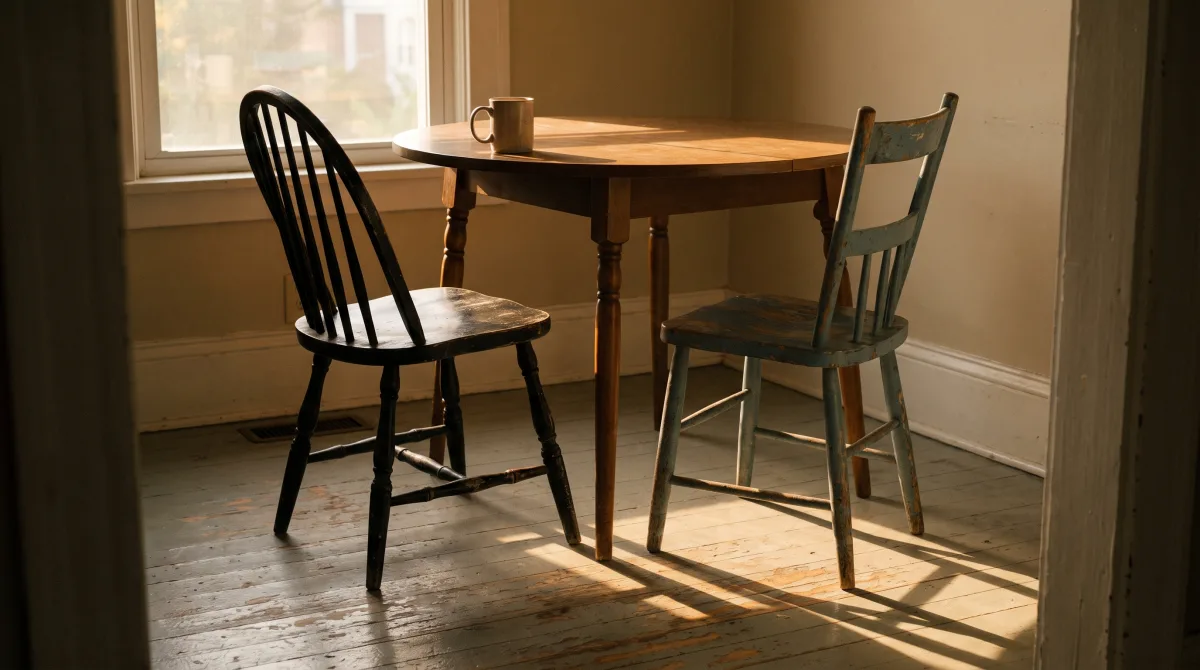
Some widowed writers give their late partner a full section. Some mention them in a single sentence, folded into a bigger story about what they've learned since. Some don't bring it up at all and let a reader ask, if they're curious. Every one of those is a complete, honest manuscript — the same way dating after divorce doesn't require a paragraph about an ex to count as honest. The difference here is that nothing is forcing the decision before you've made it yourself. You can start one whenever the timing feels like yours, not anyone else's.
Carr's research also found that men and women didn't differ much in their eventual interest in remarriage (26% vs. 19%, not a statistically significant gap) — but they did differ in how they talked about dating itself. Older women in the study described wanting "someone to go out with" more than "someone to come home to," while men's interest in remarriage tracked more closely with wanting steady day-to-day support. Neither pattern is a rule for any individual — it's an average across hundreds of people, and averages don't know your specific life.
What the research does support is that "widow" and "widower" aren't a single experience wearing two labels. If you're writing your own manuscript, that's one more reason it stays yours to shape rather than something a form shapes for you.
Two things that traditional dating apps get wrong for almost everyone, but especially for widowed daters: the cold open, and the pressure to perform in real time. A blank chat window with a stranger means inventing small talk from nothing, often at the exact moment you'd least want to perform "fine." By the time a conversation opens on Anketta, the other person has already read what you wrote and highlighted a specific line in it, so the first message has somewhere real to begin instead of nowhere.
The second piece is disclosure timing. Nobody has to decide, mid-conversation and under a stranger's gaze, exactly how and when to mention that they're widowed. A manuscript gets written and edited before anyone reads it, which means that decision gets made calmly, once, on your own schedule — not live, under pressure, with someone waiting on your next line.
Is it okay to start dating again while I still think about my late partner?
Yes. Thinking about someone you were married to isn't a symptom to manage or a phase to finish — it's a normal part of having loved them. Research on remarried widows found that most kept an active, ongoing connection to a late spouse well into a second relationship, without it undermining the new one.
Do I have to mention that I'm widowed on my profile?
No. There's no field that requires it, and no rule that says leaving it out is dishonest. Some writers give it a full paragraph, some a single sentence, some nothing at all — all three are complete profiles, and you can always add more later.
Is there a "right" amount of time to wait before dating again?
No research supports one. Interest in dating varies enormously by person — some widowed people feel ready within months, others don't for much longer, and both are documented, ordinary outcomes rather than anything to diagnose.
Is dating after loss different for widows than for widowers?
Some average differences show up in research — men and women didn't report identical timelines or reasons for wanting to date again. But averages describe groups, not individuals, and your own manuscript is where your specific version gets to be the actual answer.
Can I write about my late partner in my Anketta manuscript?
Yes, in whatever amount you choose. The manuscript has no required fields and no length limit, so a late partner can appear in a full section, a passing mention, or not at all, and you can edit any of it later.
What if someone reacts badly to knowing I'm widowed?
That says more about them than about you. A manuscript lets you write and revise how you'll say it before a stranger ever reads it, so at least the moment itself isn't happening live, under pressure, with no time to choose your own words.
None of this changes if you're also dating as a single parent while you're figuring the rest of it out — the manuscript adapts to whatever else is true about your life right now.
Nobody needs permission to write the next chapter, and nobody else gets to decide how much of the last one belongs in it.
Unsure about writing? Try reading first.