Dating for Digital Nomads: New City, Same Story
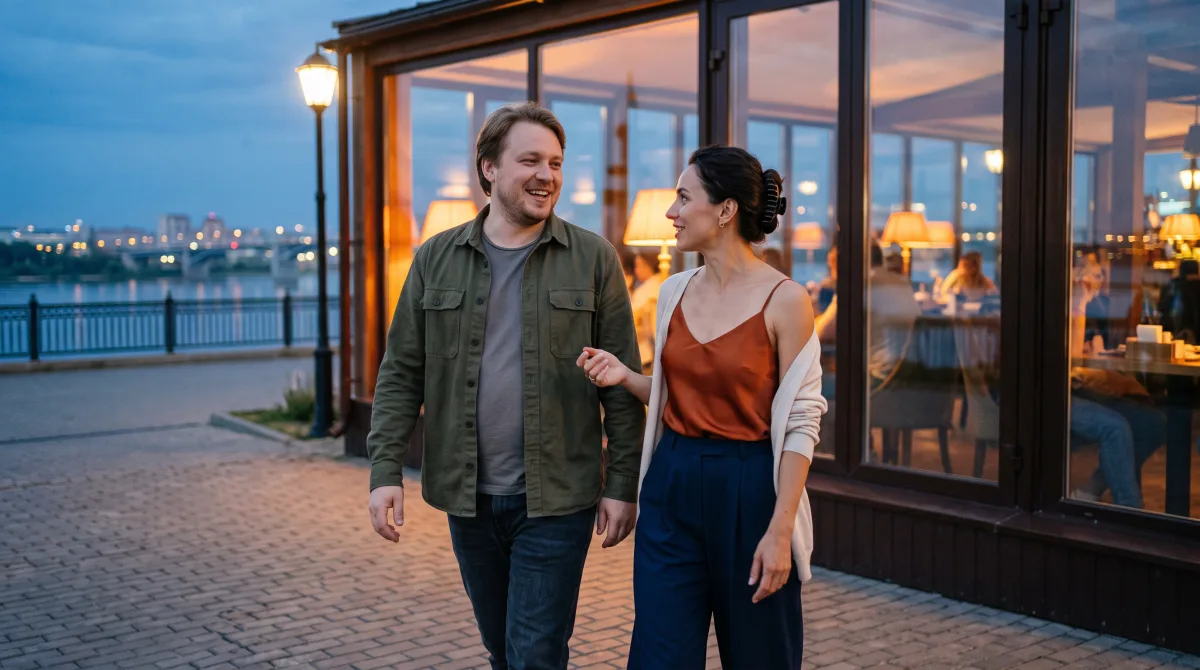
Dating for digital nomads is dating where the city changes every few weeks, not just the person across the table. It's a genuinely different problem from long-distance or cross-cultural dating — and from dating someone who just loves to travel but still comes home to the same address between trips: a 2025 peer-reviewed study on digital nomads' romantic relationships names location-based conflict as its own category, distinct from time-based or money-based strain, because relocating on a fixed schedule keeps resetting who you know before anything has time to settle.
That's the part most dating-app design ignores. Local-pool matching assumes you'll still be around next month to build a reputation; a nomad often won't be. Anketta shows no photos before a match and matches on what you actually wrote, so someone three weeks into a new city gets read on their words immediately — the premise behind text-first dating as a category — not on the weeks of being seen around town that a short stay never allows.
Write the manuscript that travels with youBecause, socially, it is starting over. Each relocation resets who you know, who'd vouch for you, and how long anyone's actually had to notice you exist. Pew Research Center (2023) found about four-in-ten U.S. adults (42%) say online dating has made finding a long-term partner easier — but that figure assumes a stable local pool most nomads simply don't have.
The reset isn't only social. It's informational. A swipe app's whole value proposition rests on volume — a local pool big enough that the algorithm can afford to be picky on your behalf. Someone staying six weeks doesn't get six months for that pool to notice them, and the pool doesn't reorganize itself around a person who's already halfway to leaving. So the real question isn't whether online dating helps daters in general. Pew's number says it does. It's whether the mechanism behind that number holds up for someone whose "local" changes every few weeks. Mostly, it doesn't — and the reason now has a name.
It says the friction is structural, not personal. A 2025 study on digital nomads' romantic relationships, published in Information, Communication & Society, identifies four distinct conflict types inside these relationships — attitude-based, location-based, time-based, and money-based — and treats location-based strain as its own category, separate from the schedule friction remote workers describe.
"DNs face challenges when trying to establish enduring personal relationships due to their networks comprising other DNs, who are constantly on the move." — Cristina Miguel, Christoph Lutz, Rodrigo Perez-Vega & Filip Majetić, 2025 study on digital-nomad loneliness (full study)
Read that carefully and it isn't really about digital nomads dating other digital nomads. It's about what happens to a social network — romantic or otherwise — when nobody in it is staying still long enough to become load-bearing. A separate paper on the same population, Miguel, Lutz, Xiao, Majetić & Perez-Vega (2025), put a name on the specific strain: relocating on a schedule doesn't just complicate an existing relationship, it complicates the part before that — actually meeting someone worth having one with.
Because their architecture is built around a stable local pool: hard filters that expect a fixed city, an algorithm that rewards volume and repeat exposure, and a queue that quietly deprioritizes anyone who hasn't been active long enough for the system to learn their taste. None of that is a design flaw exactly. It's just optimized for someone who isn't leaving.
| Question | Typical swipe app | Anketta |
|---|---|---|
| What decides who you see? | A local pool, refreshed mostly by volume and proximity | Hard filters (age, city, intent) plus what people have actually highlighted in what you wrote |
| What are you judged on first? | A photo grid, before anyone reads a word | Your writing — there's no photo before a match |
| How much local history do you need? | Enough for the algorithm to have learned your taste | None. The manuscript carries the context a longer stay would otherwise have to earn |
| What happens the day you leave? | The pool moves on; conversations that never quite started usually just don't | A match already open keeps its 48-hour window regardless of which city either of you is in |

It removes the one thing that actually needs time: building visible proof you're worth someone's attention. On Anketta there's no photo before a match — you're read on what you wrote, and a match only forms once someone has highlighted a phrase in your manuscript and pressed the heart back. That's not slower vetting. It's vetting that doesn't require weeks you don't have.
Most of what a swipe app calls "getting to know someone" is really a substitute for the local reputation a nomad hasn't had time to build: mutual friends who'd recognize a name, a face someone's already seen around a coworking space, a story that's made the rounds. Strip all of that out and you're left with the one thing that was always portable — what a person actually chose to write about themselves — which is precisely what a manuscript is built to carry from one city to the next. You can start writing before your next flight and the manuscript is still there, unchanged, when you land.
Let your writing do the vetting you don't have weeks forNot an itinerary. A list of countries tells a reader where you've been; it says almost nothing about who they'd be dating. The manuscripts that land tend to do three specific things:
- Name the rhythm, not the route. How an actual week goes — the hours you protect, the way you work, what you do when the wifi is bad — says more than a list of stamps in a passport ever will.
- Say what stays constant when the city doesn't. A habit, a running joke with an old friend, a book you keep rereading. Continuity is the detail a nomad's writing can offer that a nomad's itinerary can't.
- Be honest about what "a few weeks" means to you. Some people are looking for company while they're in town; others are open to something that could survive a time difference if it's worth it. Say which, plainly, rather than making a match guess.
It's worth starting something honest, which isn't the same question as something permanent. Slow dating isn't really about staying in one place — it's about not skipping the part where you actually find out who someone is before deciding what they're worth to you. A short stay doesn't disqualify that. It just means there's no time to waste on the version of dating that treats volume as a substitute for depth.
Six weeks in a city is enough time for one real conversation, if the format doesn't force you to spend the first two proving you're not a stranger. It's usually not enough time for ten mediocre ones with the good one buried somewhere in the pile — which is the actual math a swipe app asks a short-term visitor to run. Write instead, and the sorting happens differently: fewer people see the manuscript, but the ones who do have already read something true about you before either of you said hello.
That's the whole bet a nomad makes on writing first — not that it's faster, but that it doesn't waste the little time a short stay actually gives you. Somewhere between a coworking desk and the next departure gate, one conversation gets to matter more than the twenty that didn't, and it started on a page rather than in a photo grid, which is exactly why it travels wherever you go next.
Is Anketta worth trying if I won't be in one city for long?
Yes, and the mechanic works in your favor. Matching doesn't require weeks of visible local history — there's no photo before a match, so you're read on your manuscript from the first highlight, not on how long you've been a familiar face around one neighborhood.
Do I need a local reputation before people take my manuscript seriously?
No. Matching runs on hard filters — age, city, intent — plus what people highlight in your writing, not on local familiarity. A manuscript that's three days old reads exactly the same as one that's three months old.
Do I need a photo to start a conversation?
No. Photos are optional, capped at three, and none of them show before a match. Whoever highlights a line in your writing and hearts it back is responding to what you wrote, not to what you look like.
How long does it actually take to match with someone?
There's no fixed timeline. A match forms the moment two people have each highlighted something in the other's writing and pressed the heart — that can happen the same day you write your manuscript, or weeks later, whenever the right line lands.
What happens if I match with someone right before I leave a city?
The match doesn't expire the moment you pack. Every match opens a 48-hour window either person can use — long enough to trade a few honest messages before you're on a train or a flight, without a live chat forcing an answer that minute.
Is writing a manuscript slower than swiping through a few profiles?
Slower to start, yes. Faster where it counts. A manuscript takes longer to write than a swipe takes to register, but it also skips the weeks a photo-first app spends letting a local pool warm up to a new face — and for someone changing cities every few weeks, that trade runs the other way.
Unsure about writing? Try reading first.Somewhere down the line the address changes again, the view outside the window changes with it, and none of that touches the one conversation that was actually worth having — because you wrote it, not because you happened to be standing nearby.