Dating Apps Without Compatibility Quizzes, Explained

A dating app "without a compatibility quiz" is one that never makes you answer a battery of personality or relationship questions before it shows you anyone. No forty-item survey, no computed percentage, no scored intake standing between signup and your first match. That absence matters more than it sounds: Bumble's 2025 Dating Trends Report found that nearly two in three women — 64% of more than 40,000 members surveyed — are getting explicit about exactly what they want and refusing to settle for less. A generic score, built from someone else's categories, is a strange stand-in for that kind of clarity.
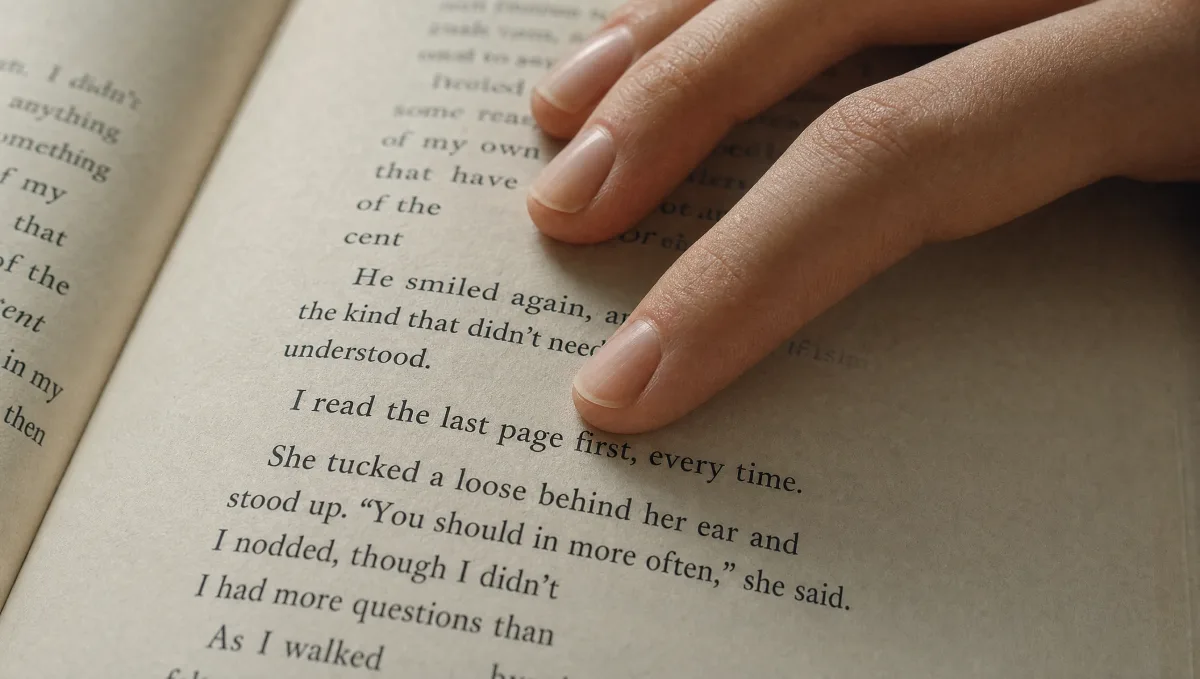
Anketta skips the quiz differently than most "no intake" apps do — it doesn't just hide the form, it replaces the signal underneath it. There's no signup survey and no personality score anywhere in the product; the editor opens as a blank page. Instead, matching learns from what you actually do while reading: highlight a line in someone's manuscript as something you like, and Anketta stores that phrase as a preference; cross a line out, and it stores the opposite. Do that consistently — a like twice, a cross-out three times — and the preference moves from pending to active, and the next batch of manuscripts you see skews toward it.
Write your manuscript — no quiz required.Skipping the compatibility quiz means the app has no upfront survey scoring your personality, values, or relationship style before it ranks who you see. eHarmony's Compatibility Quiz, OkCupid's match questions, and similar intake forms all sit in front of the product — you fill them out once, and a formula decides who gets surfaced. An app without one either drops the step entirely or replaces it with something else.
That's a different claim from "no setup at all." Most people still expect to say who they are and who they're looking for — an age range, a gender, a city. The quiz specifically means the compatibility-scoring step: the part where an algorithm decides you're a 78% match with a stranger based on how you both answered thirty questions about conflict style and religion.
Not reliably, according to the researchers who have looked hardest at it. Eli Finkel and four co-authors reviewed the online-dating industry for Psychological Science in the Public Interest in 2012 and found "little evidence that these algorithms can predict whether people are good matches or will have chemistry with one another." No major dating site has since published independent data that overturns that conclusion.
"There is little evidence that these algorithms can predict whether people are good matches or will have chemistry with one another." — Finkel, Eastwick, Karney, Reis & Sprecher, Psychological Science in the Public Interest (2012) Association for Psychological Science
A related 2020 study in the Proceedings of the National Academy of Sciences makes a similar point from a different angle. Joel, Eastwick, Finkel and dozens of co-authors ran machine learning over 43 couples studies and found that "individual differences and partner reports had no predictive effects beyond actor-reported relationship-specific variables alone." In plain terms: the traits a quiz can measure about you as an individual — the kind of thing a personality test captures before you've ever met anyone — added nothing once researchers already knew how someone felt about the relationship itself. Compatibility looks like something that gets discovered between two specific people, not predicted about either one alone.
The split isn't clean. eHarmony and OkCupid both open with a scored questionnaire; Hinge and Tinder skip the quiz but still rank you by engagement and behavior rather than by your writing; Anketta skips both the quiz and the engagement scoring, and matches on the manuscript you write plus what other people highlight in it.
| App | Quiz before you see anyone? | What actually drives who you're shown |
|---|---|---|
| eHarmony | Yes — an 80-question Compatibility Quiz, ~20 minutes | A computed Compatibility Score |
| OkCupid | Yes — an open-ended bank of match questions, weighted by importance | A computed match percentage |
| Hinge | No formal quiz | Behavioral picks — who you like, skip, and reply to |
| Tinder | No quiz | Swipe volume and profile completeness |
| Anketta | No quiz, no intake, no questions at all | What you highlight or cross out while reading someone's manuscript |
For a closer look at what an 80-question quiz buys you — and what it costs — see Anketta vs eHarmony.
By watching what you do with real writing instead of asking you to predict yourself in the abstract. Every time you highlight a phrase in someone's manuscript as something you like, or cross one out, Anketta records it as a preference — not a guess about your personality, but a note about a specific phrase you reacted to.
- You write your own manuscript — headings and paragraphs, no fixed prompts, no word count to hit.
- You read other people's manuscripts and mark lines as you go: highlight what pulls you in, cross out what doesn't.
- Each mark is stored as a word or phrase preference, positive or negative.
- Once a signal repeats — the same kind of phrase liked twice, or crossed out three times — the preference promotes from pending to active.
- The next batch of manuscripts you're shown skews toward the active preferences, and away from whatever you've consistently crossed out.
There's no dashboard showing your "type," and no percentage attached to any of it. The narrowing happens quietly, in the background, and it only reflects what you actually did — not what you predicted you'd want before meeting anyone.
You lose the reassurance of a number. A compatibility score gives you something to point to — "78% match" — even if the research above suggests that number doesn't reliably predict chemistry. Skipping it means trusting your own read of someone's writing instead of a formula's.
Skipping the quiz doesn't mean skipping setup entirely. Age range, gender, the city you're browsing, and whether you're there for relationships or friends are still asked once, as hard filters — not as inputs to a scored formula, just as the boundaries of who you'll ever see. Inside those boundaries, nothing about you is pre-scored.
If the alternative is a formula nobody outside the company has verified, writing a few honest paragraphs is a reasonable trade. It also filters harder than a quiz does, in its own way — writing a manuscript takes longer than checking thirty boxes, and reading someone else's takes longer than glancing at a percentage. For anyone tired of matches that evaporate at the first real conversation, that extra minute is the point, not the cost.
If you haven't written a manuscript before, expect it to take longer than any quiz. That's not a flaw in the format — it's the same slowness Finkel's research points to: nothing about a stranger's compatibility gets settled by a form, however long.
Do I have to answer any questions before Anketta shows me anyone?
No. There's no signup survey and no personality test. You write a free-form manuscript at your own pace, and matching starts from what people highlight in it — not from anything you filled out beforehand.
What replaces the compatibility quiz on Anketta?
Reading. When someone highlights a phrase in your manuscript as a like, or crosses one out, that becomes a stored preference. Do it consistently enough, and the app starts showing you more of what you've responded well to.
Is eHarmony's Compatibility Quiz backed by independent research?
Not conclusively. Eli Finkel and colleagues reviewed the field in 2012 and found little evidence that dating-site matching algorithms predict good matches better than chance — and no major platform has since published data that overturns that finding.
Do Hinge or Tinder use a compatibility quiz?
No — neither runs a scored questionnaire before you start seeing people. Hinge leans on behavioral signals like who you like and skip; Tinder leans mostly on swipe volume and profile completeness.
How many highlights does it take before Anketta learns a preference?
Two matching highlights promote a "like" preference from pending to active; three matching cross-outs do the same for a dislike. Below that threshold, the signal is still gathering evidence.
Can I still filter by age, gender, or city without a quiz?
Yes. Those are hard filters set once at signup — they narrow who you can ever see, but nothing about them feeds a compatibility score, because there isn't one.
Why do compatibility quizzes feel reassuring even without solid evidence behind them?
Because a number feels more objective than a feeling. Finkel's own review doesn't call quizzes useless — self-reflection has value on its own — it just means the "we did the science" framing oversells what any current algorithm can actually verify.
Unsure about writing? Try reading first.No quiz can read the sentence you paused on twice; only another reader can, and that's the only compatibility signal Anketta ever bothered to build.