The 36 Questions to Fall in Love: What They Really Do

Twelve experiments, run on strangers in a park, executives at financial firms, and pairs of college students, found the same small failure of imagination: people expect a new acquaintance to care less about their real answers than that acquaintance actually does, so the conversation stays shallow by default — Kardas, Kumar & Epley (2022). The 36 questions are a much older fix for exactly that failure: three sets of twelve, asked in turn between two people, escalating from favorite dinner guests to your most private regret. Aron, Melinat, Aron, Vallone & Bator (1997) built the list to generate closeness, not love, inside a single sitting.
Say you're three questions deep into a first date and already reaching for your phone — not from boredom, but because nobody handed you anything better to ask.
Whatever you've been avoiding asking out loud has a place to actually write it down first.
Write the question you'd actually want answered.Arthur Aron and his co-authors built the list in 1997 to solve a lab problem: how do you make two strangers feel close in under an hour, on purpose? Pairs took turns answering, moving from mild to deeply personal over about 45 minutes. What came out was closeness — not romance, and not a promise that the feeling outlives the room it happened in.
"By the end of 45 minutes, people are almost as close – on the average – to the previous stranger as they are to the closest person in their life." — Arthur Aron, the psychologist who designed the study, RNZ (2018)
That kind of fast closeness runs on the same currency as being more vulnerable in dating generally — someone has to answer first, and mean it.
Set I stays light: an ideal dinner guest, a perfect Sunday. Set II asks for real values and real memories. Set III asks for regret, mortality, and the thing you'd want a near-stranger to know about you before the conversation ends. Each set only lands because the one before it built enough trust to survive it.
A sample, drawn from the original list: Set I asks something almost playful — "Given the choice of anyone in the world, whom would you want as a dinner guest?" and "What would constitute a 'perfect' day for you?" Set II turns serious — "What is your most terrible memory?" Set III asks the last question in the whole sequence, the one built to land hardest: "If you were going to become a close friend with your partner, please share what would be important for them to know."
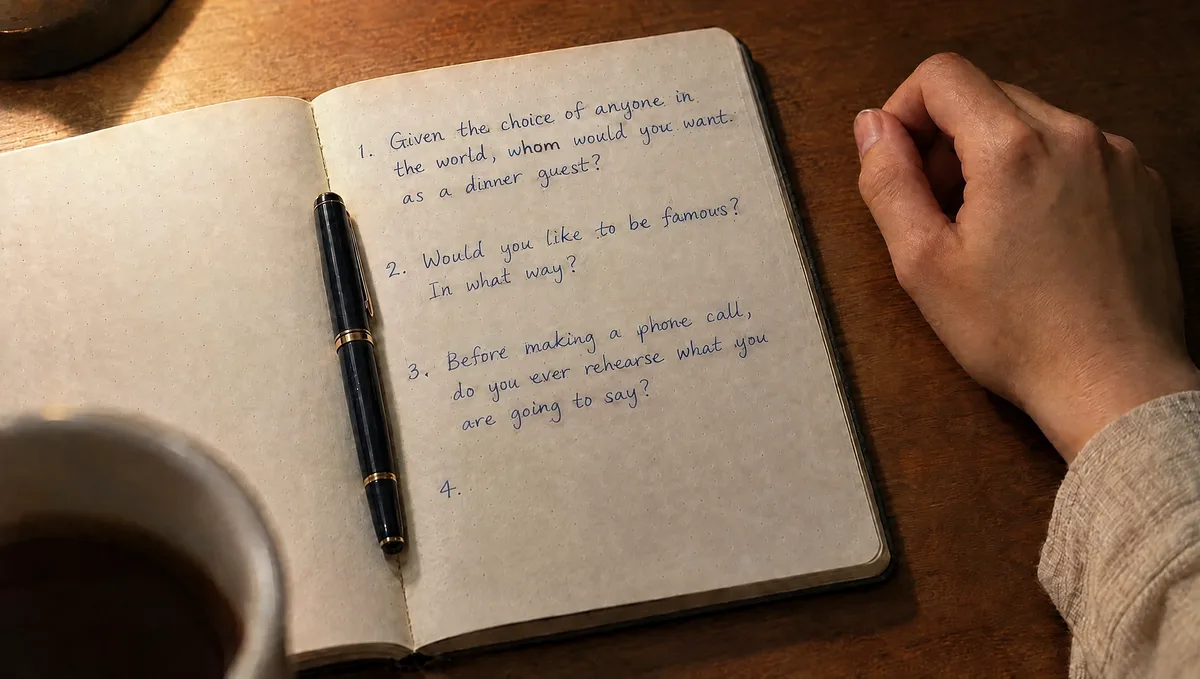
The list rewards structure more than enthusiasm, and it works better as a small ritual than as material read cold off a screen. A few rules separate a real exercise from an awkward reading assignment, and most of them are about pacing rather than the words themselves:
- Set aside 45 minutes with no interruptions — a phone face-down, not just silenced.
- Take turns, one question at a time, both people answering the same one before moving to the next.
- Go in order. Skipping to Set III early skips the trust Sets I and II were supposed to build, and it just reads as an interrogation.
- Answer like you mean it, even the light ones — a performed answer stalls the same conversation a real one would open up.
- Stop wherever you both agree to stop. The list is a structure, not a contract you owe someone the ending of.
None of this requires two people who are already comfortable with each other — the closeness effect was strongest, in the original study, precisely because the pairs were strangers with nothing built up yet to lean on. A first date that only has twenty minutes can still borrow the shape: run through Set I and part of Set II, and stop there on purpose rather than rushing toward the hardest questions to prove something.
If the list itself feels stiff to open cold, a shorter set of conversation starters works fine as a warm-up before you try the real one.
One clarification worth having before you promise someone a specific ending: the four minutes of silent eye contact that sometimes gets tacked on afterward comes from a separate lab exercise, not this one. Aron's team built that one to test romantic attraction specifically; the 36 questions were built to test closeness. Conflating them oversells what either exercise is actually claiming to do.
Try the format built for saying the real answer, not the polished one.Not by the study's own account. Aron has been explicit, in the decades since, that the questions were built to create closeness, and that closeness isn't the same finding as romantic love — love carries its own separate machinery of desire that a 45-minute lab session was never designed to produce. A magazine feature in 2015 turned the list into shorthand for "the love questions," and the label outlived the caveat that came with it.
That fast, engineered closeness can still feel a lot like the thing people call chemistry — built by structure this time, instead of by a spark neither person controlled. A well-built compatibility quiz does something the 36 questions can't: it surfaces three shared interests before either of you has said a word. What it can't do is make the disclosure feel risked, which is the actual variable behind why the list works at all.
The original study happened out loud, in one room, with an answer landing the moment it was given — no version of it has been tested at the same scale over text. What's actually testable is the mechanism underneath: escalating, reciprocal self-disclosure, not the medium it travels through. A written answer can hold the same escalation fine; it just trades the immediate reaction a spoken answer gets for the chance to actually think before you send it.
That trade is close to how Anketta's own matching starts: two strangers exchange writing — a manuscript, organized into the headings the person chose, read start to finish — before either one has seen a photo. Underlining a line someone wrote is the first real response either side gives, not a snap judgment on a face; you can see how the writing works without committing to anything past reading one.
Do you have to be strangers for the 36 questions to work?
The original study used pairs of people who had never met, which is where the closeness effect is strongest and best documented. Aron himself has said the same list does noticeably less for a relationship that already exists, since there's less genuinely new ground left for the questions to open up.
How long does the whole exercise actually take?
Plan for about 45 minutes if you go through all three sets without rushing. Some pairs stretch it past an hour once a question opens into an actual conversation instead of a straight answer — which is normal, and arguably the point.
Is the eye-contact part required?
No. The four minutes of silent eye contact often mentioned alongside the 36 questions comes from a different experiment entirely, built to test romantic attraction rather than closeness. Doing it changes what you're actually testing, so treat it as optional rather than the exercise's real ending.
Can you use the list solo, as a journaling exercise?
You can answer the questions alone, but you'd be measuring something different — self-reflection instead of the reciprocal disclosure the original closeness effect depends on. The mechanism needs two people actually taking turns, not just one person writing.
Where can you read the complete list of all 36 questions?
The University of California, Berkeley's Greater Good in Action project hosts the full set, organized by the same three escalating sets described here, along with the original suggested procedure for using them.
Does answering all 36 questions promise anything about a relationship?
No — the study measured a one-time closeness effect after a single session, not any relationship outcome that followed it. What happens afterward depends on the two people, not the list.
The forty-fifth minute doesn't promise anything you hadn't already risked in the first one: asking something real, and actually waiting to hear the answer.
Unsure about writing? Try reading first.