Which Dating App Should I Use? A 2026 Decision Guide

There's no single "best" dating app in 2026 — there's only the app that matches how you actually want to date. Before you download anything, four questions matter more than star ratings or ad budgets: casual or serious, photo-first or text-first, fast or slow, and a huge pool or a curated one. Pew Research Center (2023) found that three-in-ten U.S. adults have used a dating site or app at some point. Most of them picked one without ever answering those four questions first.
This guide sorts the major apps along those four axes instead of by popularity or user count. Tinder and Bumble sit at fast, casual, photo-first, and huge. Hinge and Coffee Meets Bagel drift toward serious and curated while staying photo-first. Anketta sits somewhere none of the mainstream apps do: fully text-first — you write a free-form manuscript instead of uploading photos — and deliberately slow, with a 48-hour window before any match becomes permanent. It isn't built for everyone. It's built for one specific kind of reader, and this guide will tell you honestly whether that's you.
Try Anketta — see if the manuscript format actually fits youEvery dating app is really a bundle of four settings dressed up as a brand personality. Intent, discovery format, pace, and pool size vary enormously between apps that market themselves almost identically. Answer the four questions below honestly and you'll know which category of app to open tonight — before you've swiped, matched, or paid for anything.
- Casual or serious? Are you looking for someone to grab a drink with this month, or someone you could build a life with over the next few years?
- Photo-first or text-first? Do you want to scan faces quickly, or would you rather read a few paragraphs before you decide anyone is attractive?
- Fast or slow? Do you want a new stream of people every day, or a small number of matches you actually sit with?
- Big pool or curated pool? Do you want access to the largest possible number of people, or a smaller pool that's already filtered for intent?
None of these answers is a personality flaw. Casual isn't shallow, and serious isn't uptight. They're different jobs. Most app frustration comes from using a tool built for one job to do the other.
Casual dating wants breadth and low commitment per interaction. Serious dating wants depth and a real filter for intent up front. Neither is the "adult" choice — they're different objectives, and an app built for one will quietly work against the other. A fast-swipe app built for volume exhausts someone looking for depth. A slow, deliberate app feels like friction to someone who just wants to meet people this weekend.
The research backs the "it's the intent, not the tool" reading. A 2025 study in Social Media + Society by Stevic, Lee, Liu & Hancock found that people felt lonelier when they used dating apps chasing social approval, but not when they used the exact same apps to pursue an actual relationship (N=521). Same interface, same swipe, opposite outcome. The variable was what the person walked in wanting.
Tinder and Bumble are built around volume, so they reward a casual, low-commitment approach even when their marketing leans serious. Hinge and OkCupid lean further toward long-term intent: more profile depth, fewer daily options, prompts designed to surface values rather than a jawline. eHarmony pushes furthest into serious territory of any mainstream photo-first app, opening with an 80-question compatibility quiz before you see anyone's bio — see how that quiz-first model stacks up against Anketta's manuscript if quiz-scored matching is part of what you're weighing. Anketta assumes serious from the first screen. There's no swipe at all — matching happens when you highlight a phrase in someone's manuscript as a "like" and press the heart, and a match only forms once both people have done that, a text-based AI matching mechanism built on meaning rather than tap history.
If your honest answer is casual, a pool optimized for volume will serve you better than a slow app ever will. Don't fight the format. And if it's serious, reading a few real manuscripts will tell you more about signal-to-noise than another week of swiping does.
Photo-first apps put a face in front of you before you know anything else about the person behind it. Text-first apps reverse the order: you read first, and a face — if there's one at all — comes later or never. Neither approach is inherently more honest, but each selects for a different strength. Photos communicate instantly. Writing takes longer to land, and it rewards patience.
Tinder, Bumble, and Coffee Meets Bagel are unapologetically photo-first — the photo is the primary unit of judgment, and everything else is decoration around it. Hinge and OkCupid soften this with prompts and longer profile fields, but the photo still leads; you see the face before you read a word. Anketta removes the axis entirely. No photo enters the decision. You're matched on your written manuscript, and whoever reads it forms an opinion of you from sentences, not a jawline or a filter.
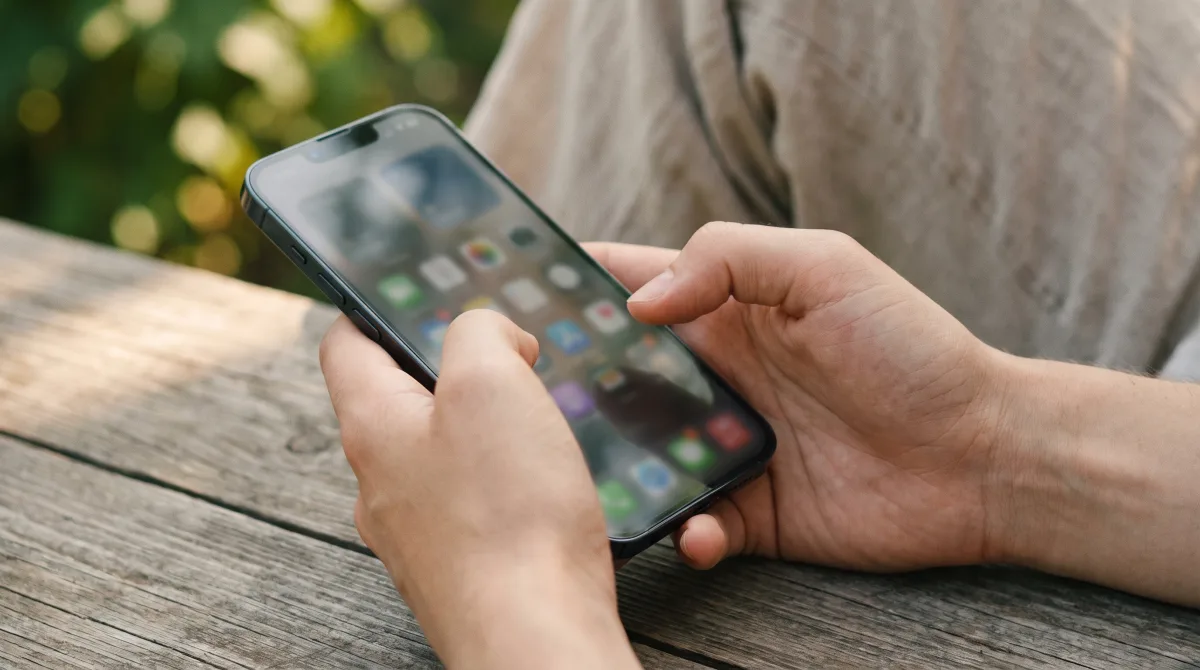
If you've ever agonized over a profile photo — the angle, the lighting, whether it reads as trying too hard — that's the tell that a photo-first app is asking you to perform something you'd rather just say outright. Writing it down is usually the faster, more honest version of the same information.
Pace is how much friction sits between "I noticed someone" and "we're talking." Fast apps remove almost all of it: a swipe registers in under a second, and a fresh face is one flick away the moment the last one bores you. Slow apps insert friction on purpose — a reading requirement, a limited number of daily picks, a waiting window — so a decision has to survive a little time before it counts.
Tinder is built for the fastest possible loop: swipe, match, chat, repeat, with nothing structurally forcing a pause. Bumble adds a real constraint — after a match, the conversation has to start within a set window, which creates urgency but not necessarily depth. Coffee Meets Bagel deliberately slows things down with a small daily batch instead of an endless feed. Anketta goes further: after a mutual match, both people get a 48-hour window where either side can still walk away; if neither does, the match becomes permanent.
That friction has a real cost, and speed isn't free of downsides either. A 2025 paper in JMIR Formative Research found that gender disparities, addictive-use patterns, and algorithmic match throttling on mainstream fast-paced apps disproportionately harm users' psychological well-being. Speed isn't a neutral design choice. It's a mechanism with its own side effects, the same way slowness has its own — a 48-hour window means you can't outrun a bad first impression by simply swiping past it.
Pool size is the axis people underweight the most, because "more options" sounds like a strict improvement. It isn't. A huge pool means more noise per signal: more profiles to sort, more low-effort matches, more time spent filtering instead of talking. A curated pool trades reach for density — fewer people, but a higher share of them are actually compatible with what you said you wanted.
Tinder and Bumble win on raw size by a wide margin, and if breadth matters most to you, no curated app can compete with that. Hinge and OkCupid sit in the middle: large enough to matter in most cities, small enough that the app can still apply some filtering logic. Coffee Meets Bagel and Anketta sit deliberately on the curated end. As of 2026, Anketta counts thousands of active users rather than millions, concentrated among the Russian-speaking diaspora and a handful of EU and U.S. cities — small by choice, because the product optimizes for depth of read per match over volume of matches per week.
| App | Casual or serious | Photo-first or text-first | Fast or slow | Pool size |
|---|---|---|---|---|
| Tinder | Casual-leaning | Photo-first | Fast | Huge |
| Bumble | Casual-to-serious | Photo-first | Fast, with a reply window | Huge |
| Hinge | Serious-leaning | Photo-first, prompts add text | Medium | Large |
| OkCupid | Serious | Long profile, photo-led matching | Medium to slow | Smaller, aging |
| Coffee Meets Bagel | Serious-leaning | Photo-first | Medium, daily batch | Medium |
| Anketta | Serious, intentional | Fully text-first | Slow, 48-hour window | Small, curated |
Match your four answers to the table above, not to whichever app has the biggest ad budget this month. If you answered casual, photo-first, fast, and big pool, Tinder or Bumble genuinely are the right tools — a full head-to-head sits here if you want the specifics. If you answered serious, photo-first, medium pace, and a large-but-not-huge pool, Hinge is the least-friction mainstream option, and our honest comparison covers where it still falls short. Our ranked breakdown of every major app, and the wider list of Bumble alternatives, cover more ground than any single decision guide can.
Anketta is the honest answer for a narrower reader: serious, text-first, slow, and comfortable trading reach for depth. If part of your answer was also "I don't want a stranger's screenshot of my number floating around before we've even matched," that reader fits doubly well — every manuscript on Anketta blurs contact details from anyone who isn't already a mutual match, automatically, with no setting to remember. That isn't the app for someone who wants the biggest pool tonight. It's the app for someone who's already tired of getting one — start a manuscript and see for yourself in less time than a first swipe session takes.
Is there one dating app that's objectively the best?
No. "Best" depends on your intent, your city's pool size, and whether you want photos or writing to lead. Tinder is the right tool for casual and fast; Anketta is the right tool for serious, text-first, and slow. Neither is universally correct — they're built for different jobs.
What's the difference between a casual app and a serious app?
A casual app optimizes for volume and low commitment per interaction. A serious app optimizes for depth and filters intent up front, usually by adding friction — more reading, fewer daily matches, a waiting period — before a match counts as real.
Are text-first dating apps better than photo-first ones?
Better for a specific reader, not universally. Text-first apps like Anketta suit people who want to be known by their writing rather than their photos. Photo-first apps like Tinder or Hinge suit people who want a faster, more visual first impression.
Does a slower dating app actually lead to better matches?
Slower apps trade speed for filtering. A 48-hour decision window, like Anketta's, gives both people time to actually read before deciding, which removes the reflexive swipe-past that fast apps reward. It doesn't guarantee a better match, but it removes one common failure mode.
Is a smaller, curated dating app worth it if the pool is tiny?
It depends what you're optimizing for. A smaller pool means less noise and a higher share of people already filtered for intent, but fewer total options. Worth it if you value density over reach; not if your city's pool is too thin for either.
How do I know if Anketta is the right fit for me?
If your honest answers land on serious, text-first, slow, and curated, Anketta is built for exactly that combination. If any of your answers land on casual, photo-first, fast, or huge, a mainstream app will serve you better tonight.
Every dating app is a bet on which variable matters most: speed, scale, or signal. The apps that win on speed and scale are honest about it, and they're genuinely good at that job. The ones worth trusting on signal are the ones willing to say, out loud, that they're not for everyone. Pick the bet that matches what you actually want, not the one with the biggest board on the subway.
Unsure about writing? Try reading first.