Cookie-jarring

Cookie-jarring is keeping someone as a deliberate backup while actively pursuing someone else. Three things have to be true at once: there is a first choice, that pursuit is live right now, and you are the hedge against it falling through. The jar is the image — something sealed on a shelf, reached for when the person who put it there wants it.
Keeping alternatives on hand is common enough to have been counted. Michelle Drouin, one of the researchers behind the original back-burner studies, defined the term for 376 young adults and reports that, among those who had any back burners at all, participants reported an average of 5.6 back burners — people they stayed in contact with as romantic possibilities without being committed to them. Single participants averaged 6.7 and those in committed relationships 4.5, a gap the researchers did not find statistically significant. Cookie-jarring is the pointed version of that habit: not a vague shelf of maybes, but one person held against one specific attempt.
Write the version of you nobody stores for later.Benching parks you against a hypothetical. The bencher has nobody particular in mind and is waiting to see whether anyone better turns up, so you sit on the roster indefinitely. Cookie-jarring parks you against a named, live pursuit: there is someone specific they are trying to win this month, and you are what happens if that attempt fails. Benching is an open question. Cookie-jarring already has an answer, and it isn't you.
That difference shows up in the shape of their attention. A bencher is diffusely unavailable — slow everywhere, in no hurry about anything, mildly interested in several directions at once. Someone with a cookie jar is sharply available and then sharply absent, because their real effort is going somewhere with a schedule of its own. The warmth you get is real. It is also what's left over.
Cushioning is plural and defensive: several people kept loosely warm while a relationship is already running, so there is a soft landing if it ends. Cookie-jarring is singular and forward-looking: one person kept in reserve while the jarrer chases someone they do not have yet. A cushion protects against a fall. A cookie gets eaten if the meal never arrives.
The clean test is what already exists on their side. Cushioning needs a relationship in place — remove the partner and there is nothing left to cushion. Cookie-jarring needs an unfinished pursuit; the moment that pursuit resolves, in either direction, the jar changes state. And breadcrumbing belongs to a different category altogether: it names a method — minimal gestures, no follow-through — while cookie-jarring names a motive. A cookie-jarrer often breadcrumbs. Not every breadcrumber has a first choice.
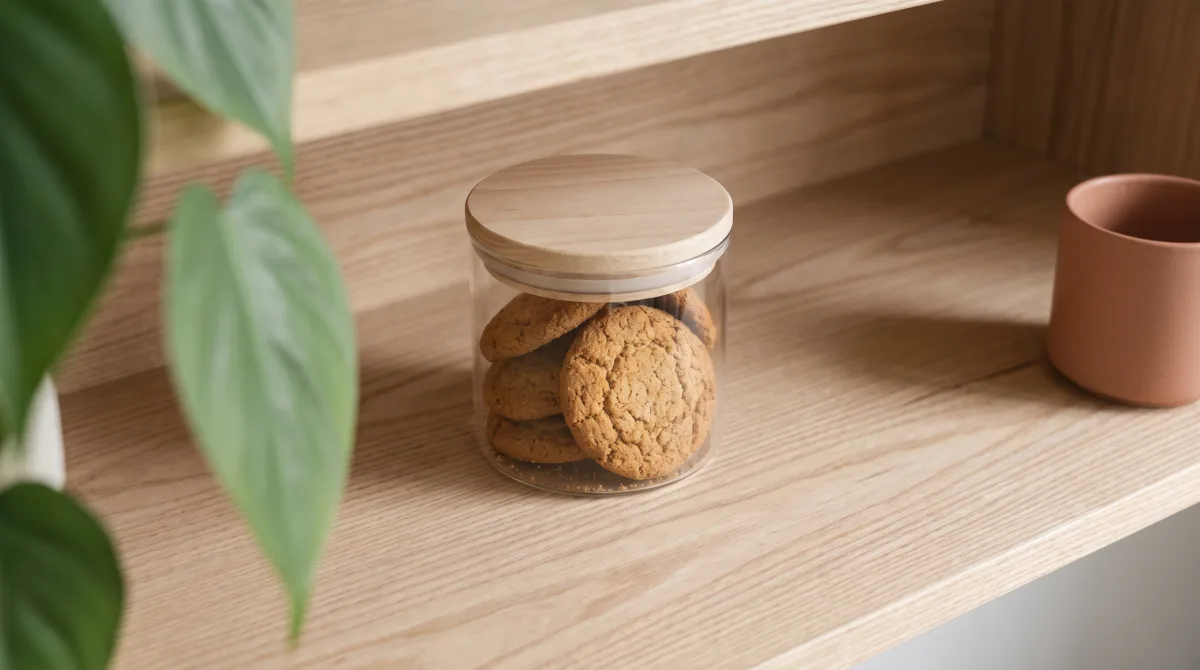
The pattern is easier to read in the calendar than in the messages. The words stay warm and specific, and the availability stays fragmentary — which is what makes it so hard to name. Look at when the contact happens rather than what it says:
- A name that keeps almost coming up — someone they mention often enough that you've noticed, and never in enough detail to place
- Plans that only ever open up — you get evenings that became free, not evenings that were set aside
- A future written entirely in the conditional — "once things settle down," "if I'm still in the city then," every plan hanging off a condition that belongs to someone else's timeline
- Blocks of unreachability that never get explained — two days of nothing, then normal warmth resumed, and no account given of the gap
- Intensity that outruns the pace — long, thoughtful messages attached to a relationship that has not moved an inch in three months
Any one of those has an innocent version. All five at once describes a person whose real week is happening somewhere you've never been shown.
The four modern terms for withheld commitment are usually sorted by how it feels to be on the receiving end, which is why they blur together — from the inside they all feel like being nearly wanted. Sorting them by what the other person already has is faster and more useful.
| Term | What they already have | Your role | What resolves it |
|---|---|---|---|
| Cookie-jarring | One specific person they're actively pursuing | Insurance against that pursuit failing | Their pursuit succeeds — or collapses, and you're abruptly promoted |
| Benching | Nobody in particular | An option held against a hypothetical better one | Nothing on its own; the bench has no clock |
| Cushioning | A relationship that already exists | One of several soft landings, kept plural on purpose | The relationship ends, or it doesn't |
| Breadcrumbing | Anything at all — it describes the method, not the motive | Someone whose hope is managed with the smallest possible gestures | You stop replying |
One question separates cookie-jarring from the rest: is there a specific person they are trying to win right now? If yes, you are in a jar. If there is no such person, you are on a bench. If that person is already their partner, you are a cushion. Slow dating is the habit that makes all three harder to run, because it replaces a queue of warm options with one connection at a time.
Because the jar costs the jarrer nothing and pays out only if they lose. Relationship psychology has a name for what a cookie jar is made of: attention to alternatives. In a 1997 study in the Journal of Personality and Social Psychology, people described their dating relationships, inspected slides of attractive strangers in a lab, and were contacted two months later to report whether the relationship had ended. Among those participants, there was no better predictor of relationship failure than high attentiveness to alternatives.
Read that from inside the jar and it stops being an insult. The jar is a forecast about their pursuit, not a verdict on you. Someone confident about the person they want does not build a fallback, and the fallback they built is the most honest thing they've told you. The trade is still lopsided, though. You spend hope, months and a real read of a real person; they spend the occasional evening that happened to open up.
Spend your attention where someone had to earn it.Ask for an ordinary Thursday two weeks out. Not a conversation about what this is — a specific, boring, mid-week evening far enough ahead that it cannot be an evening that merely became free. A jar cannot survive that request, because the calendar it depends on is not yours. What comes back is either a date or a reason, and the reason is the answer.
You are not owed a confession and will rarely get one, since most people running a jar have never used the word for what they're doing. The cleaner exit is to stop being storable: reply on your own schedule, propose nothing, and put the attention somewhere it is being returned. Someone who'd rather write you something true than keep you warm is not a higher standard. It's the ordinary one.

Because a jar is only worth keeping while the lid is free to lift. On a swipe feed the cheapest signal of interest is a tap, so one person can hold a first choice and a shelf of fallbacks for identical effort. Anketta has no swipe: to show interest you highlight an actual phrase in someone's writing and press the heart, which means reading a whole manuscript first. Holding a backup now costs a real read of a real person, and that is the one price a jarrer never intended to pay.
The match window closes the rest of the gap. After a mutual like there is a 48-hour window, and the match becomes permanent only if both people actually write to each other inside it — silence from either side ends it. A permanent match then locks the browsing surface: no new manuscripts appear while it's active. Running a first choice and a reserve at the same time needs both doors to stay open, and here the second one shuts. If you want the whole thing to happen outside an app entirely, the manuscript you can hand someone as a link or a QR code is the same document, read the same way. Why the product is built like this is a longer story, and it starts with the cost of a maybe.
What does cookie-jarring mean in simple terms?
It means someone is keeping you as a backup while actively pursuing somebody they want more. You get enough contact to stay interested and never enough to become the plan. The defining part is that they already have a first choice and haven't told you that you're the second one.
Is cookie-jarring the same as benching?
No. A bencher has nobody specific in mind and is waiting to see who turns up, so the bench has no natural end. A cookie-jarrer is chasing one identified person right now and holding you against that outcome. Same feeling from the inside, different situation on their side.
Is cookie-jarring cheating?
Usually not in the technical sense, because there is normally no relationship to be unfaithful to — that's cushioning. Cookie-jarring is dishonesty rather than infidelity: you're being allowed to believe you're a possibility when you're a contingency. The harm is in the omission, not in an agreement broken.
How long does cookie-jarring usually last?
As long as the pursuit it's attached to. Unlike benching, it has a built-in end point: the moment the person they want says yes or no, the jar either gets forgotten or gets opened. That's why it can end abruptly after months of nothing, with no explanation offered.
If they suddenly get serious, was I ever really in a jar?
Possibly, and the promotion doesn't retroactively change what happened. Being wanted after another option failed is not the same as being chosen. Worth asking plainly what changed between last month and this one — a straight answer to that question is the thing actually worth having.
How do I know if I'm cookie-jarring someone myself?
Ask whether you'd keep the conversation going if the person you're actually pursuing said yes tomorrow. If the honest answer is no, you're holding a fallback. Telling them so is uncomfortable for about ten minutes and saves them months of misreading warmth as intent.
A jar keeps things fresh by keeping the air out. That works beautifully for biscuits, and not at all for people.
Unsure about writing? Try reading first.